The Cheapest Architecture Is the One You Discover You Do Not Need

Premise: Most over-engineering is not a failure of restraint. It is a failure of grounding. You design against an imagined version of your own system instead of the one you actually shipped.
This week I watched a heavy piece of infrastructure disappear in a single conversation. Not because anyone decided to cut scope, but because we forced the design question against the real data model instead of the imagined one. The lesson generalises far past the specific build.
The situation
A property map needs to show millions of transaction points at speed. The obvious scaling answer is static tiles served from a CDN: precompute the data once, ship it to the edge, let the browser stream what it needs. That part was not in doubt.
The hard part was access control. The product is tiered. A paying customer sees the regions they subscribe to, not the whole country. The instinct was to extend the tile architecture to match: build a separate tile set per region, put a token gate in front of each, and let the edge enforce who sees what. A per-region tile fleet with an entitlement layer bolted on.
That is a real system. It has a build cost, a maintenance cost, and a failure surface. It would have taken days.
The move that killed it
Before committing, we ran the design question as a structured interrogation grounded in the actual codebase. Not "how should region entitlement work in theory," but "show me the existing subscription model and the queries it already runs."
The grounding surfaced the thing the abstract design had missed. Region scoping already exists in the product. A subscribed customer's data is already small, because the subscription itself constrains it to a handful of districts. The dynamic API that serves authenticated users is entitlement-aware by construction.
So the paid product does not need static tiles at all. It uses the existing API, which is already fast enough precisely because the data is already scoped. Static tiles are only needed for the one case that has no entitlement: the public demo showing the whole country.
The per-region tile fleet, the token gate, the edge enforcement layer: all of it evaporated. The final architecture is "static tiles for the unscoped demo, existing API for everyone who pays." Two days of work became zero, and the system got simpler, not weaker.
The named tension
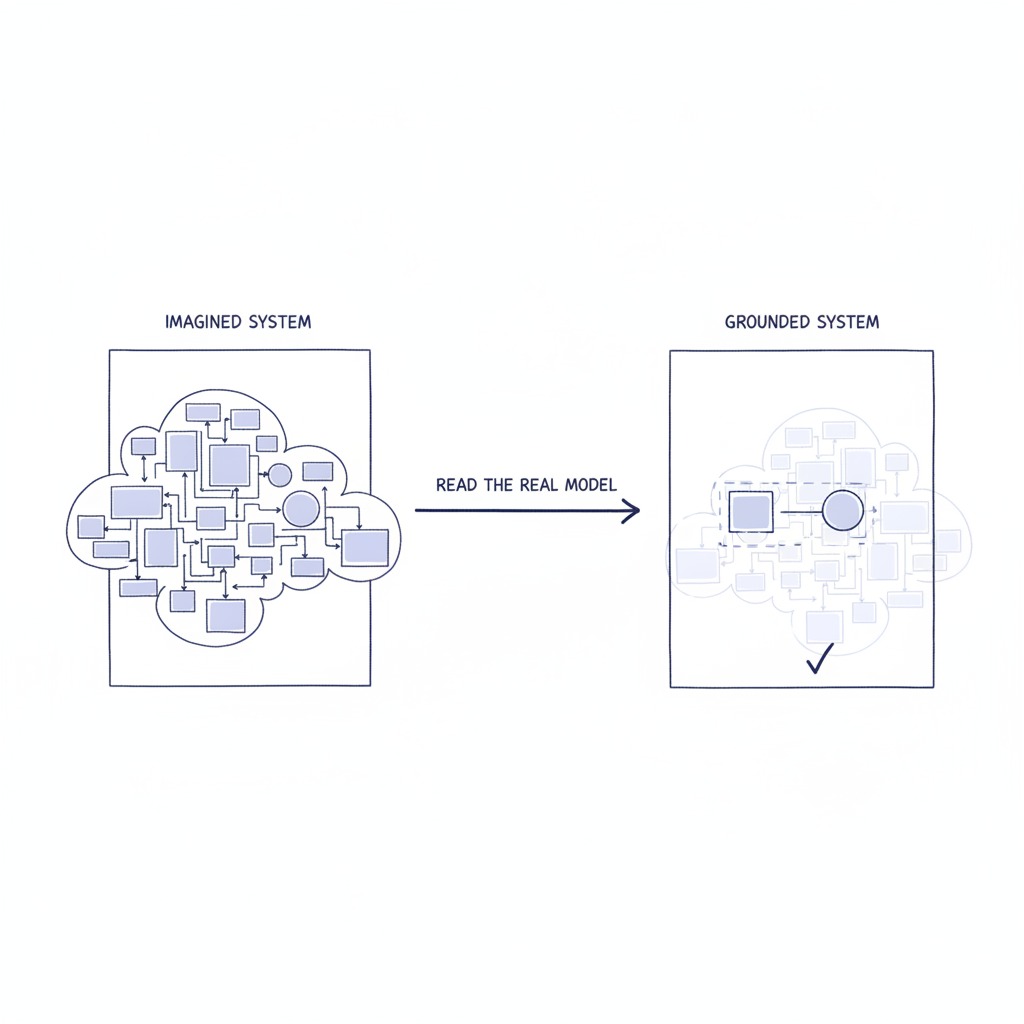
Imagined-system design vs grounded-system design. When you design against the system in your head, you solve for completeness. When you design against the system on disk, you solve for the gap that actually remains.
The abstract version of any problem is always bigger than the concrete one. In the abstract, "control region access at the tile layer" is a clean, general requirement. On disk, the access control was already done, three layers down, as a side effect of how subscriptions filter queries. The abstract requirement was real. It was also already satisfied.
This is the trap for anyone building with AI assistance specifically. Ask a capable model "how do I gate map tiles by region" and it will give you a competent, complete answer: tile fleets, token gates, signed URLs. The answer is correct for the question. The question was wrong, because it assumed a gap that the existing system had already closed.
Why AI assistance sharpens this trap
A model answers the question you ask against the context you give it. If your context is the abstract requirement, you get the abstract solution, delivered fluently and with confidence. The fluency is the danger. A plausible, well-structured design for infrastructure you do not need is more expensive than no design at all, because it looks like progress.
The defence is not skepticism about the model. It is discipline about the grounding. Before you let any design solidify, paid or generated, force it against the real artifacts:
- What does the existing data model already constrain?
- What query already runs that makes this case smaller than I assumed?
- Where is the requirement already satisfied as a side effect of something else?
These are not questions a model will ask unprompted, because it does not know which parts of your system are already built. You do. The grounding step is the part you cannot delegate. It is the same instinct behind scope compression in 0-to-1 work: the fastest build is the one that refuses to construct what the situation does not require.
The sibling pattern: sequence for the moat, not for completeness
The same week produced a related decision on a different product. A roadmap of API endpoints, some stateful (they hold and enrich proprietary data), some stateless (they pass through public sources). The completeness instinct says build them in the order users will ask for them.
The grounded instinct says build the stateful ones first. They are the moat. A stateless pass-through to a public dataset is replaceable by anyone with the same source. A stateful endpoint that enriches a proprietary dataset compounds over time and cannot be cloned. Same logic as the tile decision: do not sequence by the abstract feature list, sequence by where the real, already-owned advantage lives.
What to take from this
The cheapest architecture is rarely the one you optimise. It is the one you discover you do not need to build, because the work was already done somewhere you had not looked.
Three practices make that discovery reliable:
- Ground every design decision in the actual model before it solidifies. Read the queries. Read the schema. The gap is almost always smaller than the requirement.
- Treat fluent answers as starting points, not endpoints. A model's competent design solves the question as posed. Your job is to check whether the question assumed a gap that does not exist.
- Sequence by where the advantage already lives. Build the part that compounds and cannot be copied first. Defer the part anyone could rebuild.
The work that does not get built is invisible on every dashboard. It is also the highest-leverage work you will do all week.
Part of the Product Pipeline series from KG Consultancy.
Strategy and technology are the same decision. Over 15 years in fintech (CTOS, D&B), prop-tech (PropertyGuru DataSense), and digital startups, I have built frameworks that help founders and executives make both moves at once. Based in Kuala Lumpur.
Working on a 0→1 product?
I help founders and operators go from idea to validated product. Let's talk about yours.
Get in touch →