Your Role Is Becoming a Skill (and the Org Chart Hasn't Caught Up)

Last Week, the Same Person Was Three Different Roles Before Lunch
I sat in three meetings with a Malaysian client last Tuesday. Same operator at the table each time. In the 9 a.m. meeting, the operator was the product manager, walking the engineering lead through a feature trade-off. By 11, the same operator was the analyst, pulling cohort numbers into a board paper. By the time the board chair joined at 12:30, the operator was the comms lead, framing the same numbers as a strategic narrative.
The business card said one title. By lunchtime that title was wrong three times.
This is not a story about overwork or weak job design. It is the leading edge of something I now see in every operating company I touch, including my own consultancy. The job titles we use, the comp bands we hire into, the org chart we draw for the board, are all built around an idea of a role as a fixed bundle of responsibilities. That idea is dissolving. The bundle is being unbundled. What is left is a set of skills that any capable operator can deploy as needed, when needed, without waiting for an HR retitling exercise.
The companies that price this in first will out-recruit and out-execute the ones still hiring against 2015 role descriptions. Most of the market has not noticed yet.
Tools Collapsed the Cost of Acquiring a Role
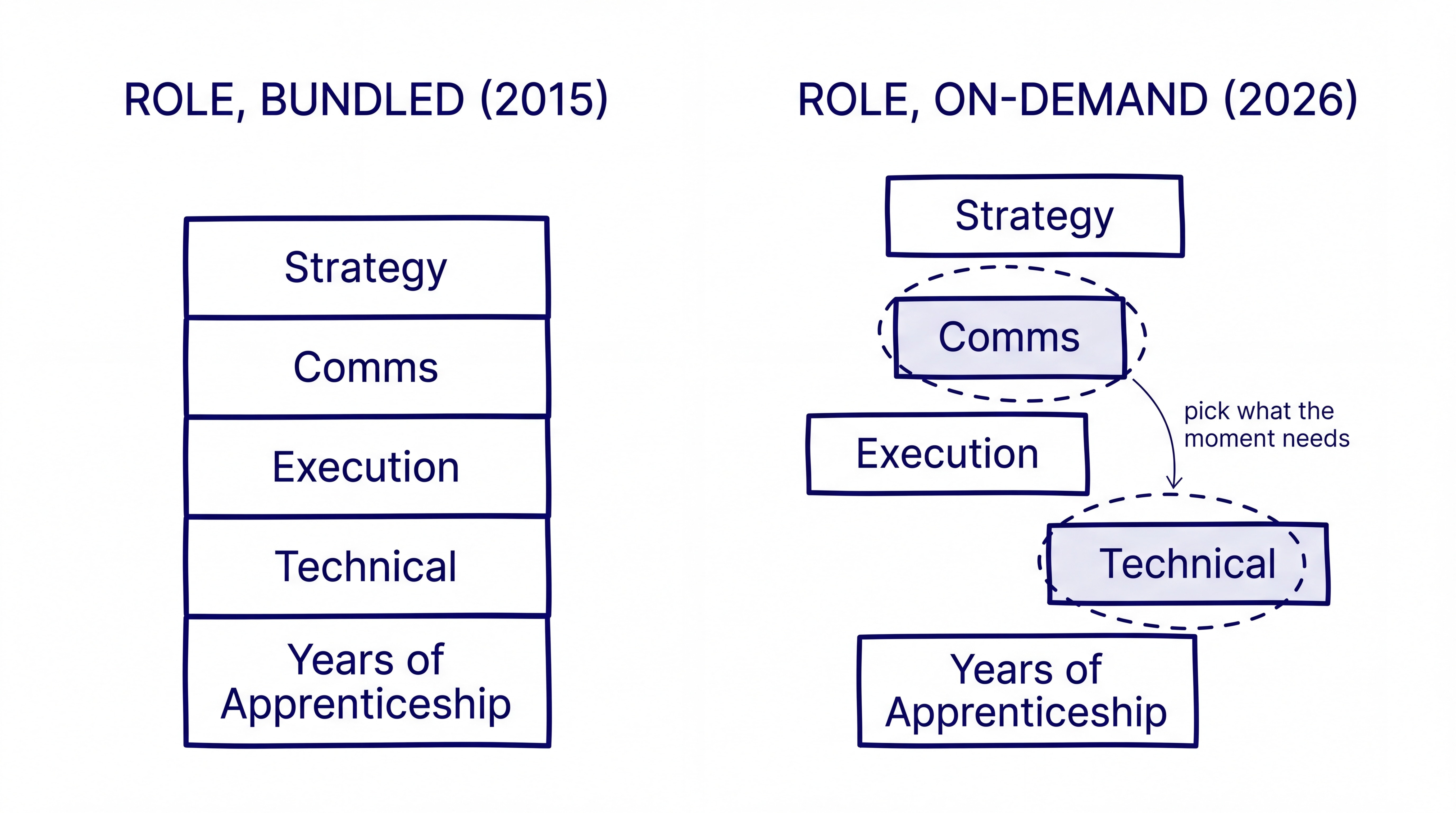
A role used to require apprenticeship. Five years as a product manager. Three years as a designer. Ten years as a controller in a manufacturing company before you ran the close. The apprenticeship was real and it was load-bearing. You were not just learning the tasks. You were acquiring a stack of skills, judgment, taste, and pattern recognition that the role required you to deploy in any combination at short notice.
That stack is still real. The skills inside it are still real. What changed is the cost of deploying them.
When a competent operator with Claude or ChatGPT at hand can write a passable PRD in 90 minutes that used to take a junior PM two days, the cost of deploying "PM skill" has fallen by 80 to 90 percent. When the same operator can use Cursor or Lovable to ship a working prototype in an afternoon, the cost of deploying "build skill" has collapsed even further. When AI-assisted close software handles 70 percent of journal entries and posts variance commentary, the cost of deploying "controller skill" drops by a comparable amount.
The role used to be the price of admission, the proof that you could deploy the stack reliably. With the stack now deployable cheaply, the role-as-gatekeeper logic stops holding. What is left is the question of whether you, the operator, can recognise which skill the moment needs and deploy it now.
What a Role Disaggregates Into
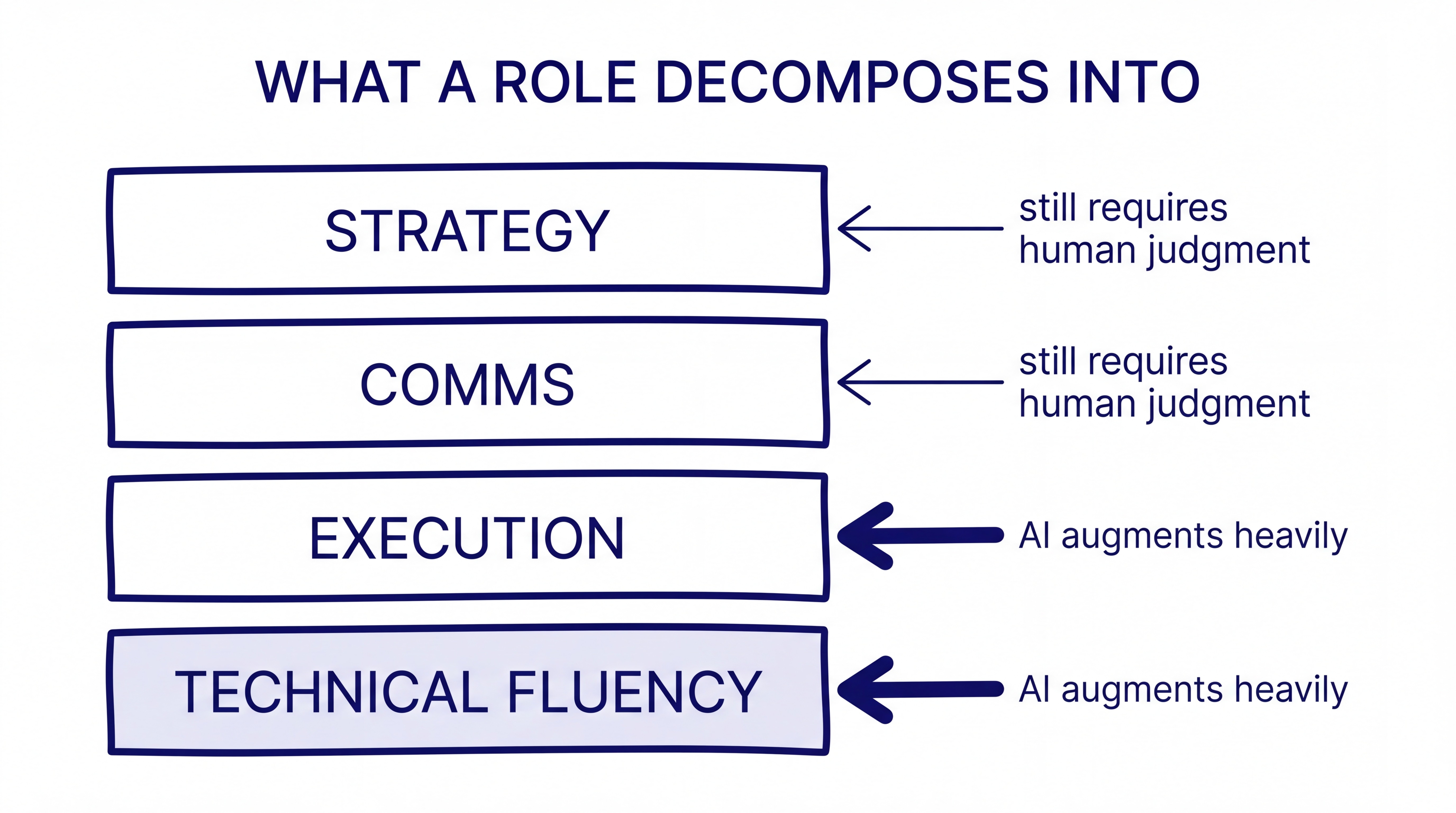
Every role I look at decomposes into four layers. Strategy, Execution, Comms, and Technical Fluency. The mix differs by role. A PM is heavy on Comms and Strategy, lighter on Technical. A controller is heavy on Technical and Execution, lighter on Strategy. A founder is heavy on Strategy and Comms, dependent on others for Execution and Technical. The bundle was always there. We just packaged it under a single title and paid for the whole bundle.
AI augments the Technical layer hardest. A controller no longer needs to know which Sage menu hides the inter-company elimination. The software handles the entry, the workflow handles the approval, and the AI summarises the variance in plain English. The Technical layer is now infrastructure.
Execution gets faster. The PM who needed a junior to format the roadmap deck now has the deck in 20 minutes. The designer who needed a researcher to synthesise five user interviews now has the synthesis in 10. The bottlenecks move.
Strategy and Comms remain stubbornly human. AI can draft a board narrative but cannot decide which uncomfortable truth to lead with. AI can suggest three positioning angles but cannot read the room and pick the one that lands.
What this means for the role: the bundled apprenticeship is no longer the only path to deploying the skill. The skill itself is still rare and valuable. The path to deploying it just got an order of magnitude cheaper.
A Worked Example: the Controller and a Four-Person Team
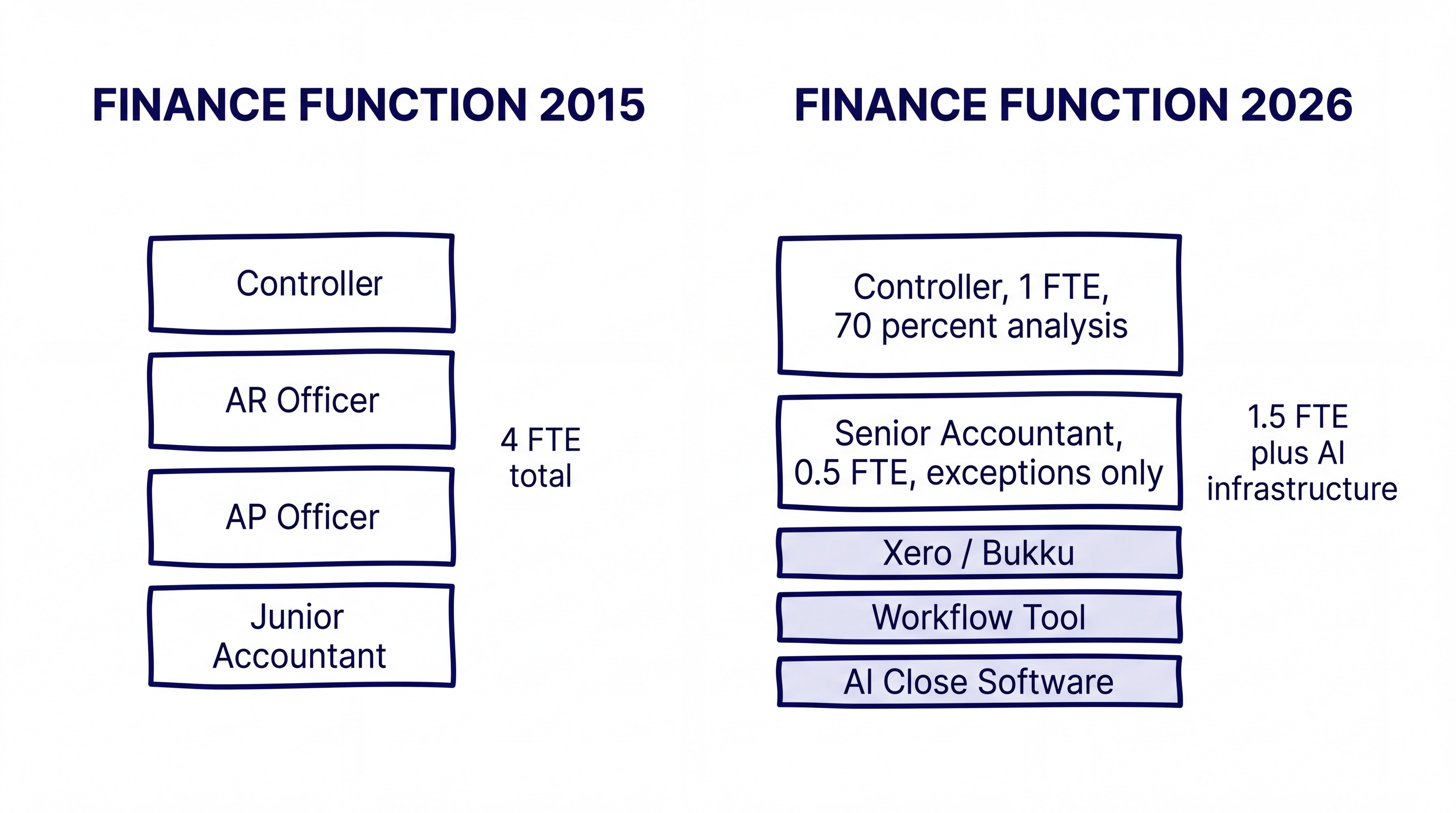
To make this concrete: a mid-sized Malaysian SME, RM 60 million annual turnover, manufacturing, three legal entities consolidated. A finance function built in the traditional model looked like this in 2015:
- Controller (the role), 1 FTE
- Senior accountant covering AR and collections, 1 FTE
- Senior accountant covering AP and supplier payments, 1 FTE
- Junior accountant covering month-end journals and reconciliations, 1 FTE
Four FTEs. The controller spent maybe 30 percent of the time on actual analysis. The rest was review, sign-off, chasing the team, and explaining variances to the MD after the fact.
By 2026, with modern tooling, the same function would look like this:
- Controller, 1 FTE, now spending 70 percent on analysis and forward-looking commentary
- One senior accountant covering exception handling across AR, AP, and reconciliations, 0.5 FTE
- Xero or Bukku for bookkeeping (automated journal posting from connected feeds)
- Workflow tool for dunning and supplier approvals
- AI-assisted close software for variance commentary and management pack drafting
The four-person team became a 1.5-person team. The role of "AR officer" was not eliminated by an organisational decision. It was eliminated because the skills inside it (chase the customer, post the receipt, reconcile the ledger) became infrastructure. The controller still does the same work at the top of the stack. The judgment work, the analysis, the board narrative. What disappeared was the bundled apprenticeship at the bottom.
This is not a hypothetical designed to justify a headcount cut. It is an illustration of what is happening across every knowledge-work function in the market. The roles are dissolving. The skills inside them remain valuable. The shape of the function changes.
What This Breaks in Hiring
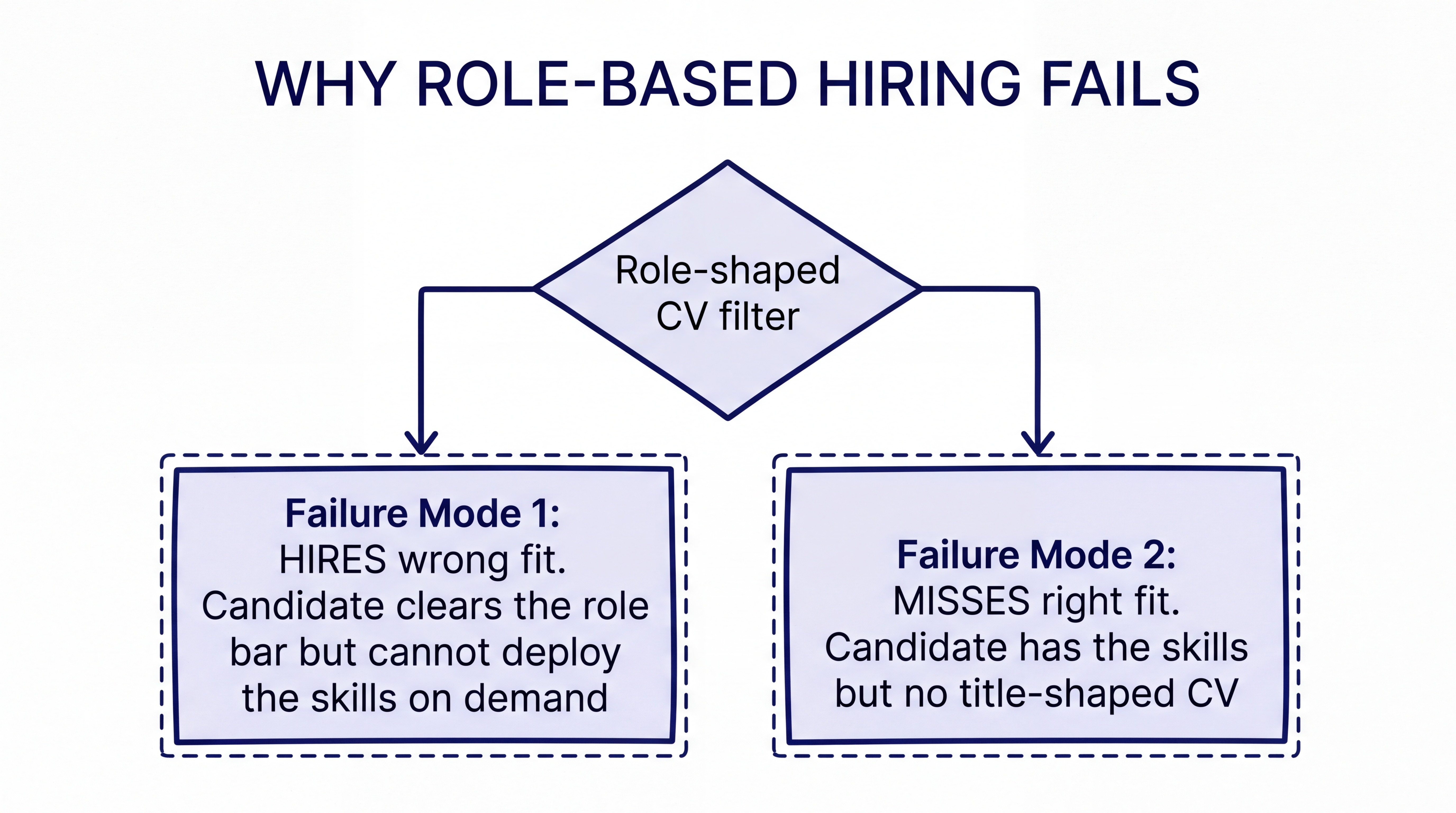
Walk through any job board in Malaysia. The ads still ask for "5 years as a Product Manager" or "ACCA with 7 years controller experience in manufacturing". That is a role filter. It assumes the bundled apprenticeship is still the proxy for capability. In a world where the bundle is being unbundled, the role filter creates two failure modes.
First failure mode. You hire the candidate who clears the role bar but cannot deploy the skills on demand. They have the years. They have the title history. They cannot, when the meeting shifts, switch from PM mode to analyst mode to comms mode and produce real output in each. The role-shaped CV said yes. The skill-shaped reality says no.
Second failure mode, harder to see. You miss the candidate who has the skills but no role-shaped CV. The operator who has been deploying PM skills for two years inside an engineering role. The accountant who has been doing controller-grade analysis inside a senior accountant title. The marketing person who has been running founder-grade strategy work without the founder badge. Your filter does not see them. Their CVs go in the no pile.
Fixing this is not a tooling problem. It is a recruiter and hiring manager problem. The new filter has to ask: which skills does the role require, and can the candidate demonstrate deploying those skills under realistic conditions? That looks more like a 90-minute working session than a CV scan. It is more expensive per candidate. It is also the only filter that holds up when roles are dissolving.
What This Breaks in Compensation
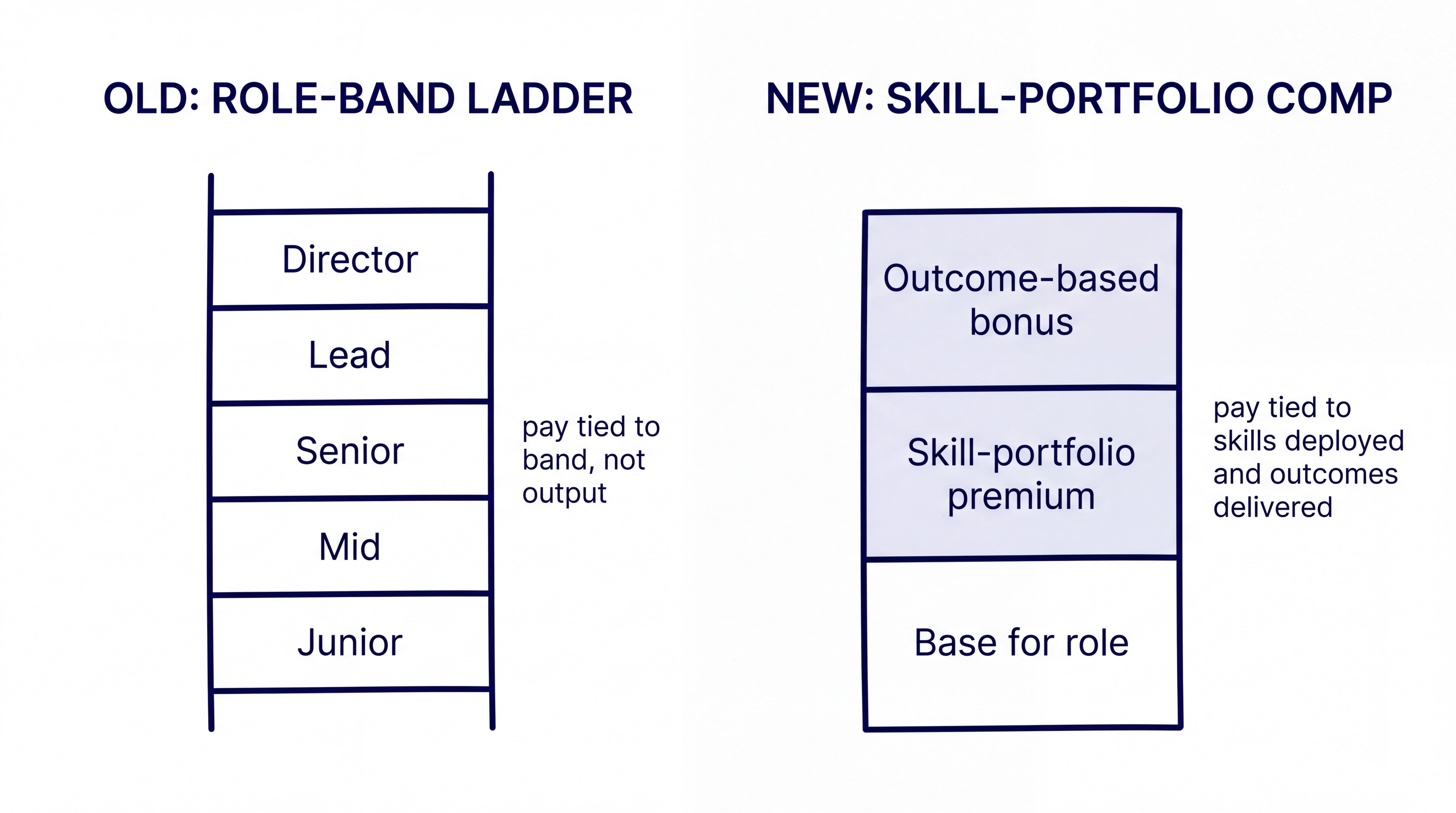
Comp bands are role-shaped by construction. Junior, Senior, Lead, Manager, Director, VP. Each band has a salary range, a set of expected outputs, and a promotion criterion that says you move up when you have demonstrated the role at the current band consistently. The ladder works when roles are stable bundles.
When the bundle dissolves, the ladder stops representing value. Two operators on the same band can produce wildly different outputs depending on which skills they can deploy and how well. One Senior PM might be running strategy, comms, and execution for two product lines while shipping a working prototype every Friday. Another Senior PM in the same band might be filing tickets and running standups. Same band, same nominal title, ten-times difference in skill portfolio deployed.
I do not know what replaces the ladder. Nobody does yet. The two shapes I see emerging in the firms that are paying attention:
Outcome-based comp. You pay for the result delivered, not the role occupied. This works for revenue-adjacent roles where the outcome is measurable. It is harder to scale to functions like finance or operations where the outcome is "the wheels stayed on".
Skill-portfolio premiums. You pay a base for the role and a premium for the documented skills the operator can deploy on demand. Think of it as the consulting hourly-rate model adapted to in-house comp. The premium is recalibrated annually based on what the operator actually deployed in the prior year.
Whatever the right shape is, the firms that figure it out first will pull ahead. They will out-recruit, because the operators who already feel this disconnect will move to where the pay matches the skills they can deploy. And they will out-execute, because their comp model creates the right incentive to keep building skill portfolios.
Three Moves for the Operator Who Already Feels This
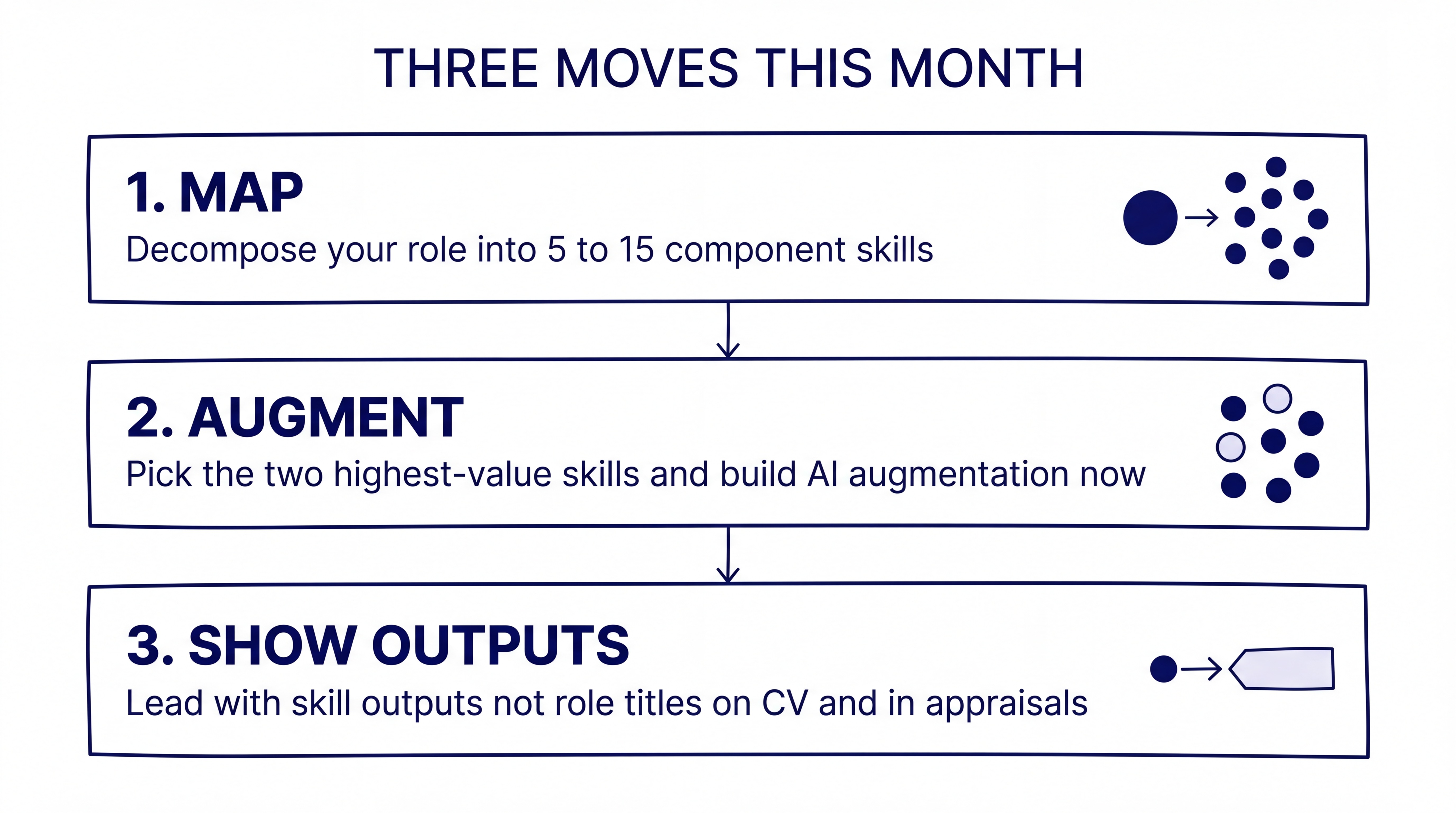
If you are reading this and recognising your own week in the Tuesday opening, you are already on the leading edge. Three concrete moves you can make this month, in order.
First move. Sit down with a blank page and decompose your current role into its component skills. Not the four-layer model I sketched above, your own breakdown. What do you actually do in a typical week, separated into the smallest functional units? When you are honest about it, you will see five to fifteen distinct skills bundled under your single job title. That list is your portfolio.
Second move. For each skill on the portfolio, ask: which of these is AI-augmentable today? Pick the two highest-value ones and build the augmentation now. Do not wait for IT, do not wait for the company subscription, do not wait for HR to update the job description. If you are a controller, start running your variance commentary through Claude this Friday. If you are a PM, start drafting your PRDs with AI assistance this week. If you are a designer, start your next user research synthesis with an AI-first pass. The point is to compress the time you spend on the augmentable skills so you have more time for the ones that still require your judgment.
Third move. When you talk about your work, on your CV, in your appraisal, in the interview, lead with skill outputs and not role titles. Say "I deployed forecasting and board-narrative skills to close a 6 percent variance in three days" rather than "Senior Accountant, 2024 to 2026". The role title is becoming a weak signal. The skill output is becoming the strong one. The market will catch up. You can move first.
This is happening regardless of when the org chart catches up. Plan accordingly. The operators and firms that see it now will have a two-year head start on the ones that wait for HR to send out a memo.
Part of the Operating Principles series from KG Consultancy.
Strategy and technology are the same decision. Over 15 years in fintech (CTOS, D&B), prop-tech (PropertyGuru DataSense), and digital startups, I have built frameworks that help founders and executives make both moves at once. Based in Kuala Lumpur.
Working on a 0→1 product?
I help founders and operators go from idea to validated product. Let's talk about yours.
Get in touch →