Generated Worlds and Measured Ones

A European startup sells AI-generated, walkable 3D worlds at $1.60 each. What it cannot do is the actual business in this region.
First, the technology, because it is genuinely new to most readers. Gaussian splatting represents a 3D scene as millions of coloured, semi-transparent ellipsoids instead of textured triangle meshes. The result renders photoreal in an ordinary browser, in real time, no app install. You can walk through a splat scene the way you walk through a game. It is produced one of two ways: generated by an AI model from a prompt or a photo, or reconstructed from many photographs of a real place.
A well-funded German startup, SpAItial, now sells the first route as an API. Send a text prompt, an image or a 360 panorama; several minutes later, get back a walkable world. A standard-quality world costs $1.60 in credits, a high-quality one $8.00. The API is clean, asynchronous, well documented, and, tellingly, designed to be called by AI agents rather than clicked by designers. The example gallery leans hard into interiors, real estate, restaurants and retail. They know exactly who their buyers are.
Read the Pricing, Then the Physics
Two facts frame the opportunity. The top subscription tier funds about 30 standard worlds a month; this is priced as a low-volume creative tool. A property agency shooting 50 listings a month exhausts it in a fortnight, so bulk reconstruction is not the business they are in.
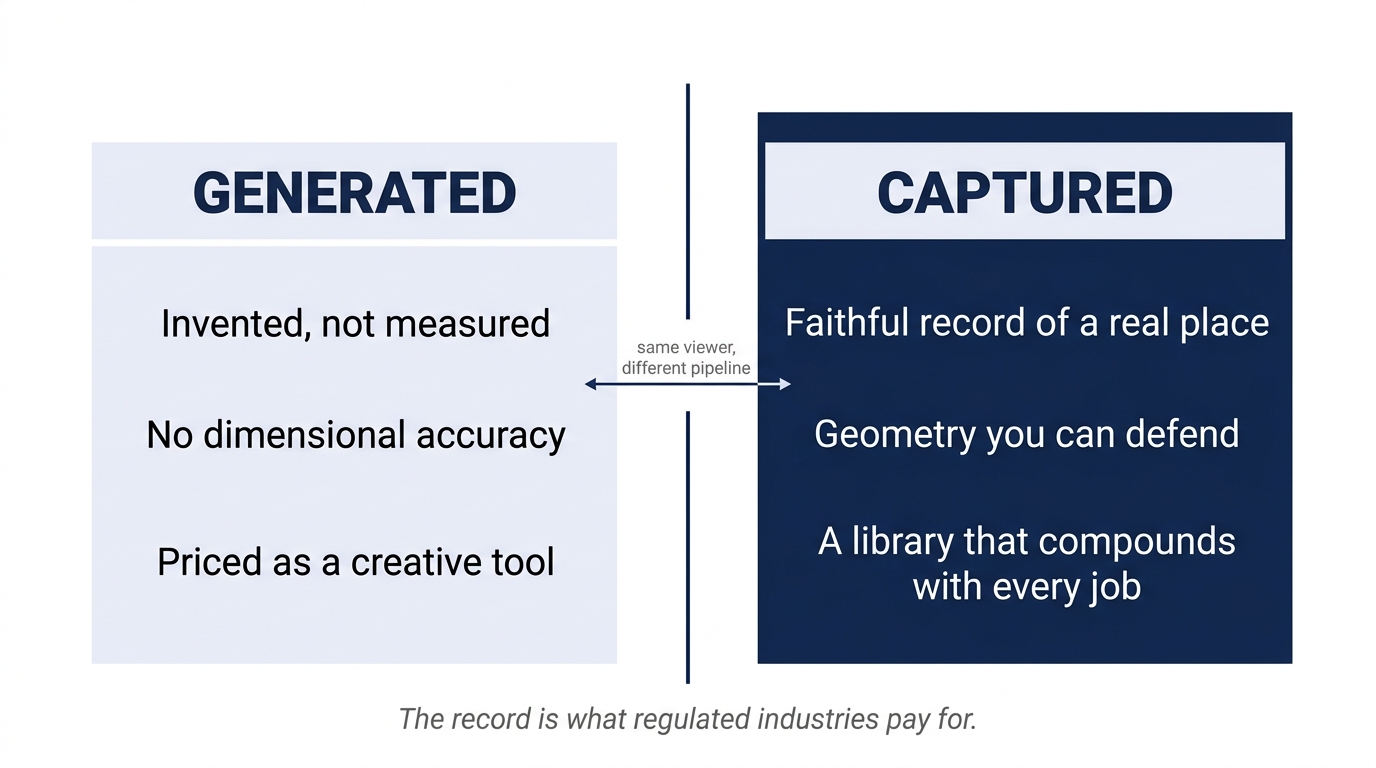
The deeper limit is in the nature of the output. A generated world is invented, not measured. It is a plausible hallucination of a space, with no dimensional accuracy whatsoever. For a mood board, a concept render or a game environment, that is fine. For anything where the geometry must be true, a valuation, a survey, an as-built check, a heritage record, it is disqualifying. The scene looks like a place; it is not evidence of one.
Generation and capture share a file format and a viewer, and almost nothing of the pipeline that matters. One sells imagination. The other sells a faithful record of a real place, and the record is what regulated industries pay for.
The Opening
Which defines the opening in a market like Malaysia. The capture route, photograph a real property, a venue, a heritage site, and reconstruct it faithfully as a splat, serves buyers the generative product structurally cannot: agencies with volume, owners who need the scene to be true, institutions that need a record. The delivery experience is identical, a link that opens a walkable scene in any browser, and the entire capture pipeline can be assembled today from open-source components.
The teardown's last lesson is about moats. Behind the API sits one genuinely hard asset, the model weights. Everything else, auth, billing, job queues, a web viewer, is standard SaaS plumbing. In the capture business the equivalent moat is not software at all. It is the library of real, rights-cleared, accurately captured local places, which compounds with every job and cannot be prompted into existence.
Part of the Regulated-Industry Product Management series from KG Consultancy.
Strategy and technology are the same decision. Over 15 years in fintech (CTOS, D&B), prop-tech (PropertyGuru DataSense), and digital startups, I have built frameworks that help founders and executives make both moves at once. Based in Kuala Lumpur.
Working on a 0→1 product?
I help founders and operators go from idea to validated product. Let's talk about yours.
Get in touch →