Nobody Wants to Hire a Stranger's Robot

The agent marketplaces are failing in public. The numbers explain why, and they point at where the money actually is.
RentAHuman launched in February 2026 with a striking premise: autonomous AI agents hire humans for real-world tasks, settled in crypto, with escrow and an API. Six months later it claims more than 70,000 registered humans. Researchers examining the platform could find 83 visible profiles. Only 13 per cent of registered users ever connected a wallet, which means the overwhelming majority signed up for the novelty and never set up the ability to be paid. A 40-dollar task to collect a package in San Francisco drew 30 applicants and was still incomplete two days later.
The security picture is worse than the liquidity picture. An academic team analysed 303 bounties on the platform and found that a third of them originated from programmatic channels rather than a real principal, across six active abuse classes including credential fraud and identity impersonation. On a platform whose premise is that the demand side is machines, a third of the demand turned out to be synthetic in the bad sense. The payment rails show the same shape in gentler form: of the 165 million transactions claimed by x402, the leading agent-payment protocol, roughly half is judged to be testing rather than commerce.
This is not a young market waiting to mature. It is a structural result. A normal marketplace runs on four things: buyer identity, persistent reputation, repeat-business incentive, and legal recourse. An open market where the buyer is an anonymous autonomous agent removes all four at once. Escrow does not replace them, because escrow protects against non-payment, and the observed abuse is not non-payment.
The Lane That Works
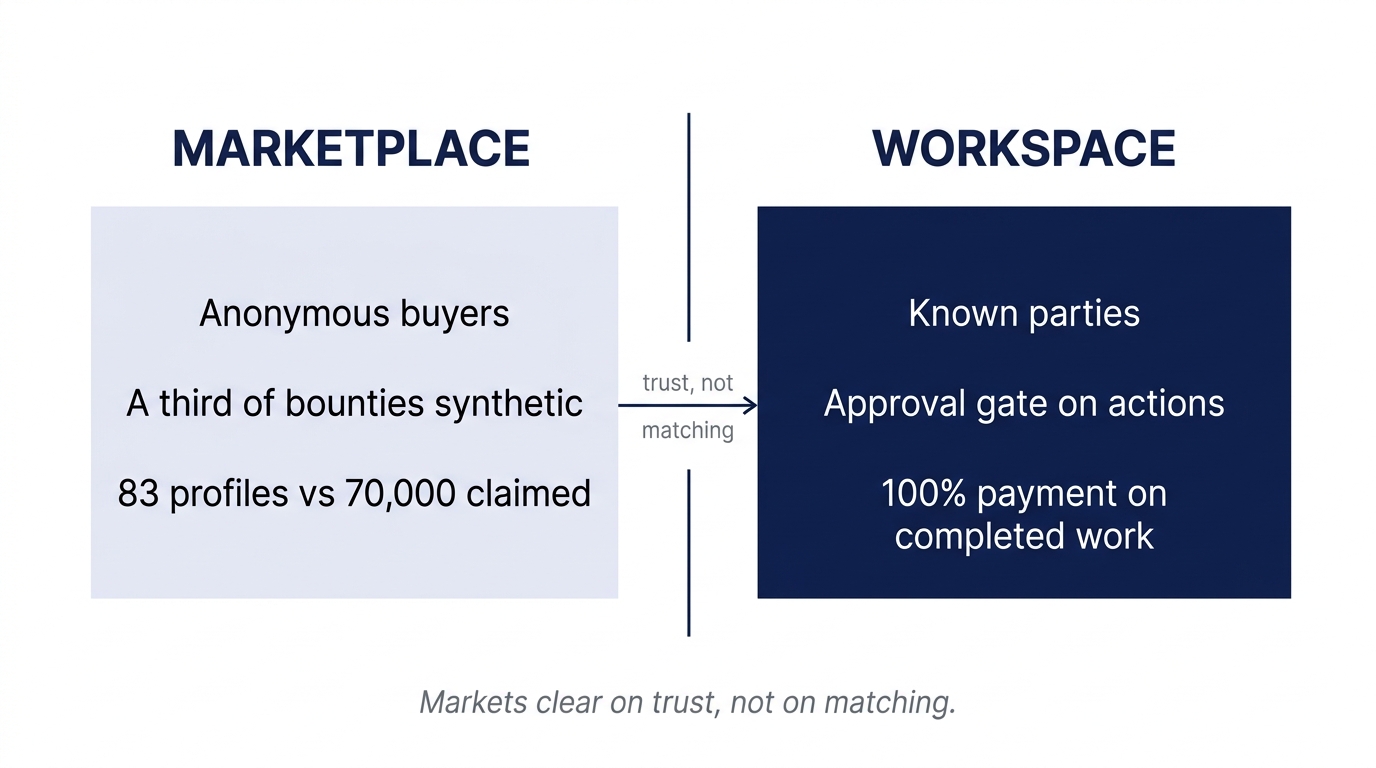
Meanwhile the boring lane is quietly profitable. Enterprise agent marketplaces passed 10 billion dollars this year, and the platforms reporting 100 per cent payment rates on completed work are the ones running escrow plus a conventional payment processor between parties who know each other. The difference is not technology. Both sides have escrow. The difference is that one side knows who it is dealing with.
The vocabulary is the tell. The two products in this category that actually shipped in August, Cumora and Crew, both describe themselves as a workspace, not a marketplace. A workspace is a bounded place where known parties collaborate. A marketplace is an open venue where strangers transact. The builders closest to the problem picked the bounded word.
Markets clear on trust, not on matching. The unit of agent commerce that survives is a piece of work with a budget, inside a boundary a named person answers for.
The Part Everyone in the Category Is Ignoring
Every platform in this sweep is jurisdiction-blind by design, because the category assumes the human is the interchangeable part. Professional reality runs the other way. There is a large class of work where an agent can do most of it and a licensed human must sign the last part: a valuation, a statutory filing, an audit opinion. No platform in the evidence set handles that split. The signature is the product, the agent is the cost line, and the firms that understand this will sell attestation while the marketplaces keep selling matching.
Part of the Product Pipeline series from KG Consultancy.
Strategy and technology are the same decision. Over 15 years in fintech (CTOS, D&B), prop-tech (PropertyGuru DataSense), and digital startups, I have built frameworks that help founders and executives make both moves at once. Based in Kuala Lumpur.
Working on a 0→1 product?
I help founders and operators go from idea to validated product. Let's talk about yours.
Get in touch →