The AI Employee Is Two Stacks, Not One

Everyone selling an "AI employee" is really assembling two different stacks. Buying one and forgetting the other is how these projects fail.
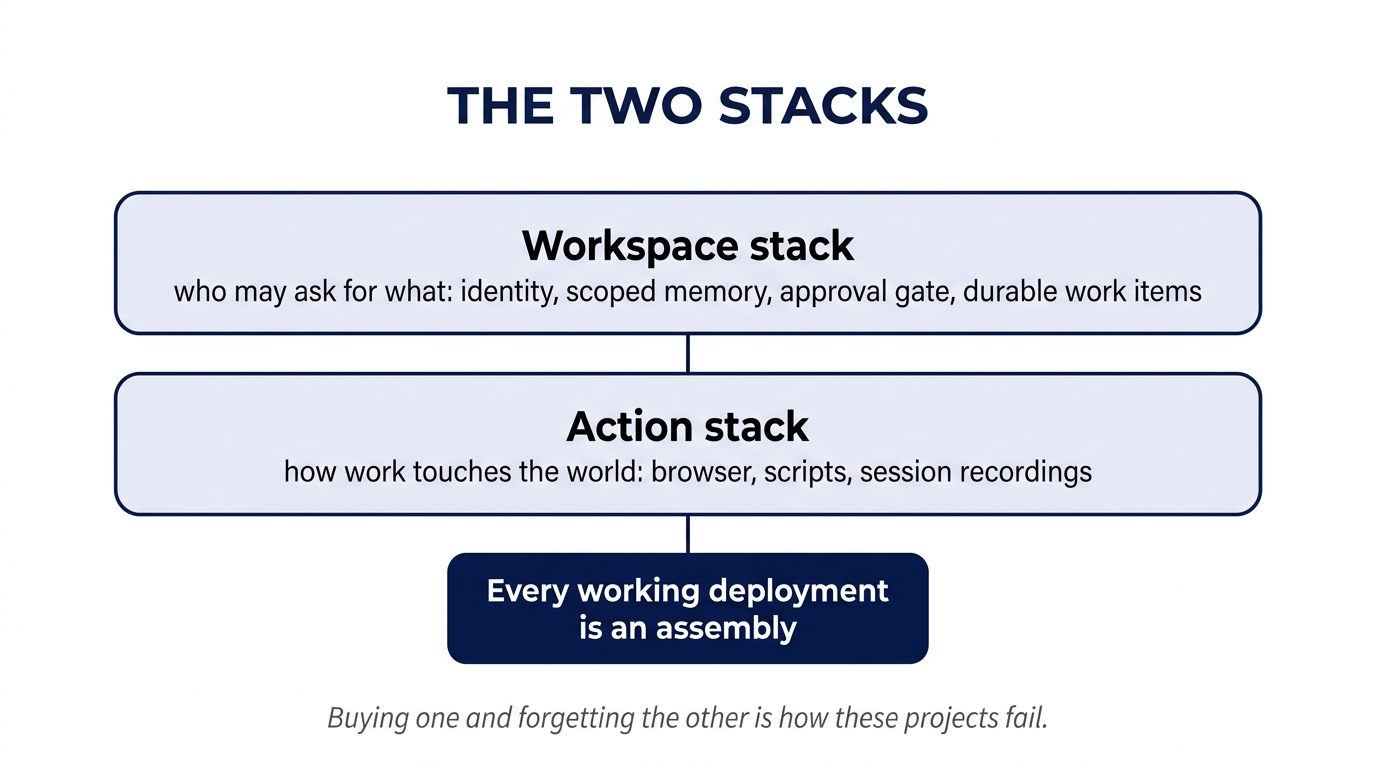
Map the market for AI agents that do real work for a business and it splits cleanly in two. The workspace stack answers: where do humans and agents collaborate, and who is allowed to ask for what? The action stack answers: how does an agent actually touch the outside world, of which the browser is the most important limb? As of August 2026, no single product covers both well. Every working deployment I have mapped is an assembly.
The workspace side has five recognisable categories: governed multi-user substrates where each channel gets a scoped agent with its own memory and permissions; issue boards where agents appear as assignees and every run leaves an auditable work item; chat relays where agents are channel members; packaged commercial "AI employees" with a price tag; and the infrastructure primitives underneath. The action side runs from deterministic scripting, through open agent-browser frameworks, hosted browser infrastructure with session recordings, vendor computer-use tools, to local bridges that drive your own logged-in browser so data stays on your machine.
What the Demos Reveal
The month's most instructive demo was a failure. A reviewer put two agents in Buzz, Block's chat relay workspace, and had them mention each other. They talked themselves into a runaway loop on the first prompt. His verdict transfers to half the category: the platform has prompting rules, not orchestration. A membership list is not a governance model, and a system prompt asking agents to behave is not a control.
Two features separate the platforms that can carry client work from the ones that cannot. A human approval gate on outward actions, so nothing leaves the boundary without a person; and durable per-run work items, so there is something an auditor can read afterwards. Almost every platform demos well without both. Very few ship both.
A managed AI service is a workspace layer governing who may ask for what, wired to action tools deciding how the work touches the world, with recordings kept for the day someone asks for proof.
Two Traps for Buyers
First, the packaged "AI employee" products are pricing evidence, not platforms. They tell you what a single-role finance or social media agent rents for per month, which is exactly the comparable you need to price your own offer. Building on them transfers your margin and your client relationship to the vendor.
Second, read licences before architecture. Multica, the most mature work-tracking platform in the field, carries an added licence condition prohibiting use of its source to host a service for third parties. For an internal team, irrelevant. For anyone offering managed agents to clients, the textbook description of the business is the prohibited act. Twenty minutes with the licence file, before the proof of concept, in every case.
Part of the Product Pipeline series from KG Consultancy.
Strategy and technology are the same decision. Over 15 years in fintech (CTOS, D&B), prop-tech (PropertyGuru DataSense), and digital startups, I have built frameworks that help founders and executives make both moves at once. Based in Kuala Lumpur.
Working on a 0→1 product?
I help founders and operators go from idea to validated product. Let's talk about yours.
Get in touch →