Self-Hosting Fails for Want of a Rule, Not Money

Five excellent free tools sat unadopted for years. The blocker was never cost. It was the absence of a place to put them and a rule for letting them in.
The self-hosting world is full of genuinely good free software: a PDF toolbox (Stirling-PDF) that replaces the monthly Adobe ritual, a document archive (Paperless-ngx) that OCRs every receipt and statement into a searchable store, an uptime monitor (Uptime Kuma) that watches your servers from outside. Every one has been mature and free for years. In most small firms, none of them is running. The usual explanation is time. The honest one is that nobody defined where such a thing would live or the test it must pass to earn the slot.
This month I ran five candidates through an intake rule with three clauses. Name the manual step or paid tool this replaces; no named workflow, no install. Confirm it fits the host it lands on, in RAM and disk, before installing rather than after. And give it a use-it-or-retire-it date one month out: if it has not entered the weekly workflow by then, it comes off.
What the Rule Produced
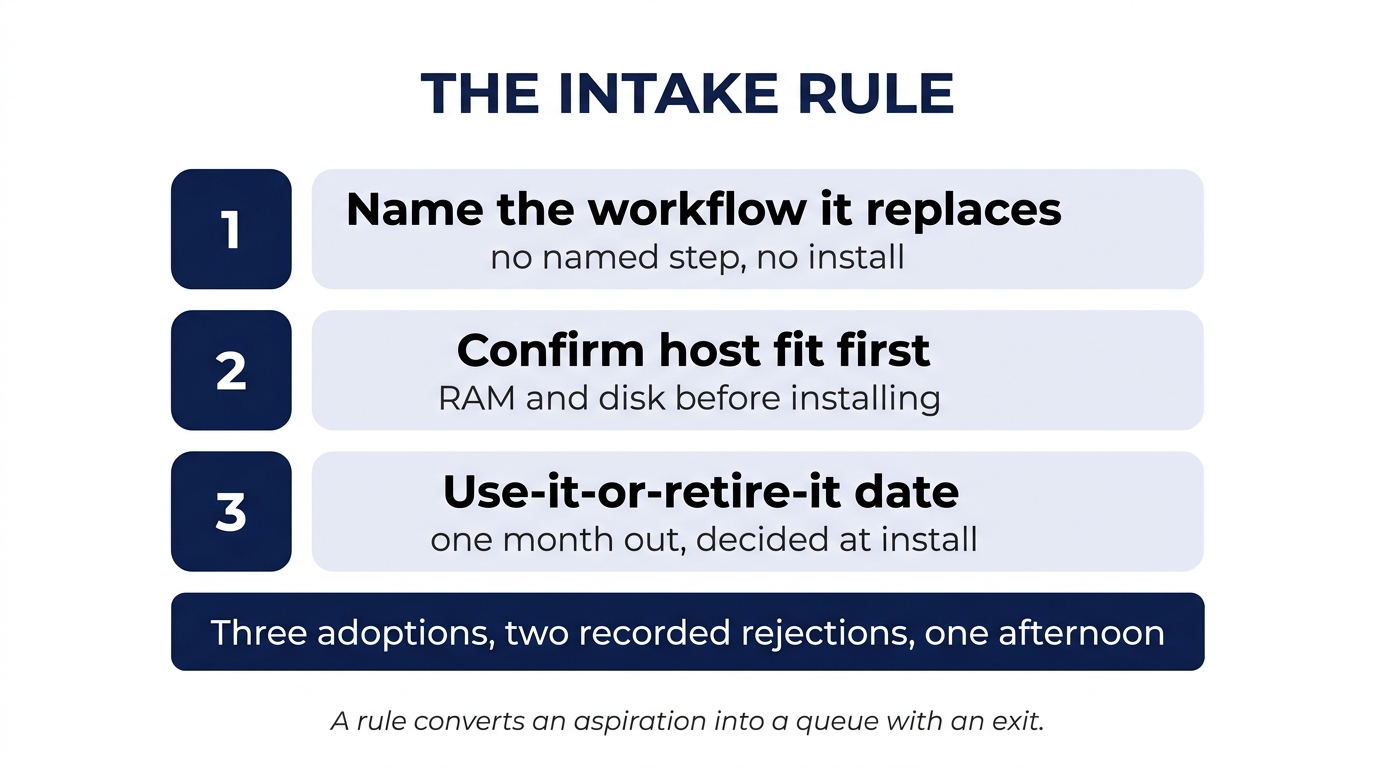
Three adoptions, each with a named workflow and a measured footprint. Two rejections, and the rejections are the underrated output: a workflow automation platform rejected because it duplicates a scheduler already in place, a file-drop tool rejected because the need was already met. Both recorded with reasons, so neither gets re-investigated on the next idle impulse. An unrecorded rejection is a future evaluation you will pay for twice.
The placement decisions carried the real lessons. The uptime monitor must not live on a machine it monitors; its entire value is failure-domain independence, a different box, a different provider, ideally a different power grid. The document archive went to the isolated machine with the big disk, next to the backups it now rides for free, because client documents belong in the strongest trust position available, not on the most convenient host. Cheap infrastructure still deserves deliberate placement.
The intake rule did in an afternoon what "we should self-host some tools" had failed to do in three years, because a rule converts an aspiration into a queue with an exit.
The Clause That Does the Work
The retirement date is the load-bearing clause. Every tool is exciting at install time. The only honest test is whether it is still in use a month later, and pre-committing to that test at install, when nobody is attached to the thing yet, costs one line. Without it, every install is permanent, the server fills with well-intentioned software nobody opens, and the maintenance burden quietly becomes the reason the next good tool is refused.
The pattern is not about servers. Any capability acquisition, a software subscription, a dashboard, a standing report, benefits from the same three questions: what named step does this replace, where does it live, and what evidence retires it.
Part of the Operating Principles series from KG Consultancy.
Strategy and technology are the same decision. Over 15 years in fintech (CTOS, D&B), prop-tech (PropertyGuru DataSense), and digital startups, I have built frameworks that help founders and executives make both moves at once. Based in Kuala Lumpur.
Working on a 0→1 product?
I help founders and operators go from idea to validated product. Let's talk about yours.
Get in touch →