When the Build Muscle Outran the Human Layer

I finished a fortnight of the most productive building I have done all year, and at the end of it almost nothing had actually moved forward. That contradiction is the most important thing I have learned about running a business on AI. The bottleneck is no longer how fast you can build. It is how fast a human can decide, sign, call, or pay. And that layer does not speed up when you add more compute.
The pattern I could not unsee
Late in the fortnight I did the usual review of where every major thread stood. What I found was uniform in a way that stopped me. Every single frontier was a non-build act.
The data programme was documented to the edge, a full operating manual, twelve annexes, a confidence ladder like the one where only proof buys a rung. Its next step was not more documents. It was a phone call to recruit one person, and a signature on an award letter sitting in someone's legal review.
The messaging product was built, tested, reviewed twice, pushed to the repository. Its next step was not more code. It was a colleague confirming direction and a payment gateway approving a merchant application.
A new capability I had built and benchmarked, and it scored higher than the baseline, was finished. Its next step was a single review click from me that I had not made.
Money owed to me, small amounts, a five-minute transfer, had sat for over a week, named in every daily briefing, unmoved.
Not one of these was blocked on capacity. The building was done, and done well. Every one was blocked on a human doing a small, un-automatable thing.
Why this is new
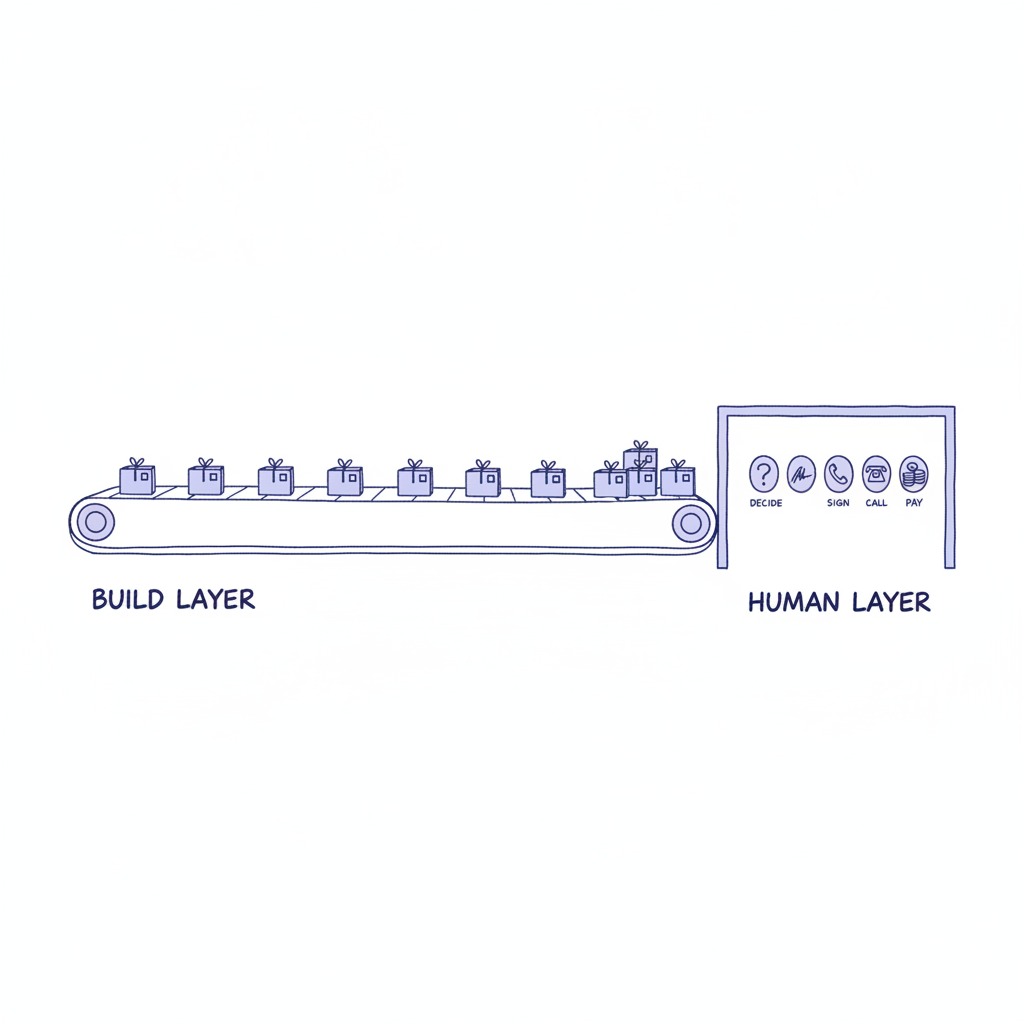
For most of the history of small business, the binding constraint was production. You could sell more than you could make, advise more than you had hours for, build more than you had hands to build. The whole art of scaling was relieving the production constraint: hire, delegate, systematise, automate.
AI relieves the production constraint almost completely for a certain class of work. I can now build, in a fortnight, more finished things than I could previously build in a quarter. The agents do not tire, do not context-switch expensively, do not need the weekend. Production is no longer where the work backs up.
So the queue moves. It moves right up against the one thing that has not sped up at all: the moments that require a specific human to exercise specific judgment or authority. A signature. A phone call to a candidate. A decision that only I can make because only I carry the context and the accountability. A payment that only I can authorise.
When production stops being the constraint, the constraint moves to the human decisions that production was always waiting on. They were there before. They were just never the bottleneck, because building was slower.
The trap inside the productivity
Here is the uncomfortable second-order effect. When building is fast and satisfying, and deciding is slow and uncomfortable, you will unconsciously spend your time building.
I felt this directly. Faced with a phone call I did not want to make and an award letter I could not personally accelerate, the available comfort was to build the next thing. And the next thing built cleanly, and produced a visible artifact, and felt like progress. Meanwhile the actual frontier, the call, the signature, the click, sat exactly where it was.
This is the trap: the build muscle is now so strong that it becomes the place you hide from the human layer. You produce more and more finished work stacked up behind decisions you are avoiding, and the volume of the work disguises the fact that the business has not advanced. A pile of completed-but-unlaunched things looks like productivity. It is often avoidance wearing productivity's clothes.
What actually moves the business now
The reframe that fixed my fortnight was blunt. On a board where every frontier is a non-build act, the highest-leverage thing I can do is subtraction, not addition. Not build one more thing. Clear one human gate.
The five-minute payment that had sat for ten days was, by any honest measure of leverage, the best move on the board. It closed a loop completely, cost almost nothing, and required only that I stop building long enough to do it. The award letter needed one act: getting it to a lawyer with a real deadline attached, so a review that had drifted for over a week acquired an owner and a date. The new capability needed one click.
None of these are impressive. None produce an artifact I can show. Every one of them advanced the business more than the next thing I could have built, because they were the actual constraint and building was not.
The rule I am keeping
For anyone running a business on AI-augmented production, the operating discipline inverts from the one we were all trained on. I have described the mechanics of running everything as one integrated operating model; this is the discipline that keeps the human at the centre of it useful.
Audit your frontiers by type, not by status. For each major thread, name the single next action and ask one question: is it a build act or a human act. When the honest answer across the board is "human act," more building is not progress. It is motion.
Treat the un-automatable act as the priority, precisely because it is uncomfortable. The phone call, the signature, the difficult decision, the payment. These do not speed up with better tools, which means they are permanently scarce, which means they are permanently the leverage. The discomfort is the signal that you have found the real constraint.
Watch for finished work piling up behind decisions. A growing stack of built-but-unlaunched things is not a productivity win. It is a diagnostic. It tells you the human layer has fallen behind the build layer, and the fix is not to build faster. It is to decide faster, or to move the decision to someone who can.
Protect human time for human work. If production is cheap and decisions are the constraint, then the scarcest resource in the business is your own judgment and authority. Spending it on things the agents could do is the new version of the founder doing data entry. The job is increasingly to decide, to authorise, to make the calls, and to let the build layer run underneath.
The honest close
I am not going to pretend I have solved this. At the end of the fortnight the same gates were still mostly open, and I still felt the pull toward the next clean build over the next awkward call. But I can see the shape of it now, and the shape is the whole lesson.
The machines got fast. The part of the work that is irreducibly human did not. The business now moves at the speed of that human layer, and no amount of additional building changes the number. The founders who win the next few years will not be the ones who build the most. They will be the ones who clear their human gates fastest, and who are honest enough to notice when a fortnight of brilliant production moved nothing at all.
Part of the Operating Principles series from KG Consultancy.
Strategy and technology are the same decision. Over 15 years in fintech (CTOS, D&B), prop-tech (PropertyGuru DataSense), and digital startups, I have built frameworks that help founders and executives make both moves at once. Based in Kuala Lumpur.
Working on a 0→1 product?
I help founders and operators go from idea to validated product. Let's talk about yours.
Get in touch →