The Ladder Where Only Proof Buys a Rung

I spent a fortnight writing an operating manual for a project that does not exist yet. A standard operating procedure, twelve annexes, a delivery schedule, a hiring plan. Good work, all of it. Then I built a tool that told me the work had stopped mattering. Here is the tool, because it fixes the most common self-deception in project readiness: mistaking the volume of your preparation for the strength of your position.
The setup
The project is a national data collection programme. Before it can start, one question has to be answered without flinching: how confident are we that this will actually work when we mobilise. Not "does the plan look complete" but "will the field team, on day one, know what to do when something goes wrong."
The instinct, and I have this instinct as strongly as anyone, is to answer that question by writing more. Another annex closes another gap. The document estate grows, and growth feels like progress. By the end of the fortnight the manual was thorough. My confidence that the programme would survive contact with reality was sitting somewhere around 75 percent, and it had stopped moving no matter how much more I wrote.
That plateau is the whole point. I built a confidence ladder to explain it.
The ladder
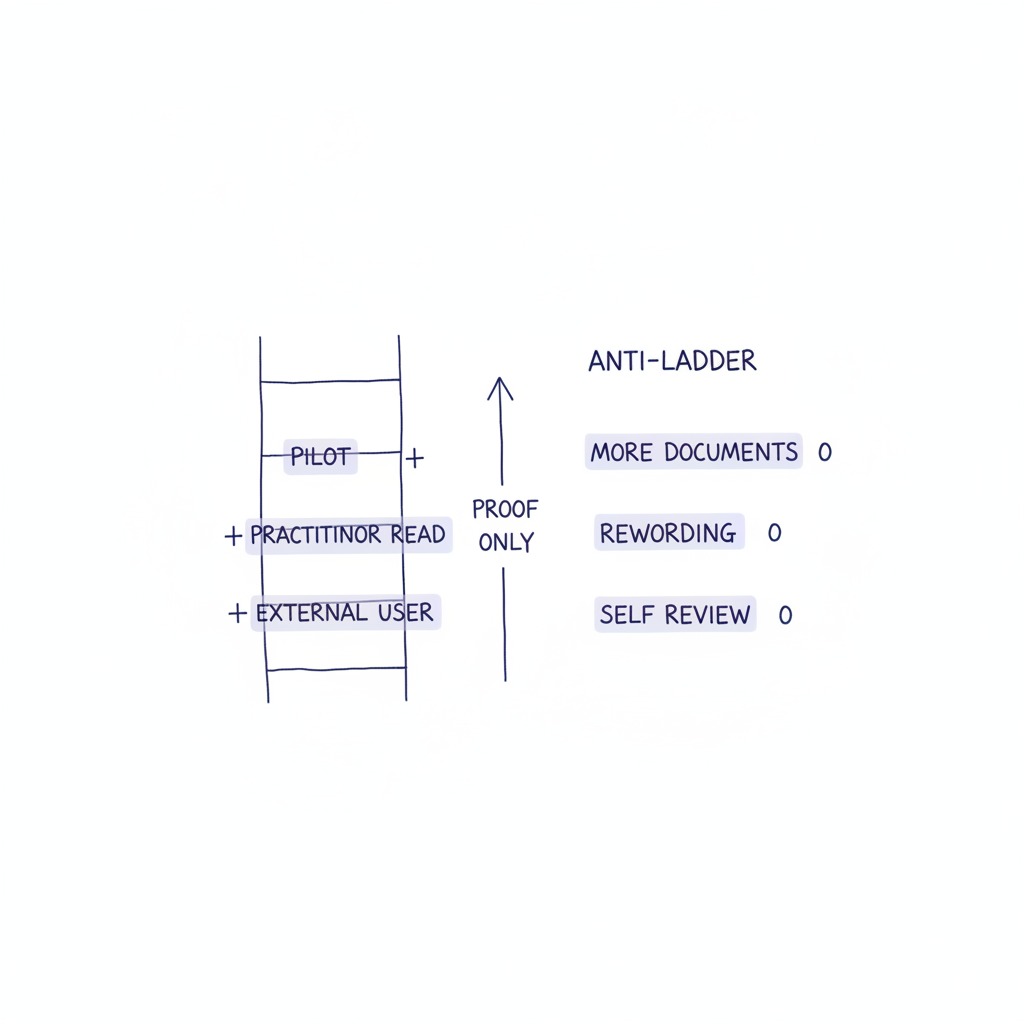
The ladder is a simple instrument. It lists every rung between where confidence sits today and where it needs to be before launch. Each rung is a specific action, each action carries a points estimate, and there is one rule that governs the entire structure.
Only a proof action buys a rung. A document does not.
A proof action is anything that tests the plan against the real world. Recruit the field operations manager and have them read the SOP for the first time: that buys points, because a real practitioner either can or cannot follow it. Run a pilot in one area and measure what breaks: that buys points, because the failures are real, not imagined. Get one external party to use the system and report back: that buys points.
Writing a thirteenth annex buys nothing. It cannot, because the annex is written by the same mind that already believes the plan is sound. It adds pages, not evidence.
The anti-ladder
The instrument only works if it also names what earns zero. So the ladder has a second half, an anti-ladder, listing the activities that feel productive and move confidence not at all:
- Adding another document to an already complete estate
- Rewording an existing procedure for clarity
- Building a more detailed version of a plan no practitioner has read
- Reviewing your own work and finding it good
Every item on that list is real work. Every item is the kind of thing a diligent operator does on a Friday and feels satisfied. And every item leaves the actual readiness of the project exactly where it was. The anti-ladder exists to break the reflex, to make it visible that you have spent a day polishing the inside of a box nobody has opened.
Why the average lies here
The reason this matters is that most readiness assessments are a weighted average of activity. Count the deliverables, weight them, sum the completeness, report a percentage. By that measure my project was near done. Twelve annexes, a full SOP, schedules signed off. The average said 90.
The ladder said 75, and the ladder was right, because it refused to count anything that had not been tested. The gap between those two numbers is the exact size of the self-deception. It is the confidence you have granted yourself for preparation that no external reality has yet confirmed.
I have watched this gap sink projects. A business plan that reads beautifully and has never been shown to a single customer. A compliance framework that is airtight on paper and has never survived an audit. A product spec so complete that the team mistakes it for a product. In each case the document estate is impressive and the true readiness is unknown, because impressive-on-paper and survives-contact are different measurements, and only one of them is on the average.
The rule this gives you
The instrument reduces to one operating rule, and it is worth more than the ladder itself:
When your confidence stops moving, you have run out of things to write and you have not yet started doing the things that prove it.
The plateau is a signal, not a wall. It tells you that the cheap work is finished. Every additional document from that point is a way of staying busy inside your own assumptions. The only path upward is out of the document and into a test: a pilot, a practitioner, a customer, a measurement, anything that lets the real world return a verdict you did not write yourself. It is the same logic as validating before you build, applied to the readiness of a whole programme rather than a single feature.
When I hit 75 percent and could not move it, the correct next action was not another annex. It was a phone call to recruit the person who would read the manual cold, and a small pilot in one area to see what the simulation missed. Neither of those is writing. Both of them are uncomfortable in a way that writing is not, because both of them can fail in public.
That discomfort is the tell. The work that can fail in public is the work that buys a rung. The work that cannot fail, because you are the only one who sees it, buys nothing.
How to build one
You do not need my project to use this. Any readiness question takes the same shape.
List the proof actions between here and launch. Not the documents. The tests. A proof action is anything where an outside reality, a customer, an auditor, a new hire, a live run, returns a verdict you did not author.
Assign each one a rough confidence gain. Precision does not matter. What matters is that a document scores zero and a pilot scores real points, and the structure forces you to see the difference.
Write the anti-ladder next to it. Name the satisfying, zero-value activities explicitly, so that when you reach for one on a slow afternoon you catch yourself in the act.
Re-score on a fixed cadence. Monthly is enough. If the number has not moved, ask which proof action you avoided, and why. The answer is almost always that the proof action was the one that could embarrass you.
The manual I wrote was not wasted. A plan you have not tested is still better than no plan. But the plan was never the thing standing between the project and 95 percent confidence. The untested assumptions were, and no amount of writing was ever going to find them. Only the world can do that, and only if you let it.
Part of the Operating Principles series from KG Consultancy.
Strategy and technology are the same decision. Over 15 years in fintech (CTOS, D&B), prop-tech (PropertyGuru DataSense), and digital startups, I have built frameworks that help founders and executives make both moves at once. Based in Kuala Lumpur.
Working on a 0→1 product?
I help founders and operators go from idea to validated product. Let's talk about yours.
Get in touch →