The Unblock Pattern: Why a 15-Minute Validation Saves 15 Hours of Wasted Build

Every consulting operation hits the same wall eventually. You build a system that works at small scale. Then the inputs multiply by a factor of ten, and the system does not break gracefully. It breaks silently. Outputs look correct but carry invisible gaps. Reports reference URLs that were never actually read. Briefings summarize content that was never actually retrieved. The architecture holds, but the data underneath is hollow.
This is the state most AI-augmented workflows reach within their first month of production. The question is not whether the system can process your work. It is whether you have built the validation layer that tells you when the system is lying.
The Landscape: Why AI Workflows Fail Quietly
The market for AI automation tools has grown significantly and 47% of organisations now report deploying AI agents in production. The growth is real, but a pattern is emerging that the adoption numbers do not capture: the gap between deployed and reliable.
Consider the typical consulting research workflow. A practitioner collects URLs from reading, conversations, and social media. Those URLs get queued for analysis. An AI agent reads each URL, extracts the key arguments, and produces a structured briefing. The consultant reviews the briefings and decides which findings merit action.
This sounds clean. In practice, the failure rate on URL content retrieval runs between 30% and 60% depending on the source. Social media posts require authentication. Paywalled articles return login prompts instead of content. Client-rendered pages deliver empty HTML shells. The AI agent, presented with these failures, does not flag them as errors. It generates plausible summaries from the metadata it can access: the URL slug, the page title, the preview text. The output looks complete. The analysis is built on sand.
Silent Failure: A system failure that produces output indistinguishable from correct output. The consumer of the output cannot detect the error without independently verifying the source. In AI-augmented workflows, silent failures are more dangerous than crashes because they erode trust gradually rather than triggering immediate remediation.
Close Shot: 2,641 URLs and a 15-Minute Bet
My research pipeline had accumulated 2,675 items over two years of WhatsApp forwards: links to articles, threads, academic papers, product launches, regulatory updates. A custom parser had extracted and categorised every item. A briefing generator had routed them to nine project folders. The infrastructure was sound.
But when sub-agents attempted to research the 580 highest-priority items, the content retrieval failure rate was catastrophic. 93% of the URLs came from a platform that blocks standard HTTP fetching. The remaining 7% included paywalled journals, Lark Suite documents behind authentication, and pages that required JavaScript rendering. The agents compensated by generating briefings from whatever fragments they could scrape. The output was voluminous and unreliable.
The candidate solution was an open-source content extraction library that strips web pages down to their readable content. For authenticated platforms specifically, it routes through a public API, bypassing authentication entirely, but before writing a single line of integration code, the critical question was: does it actually work on these specific URLs?
This is where the Unblock Pattern begins.
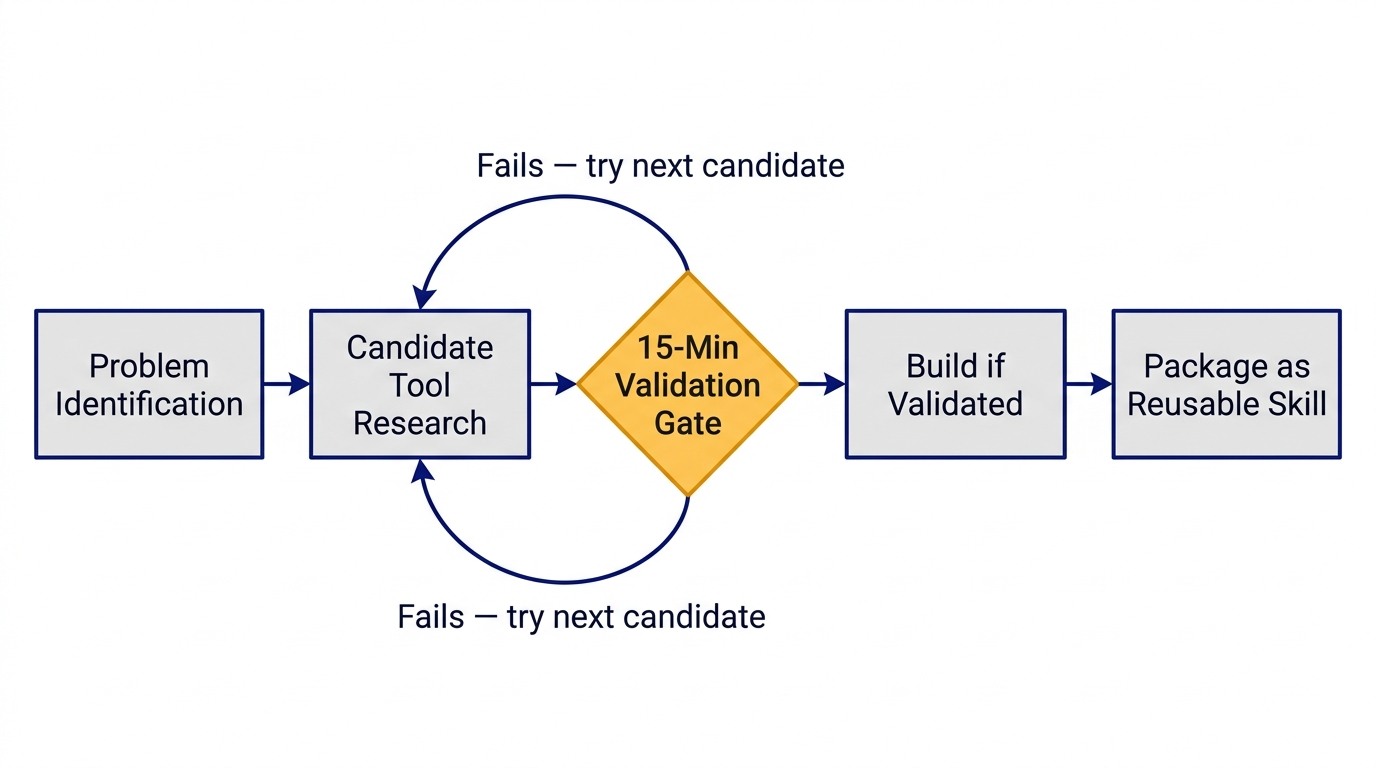
I pulled 10 representative URLs from the pipeline. Four social media threads, two paywalled articles, one Lark document, two standard web pages, one PDF link. I ran each through the library's API in a Node.js REPL session. The test took 15 minutes.
The results: 8 of 10 succeeded. The two failures were a Lark document (authentication-gated, unfixable by any scraper) and a 404 (the original post had been deleted). Both failures were legitimate: no tool would have succeeded.
That 15-minute investment authorised the next phase: building a full content extraction script, running it against all 2,641 URLs, and caching the results. The final batch completed with an 89% overall success rate. The failures were all genuinely unreachable content: deleted posts, server timeouts, authentication walls.
The Unblock Pattern: Problem identification, candidate tool research, small-scale validation, build if validated, package as reusable skill, integrate into pipeline. The validation gate between "candidate" and "build" is the highest-value step. It costs minutes and saves hours.
The token economics make the structural shift visible. Without the content extraction layer, enriching 2,641 research items would require individual AI agent calls for each URL, at approximately 10,000 tokens per call. Total: roughly 26 million tokens. The batch script processes the same URLs for approximately 50,000 tokens. That is a 99.8% reduction, not an incremental improvement, but a structural change in what is economically feasible.
The Wider Frame: Deterministic Work vs. Creative Work
The specific technology here matters less than the principle it reveals. Every AI-augmented workflow contains two types of work: deterministic operations (fetching, caching, parsing, formatting) and creative operations (synthesis, writing, strategic analysis, judgment calls). The economics of these two categories differ by orders of magnitude.
Deterministic work, when delegated to AI agents, is extraordinarily wasteful. An AI model reading a web page, extracting the key points, and returning structured data is using a billion-parameter neural network to do what a 350-line script does better, faster, and for a fraction of the cost. The model adds no value in the extraction step. Its value arrives later, when it synthesises across extracted content, identifies patterns, and generates recommendations.
The boundary between deterministic and creative work is the highest-value architectural decision in any AI-augmented operation. Get the boundary wrong, and you burn tokens on tasks a script should handle. Get it right, and your AI budget concentrates entirely on the work that only AI can do.
This is not a new principle. Manufacturing understood it decades ago: automation should handle the repeatable; skilled workers should handle the exceptions. The difference in AI workflows is that the boundary is not always obvious. URL content retrieval feels like creative work because it involves "reading" and "understanding." But the reading is mechanical. The understanding happens downstream, in synthesis. Separating these two operations is the architectural insight that makes the pipeline viable.
This is the same principle behind the 95% margin workflow: keep the high-leverage AI work concentrated, and make everything else mechanical.
Architects think about boundaries. The most consequential decision in any system is not which components to build. It is where to draw the line between what is automated and what requires judgment. In AI-augmented consulting, that line determines whether your operation scales or stalls.
Why the Validation Gate Is the Whole Pattern
It is tempting to focus on the token savings and miss the structural lesson. The 99.8% reduction is impressive, but it is a consequence, not a cause. The cause is the 15-minute validation gate.
Most teams building AI-augmented workflows skip this step. They identify a tool, commit to an integration, spend days or weeks wiring it in, and discover the failure modes in production. The cost is not just the wasted engineering time. It is the opportunity cost of building around a tool that does not work, then rebuilding around one that does. In consulting, where time is the scarce resource, this pattern is fatal.
The validation gate inverts the risk. Instead of investing heavily and validating late, you invest 15 minutes and validate immediately. If the tool fails on your specific inputs, you learn this before writing a single line of production code. If it succeeds, you proceed with confidence and the integration is straightforward because you already understand the tool's behaviour on your data.
There is a deeper principle here that information economists call real options theory: a small upfront investment that gives you the right but not the obligation to make a larger investment later. The 15-minute test was a real option. It cost almost nothing. It gave me the information needed to decide whether to commit 90 minutes to the full build. The asymmetry is striking: 15 minutes of testing versus potentially 15 hours of wasted integration if the tool had failed on the target URLs.
What This Means for the Solo Operator
The one-person consulting model depends on AI as a force multiplier, but "force multiplier" is vague unless you can name where the multiplication happens. It does not happen in email drafting or calendar management. Those are convenience gains. The multiplication happens at the boundary: when deterministic infrastructure handles the 95% of work that is mechanical, and AI tokens concentrate on the 5% that requires genuine synthesis.
The Unblock Pattern is one instantiation of this principle, but the principle extends to every workflow a solo operator builds. Invoice reconciliation, market research, competitive analysis, content production: each contains a deterministic layer and a creative layer. The consultants who build infrastructure for the deterministic layer will outperform those who throw AI at everything, because their cost per insight will be structurally lower.
The practice is straightforward. Before committing to any tool integration, run the validation gate. Pull 10 representative inputs from your actual workflow. Test the candidate tool against those specific inputs. Measure the success rate. If it passes, build with confidence. If it fails, you have saved yourself the most expensive mistake in consulting: building something nobody can use.
The question is not whether you can afford AI tools. It is whether you have built the infrastructure that makes your AI spend intelligent.
You can see the same discipline applied to product decisions in Brief-then-Fire: the cheapest test is always the one you run before you commit.
Strategy and technology are the same decision. Over 15 years in fintech (CTOS, D&B), prop-tech (PropertyGuru DataSense), and digital startups, I have built frameworks that help founders and executives make both moves at once. Based in Kuala Lumpur.
Working on a 0→1 product?
I help founders and operators go from idea to validated product. Let's talk about yours.
Get in touch →