Prompt Engineering as Defensible IP: The New Excel Model

Everyone has access to the same language models now. GPT-4, Claude, Gemini. The tools are democratized. So the thinking goes: competitive advantage in consulting has been equalized. The faster typist wins. The luckier prompt wins.
This conclusion is wrong.
The advantage has shifted one layer deeper. It has moved from access to the tool into the institutional knowledge encoded inside your prompt chains.
Here is the tension: access to AI models is no longer scarce. So the practitioners who think competitive advantage comes from access are already behind. But the practitioners who have engineered proprietary prompt chains that encode their methodology, their judgment, and their years of pattern recognition are building an unmatchable moat. Not because they have better tools. Because they have documented their thinking.
In the 1990s, management consultants and financial modelers who built proprietary Excel models became indispensable. The ones who just used Excel became commodities. Prompt engineering is the exact same inflection. We are watching it happen in real time. The question is not whether this matters. The question is which bucket you are in.
The Valuation Parallel
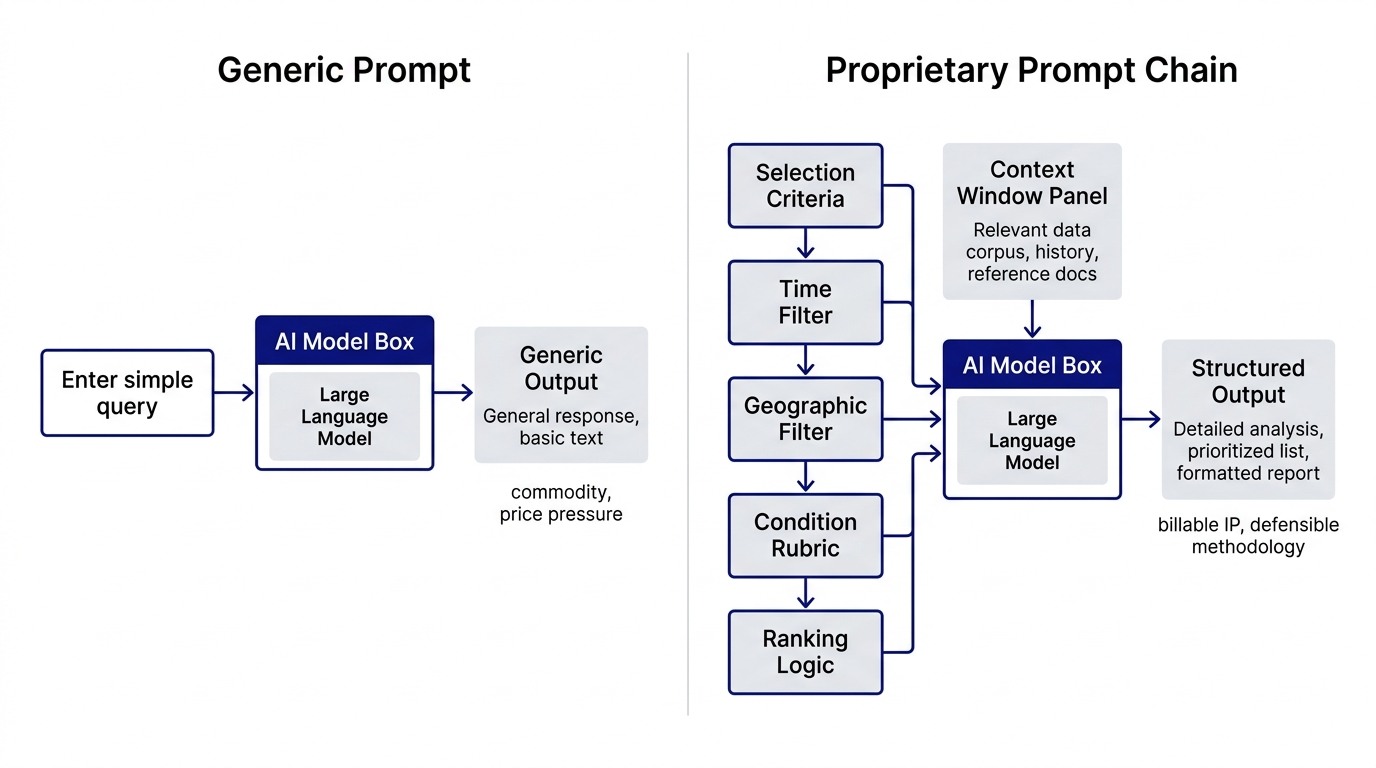
Let me ground this in property valuation, because it is the clearest example.
A property valuer's job is to select comparable properties, apply adjustments, and deliver a defensible opinion of value. The selection logic is judgment. How many comparables should you pull? What time period is valid? What geographic boundaries? How much weight should location adjustment carry versus condition adjustment? How do you rate condition from limited information?
That judgment has always lived in the valuer's head. They learned it through cases, through repetition, through correction. After ten years of practice, a senior valuer can select comparables from thousands of options in minutes. She knows her market. She knows the adjustments. She knows which signals matter.
Now suppose that valuer documents that logic.
Not in narrative form, which is slow and imprecise. As a prompt chain: a structured sequence of decisions, data retrieval steps, filtering rules, and output formats that an AI can execute reliably and repeatably.
The prompt might look like this:
"You are an expert property valuer with 15 years of experience in Malaysian residential markets. Your task is to select comparable properties for a residential unit in [LOCATION]. Your selection criteria are: (1) Properties sold within [TIME PERIOD]. (2) Properties within [PRICE RANGE]. (3) Properties within [DISTANCE RADIUS]. (4) Properties with similar architectural type. (5) Filter out properties with major condition issues [DEFINE]. Return the top 5 comparables ranked by adjustment risk. For each property, calculate the estimated condition adjustment using the following rubric: [RUBRIC]. Explain your selection logic for each property."
This is not a clever prompt. It is not even complicated. But it is specific. It encodes years of her judgment into a repeatable structure.
Now she runs this prompt on her firm's proprietary NAPIC/JPPH data integration. The AI returns a shortlist of comparables with condition adjustments and explanation. She reviews, refines, and approves. The report is 80 percent drafted. The methodology is consistent across all her cases. The time from instruction to output is hours, not days.
And here is the key move: she owns this. This is her IP. It is repeatable. It is teachable to juniors. It is defensible because it encodes her methodology, not a generic process.
When a client asks why she charges $8,000 for a three-day turnaround where a competitor charges $5,000 for a two-week turnaround, the answer is not "I have faster software." The answer is "I have documented, iteratively refined, and operationalized my judgment. You are paying for fifteen years of pattern recognition compressed into a reliable system."
The competitor with the generic approach remains a commodity. The valuer with the proprietary prompt chain becomes a service.
The Iteration Advantage: Context Beats Cleverness
Here is what most practitioners miss about prompt engineering: it is not about writing a clever prompt once and reusing it forever. It is about iterative refinement.
Each time you run a prompt, you learn something. Sometimes the AI misses a nuance. Sometimes your rubric was too vague. Sometimes a result surprises you and teaches you something about your own judgment that you had not articulated.
You refine the prompt. You run it again. The output improves. You refine again.
This is how institutional knowledge is built.
After twenty iterations of your "comparable selection prompt," it is no longer a generic tool. It has absorbed your market experience, your adjustment patterns, your risk tolerance, your quality standards. The context window inside that prompt has become increasingly specific and valuable.
Context, in prompt engineering, beats cleverness every time.
A mediocre prompt ("find properties like this one") with a rich context window, your past valuations, your market taxonomy, your preferred adjustment categories, examples of good and bad comparable selections, will outperform a sophisticated prompt with empty context. The context is where the knowledge lives.
This is why a consultant delivering $30,000 outputs in 72 hours is not smarter than her competitors. She has invested in context. She has documented her methodology. She has iterated. She has encoded knowledge.
When you do that, your prompts stop looking like questions and start looking like intellectual property. This is the same principle behind Brief-then-Fire: structured context up front is what makes AI outputs reliable at professional quality.
The Packaging Problem: Methodology as a Billable Asset
Property valuers work in a constrained market. You cannot just charge whatever you want. You are bound by professional standards (IVSC, JPPH, LPPEH), by comparable rates, and by client budgets. Margin pressure is real.
But if you can package your methodology as IP, the pricing model shifts.
Instead of "I will spend 40 hours on your portfolio valuation," you can say "I will spend 40 hours on the first property, then run my proprietary comparable selection and condition adjustment system on the remaining 199 properties. The system encodes fifteen years of my methodology. You are paying for the first property at full rate. The remaining properties benefit from that encoded knowledge. Here is the pricing."
You have turned your prompt chain into a product. You have turned your time into a service that scales without headcount.
This is exactly what happened when Excel modeling became professionalized in the 1990s. The first build of a complex financial model took weeks. But the model was reusable. It was proprietary. It was valued accordingly.
Prompt chains are the modern version of that.
For a LPPEH-registered valuer in Malaysia, a proprietary prompt chain trained on 500 past valuations in your market is worth more than the valuation software itself. The software is a tool. The prompt is institutional knowledge.
Price accordingly. Document it. Iterate it. Protect it.
The CPD Gap: Why Professional Bodies Are Behind
Most CPD curricula include Excel modeling, Python for data analysis, financial analysis, market research. All valid. But prompt engineering as a professional skill?
It is missing.
This is a problem because the market is already ahead. Practitioners are already building proprietary prompt chains. Clients are already expecting them. The gap between what the profession is teaching and what the market is demanding is widening.
A LPPEH valuer who completes a CPD program today leaves without any structured training in:
- How to design a prompt chain for valuation decisions
- How to build context windows from proprietary data
- How to test and iterate prompts for consistency
- How to document prompt logic as methodology
- How to price prompt-driven services
- How to manage prompt intellectual property
These are not optional nice-to-haves. They are core professional skills now.
Professional bodies need to catch up. This is not about being trendy. This is about ensuring that members remain professionally current.
The Moat: Iteration, Documentation, Consistency
Why is a proprietary prompt chain defensible as IP?
Three reasons.
First, it is documented. Unlike tacit knowledge (which lives in your head and walks out the door when you do), a prompt chain is explicit. It is code. It can be versioned, tested, and improved.
Second, it is iterated. Each refinement makes it more specific to your market, your methodology, your standards. A prompt written by someone else and used as-is will not be as good as one refined across hundreds of your own cases.
Third, it is consistent. A junior valuer using your prompt chain will produce outputs that match your quality standard. You can scale judgment without diluting it.
This is why your prompt chains are defensible. They are not clever. They are not even that complicated. But they are yours. They encode your knowledge. They scale your practice.
And they compound. The Scope Compression and 0→1 model only works when your execution layer is systematized enough to absorb compressed timelines. A well-iterated prompt chain is part of that execution layer.
The New Model for Professional Services
We are at an inflection point.
For the past decade, professional services firms have competed on expertise, relationships, and headcount. You hire the best people, you train them well, you build client relationships, you scale by hiring more people.
This model is not wrong. But it is not the only model anymore.
A one-person consultancy with proprietary prompt chains can now compete with a fifty-person firm on speed and consistency. A solo property valuer with a refined comparable selection and condition adjustment system can deliver portfolio-level analysis that would have taken a team weeks.
The margin structure changes. The time structure changes. The scaling mechanism changes.
But it only works if you have done the work to encode your knowledge.
The practitioners who will win in the next five years are the ones who treat prompt engineering as a professional discipline. Who document their methodology. Who iterate relentlessly. Who price their prompt chains as IP.
The ones who treat prompts as one-off questions will be commoditized.
The advantage is not access to the models anymore. Everyone has that.
The advantage is the knowledge you have encoded inside your prompts.
Start documenting. Start iterating. Start pricing it.
The market is already there. Your methodology can either follow, or it can lead.
Strategy and technology are the same decision. Over 15 years in fintech (CTOS, D&B), prop-tech (PropertyGuru DataSense), and digital startups, I have built frameworks that help founders and executives make both moves at once. Based in Kuala Lumpur.
Working on a 0→1 product?
I help founders and operators go from idea to validated product. Let's talk about yours.
Get in touch →