The One-Person Operating Model: Integration Beats Collection

The one-person company narrative comes bundled with assumptions. It is a lean operation. It is a cost-saving hack for founders who cannot afford employees. It is a lifestyle business, not a growth business. The implicit message: smaller is necessary, not optimal.
That story is changing.
There is a class of practitioners operating today who demonstrate something different. One person, multiple major projects simultaneously, output quality and throughput that would normally require a team of 3 to 5. The difference is not that they work harder. The difference is architectural.
They operate with 10 to 15 integrated AI tools. The tools are not powerful because they are cutting-edge. They are powerful because they are integrated. Output from one tool becomes input to the next. Context flows automatically. Human handoff points evaporate. What emerges is not a collection of point solutions. It is a system.
I started experimenting with this architecture two years ago while running multiple embedded executive roles across PropTech, valuation, and AI-augmented operations. The financial result is compelling. The operational result is more interesting.
The Taxonomy: Stacking vs. Piping vs. Architecture
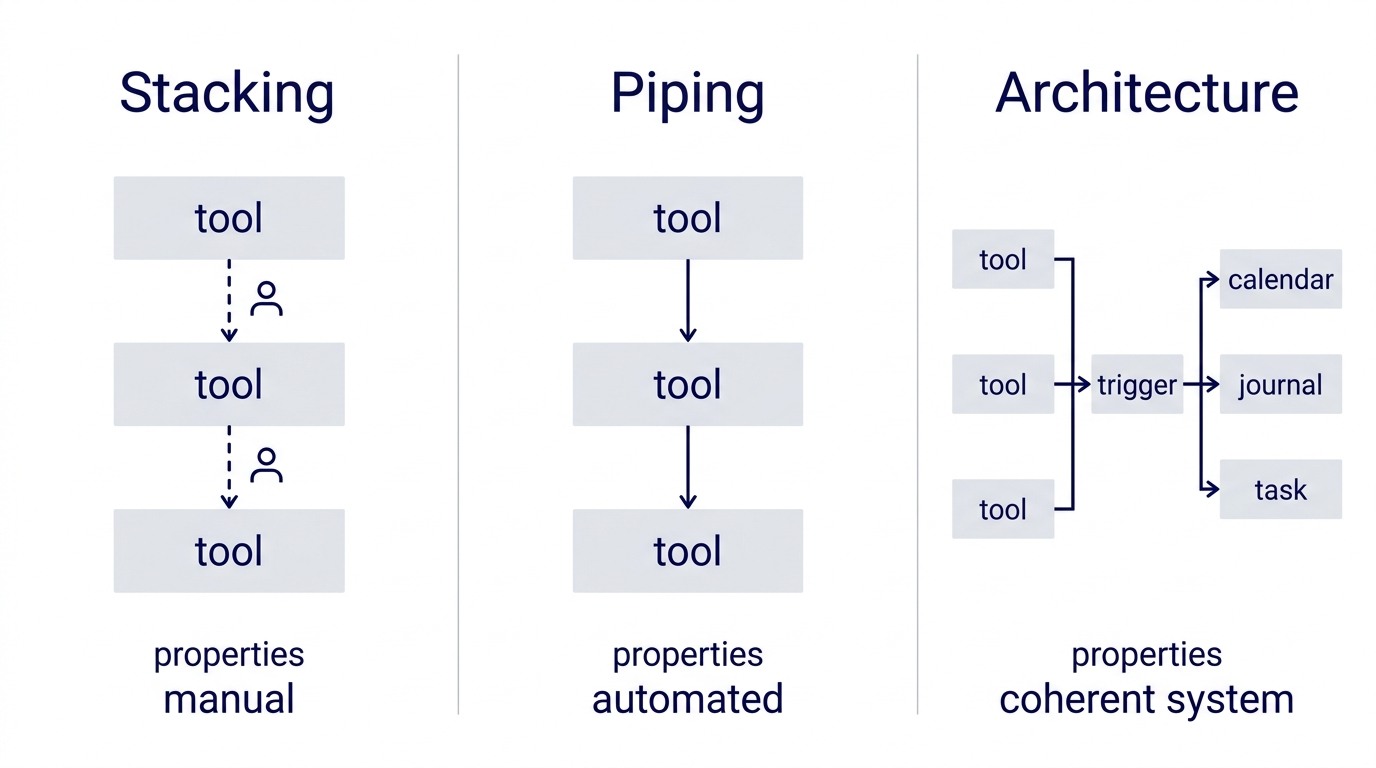
Let me start with the taxonomy, because people use the word integration loosely.
There are three ways tools relate to each other.
Stacking is having multiple tools and using them sequentially: you run research in Claude, copy the results, paste them into a brief in Google Docs, then send the brief via email. Each tool is effective. The transitions are manual. You are in the middle of every handoff.
Piping is connecting tools so that the output of one automatically becomes the input to another: Claude generates a research summary, it is automatically formatted and sent to Slack, and team members can see it without you copying anything. The human is removed from the transition.
Architecture is designing your entire workflow system so that multiple piped chains work together coherently. Your morning briefing pulls data from five sources, runs analysis in parallel, produces structured output, and integrates that into your calendar and task list, all triggered by a single 8 AM event.
Most practitioners are stacking. Some have moved to piping. Almost nobody is doing architecture.
The Hidden Cost of Transitions
Management accounting teaches a principle that applies here: costs compound at process transitions. In manufacturing, the cost of moving a widget from one station to another is not trivial. In knowledge work, the cost is context switching and re-entry friction.
I did a time audit on my own workflows three years ago. I operate eight tools regularly: Claude, Cursor, Logseq, n8n, Lark, Google Workspace, Figma, and Notion. On a typical day, I was switching between them approximately twelve times. Each switch involved context loss. Each re-entry involved reorienting. Each tool handoff involved manual data transfer or copy-paste.
Conservatively, five minutes lost per transition. Twelve transitions per day. Sixty minutes of waste daily.
When I mapped the workflow, I saw the gaps:
- Morning planning required opening five different project folders and manually synthesizing the task state. Thirty minutes.
- Research on a strategic question required pulling from documents, papers, and prior notes scattered across three tools. Twenty minutes.
- Drafting a client brief required pulling data from five sources and manually entering it into a template. Twenty-five minutes.
- Weekly reporting required exporting from project management, importing into a spreadsheet, formatting, and sending. Thirty minutes.
The tools were not the problem. The transitions were the problem.
Designing for Integration
The operational redesign looked like this.
First, I identified the core workflows that happen repeatedly. Morning planning, research synthesis, brief generation, weekly reporting, project status updates. These five workflows account for about 60 percent of my operational time.
Second, I mapped which tools actually owned which data. Logseq owns project notes and decision context. Google Workspace owns shared documents with clients. Lark owns task and project state. My billing system owns time and revenue data. The opportunity became clear: automate the handoff between these systems and eliminate the manual transitions.
Third, I built the connectors using n8n, a workflow automation platform:
Morning Briefing: 8 AM, n8n queries Logseq for project contexts, reads the task list, pulls calendar, generates a prioritized briefing with today's key decisions and open items. Outputs to my journal as a Logseq entry. Forty-five minutes of cognitive work removed from my day.
Research Synthesis: When I save a research item to Logseq with a URL, n8n automatically pulls the full content, passes it to Claude for summarization, tags it with project context, and files it in the right project folder. Manual research filing time went from 30 minutes per week to zero.
Brief Generation: A Lark template triggers n8n to pull data from Google Workspace (client profile, prior agreements) and Logseq (project context and prior decisions), then generate a client brief outline in Google Docs for me to refine rather than create from scratch. Twenty minutes of typing eliminated.
Weekly Reporting: At 5 PM Friday, n8n pulls time logs, project completions, and deliverables, generates a JSON summary, formats it as a client report, and queues it for my review. I edit, I send. The assembly is gone.
Each workflow is built once. It runs automatically. This is the distinction The 95% Margin Workflow describes: the design investment pays forward indefinitely.
The Capacity Calculation
The math is straightforward when you track it carefully.
- Morning planning: 45 minutes per day eliminated. 3.75 hours per week.
- Research filing: 30 minutes per week eliminated.
- Brief generation: 90 minutes per week eliminated.
- Weekly reporting: 60 minutes per week eliminated.
- Miscellaneous context switching: 40 minutes per week eliminated.
Total: approximately 20 hours per week of reclaimed capacity.
At a billing rate of RM 300 per hour, that is RM 6,000 per week. Annualized, RM 312,000 per year of additional capacity without hiring a single person.
But the financial calculation understates the real value.
Why This Is Not Really About Productivity
When I started integrating workflows, I expected the primary gain to be time. It is not. The primary gain is cognitive bandwidth.
Running four companies and multiple advisory roles means holding multiple complex threads simultaneously. Each context switch imposes a tax. When I had to manually synthesize my morning briefing from five folders, that cognitive load contaminated the rest of my day. When I had to manually file research across three projects, that friction created a decision point every single time.
Integration removes that. The morning briefing is synthesized automatically. The research is routed automatically. The decisions are consolidated automatically. What remains is the actual strategic thinking. The actual client work. The actual creation.
This is the part that scales in a one-person operating model. You can hold more context, make faster decisions, and maintain quality across more simultaneous work when the tool layer handles the organizational overhead.
The Organizational Design Insight
Traditional organizations use hierarchical specialization. You have a researcher who does research. An analyst who does analysis. A writer who does writing. A project manager who coordinates. Each person is efficient at their narrow task. But they create handoff overhead. The researcher's output must be reframed for the analyst. The analyst's output must be reformatted for the writer.
The integrated one-person model inverts the structure. One generalist with well-designed automation workflows outperforms the specialist hierarchy. Why?
- No reinterpretation. The researcher (same person as the analyst and writer) does not need to reframe the output. It is already in context.
- No handoff delay. The output of research automatically becomes the input to analysis. Analysis automatically informs the brief.
- Control. You maintain full agency over the entire workflow. You see the end-to-end picture. You can optimize at the system level, not just the task level.
- Speed. A one-person model with integrated workflows can move from research to client delivery in hours. A team of specialists requires meetings, approvals, and coordination.
The constraint is not capacity. It is depth. One person cannot know everything. But one person who is specialized in one domain and equipped with integrated AI workflows can operate at a throughput that would normally require a team. The How I Run 0→1 Product Sprints model depends on this exact structure.
The Practical Implication
If you are considering solo practice, whether as a consultant, freelancer, or founder, the question is not "Can I hire an assistant?" The question is "How would I design my workflows if I could not hire?" Then build the AI integration layer that makes that design work.
It is not sexy. It is not a feature of the individual tools. It is architecture.
A one-person company is cost-saving, yes. No payroll overhead. No management complexity. But that is not why the model works at scale. The model works because it removes the structural penalties that plague larger teams: handoff delay, reinterpretation friction, decision bottlenecks at coordination points.
When one person is equipped with integrated AI workflows, they are not constrained by context switching. They are not bottlenecked by coordination. They are not taxed by reinterpretation. They can hold multiple complex projects simultaneously because the tool layer is doing the organizational work that would normally be done by managers.
The solo practitioner equipped with integrated AI is not smaller than a team. They are structurally different. They move faster. They maintain higher quality. They scale in throughput without sacrificing specialization.
That is not a hack. That is an architecture worth understanding.
Strategy and technology are the same decision. Over 15 years in fintech (CTOS, D&B), prop-tech (PropertyGuru DataSense), and digital startups, I have built frameworks that help founders and executives make both moves at once. Based in Kuala Lumpur.
Working on a 0→1 product?
I help founders and operators go from idea to validated product. Let's talk about yours.
Get in touch →