The 95% Margin Workflow: How One Consulting Engagement Compressed RM 30,000 of SEO Work into RM 800

The Tension
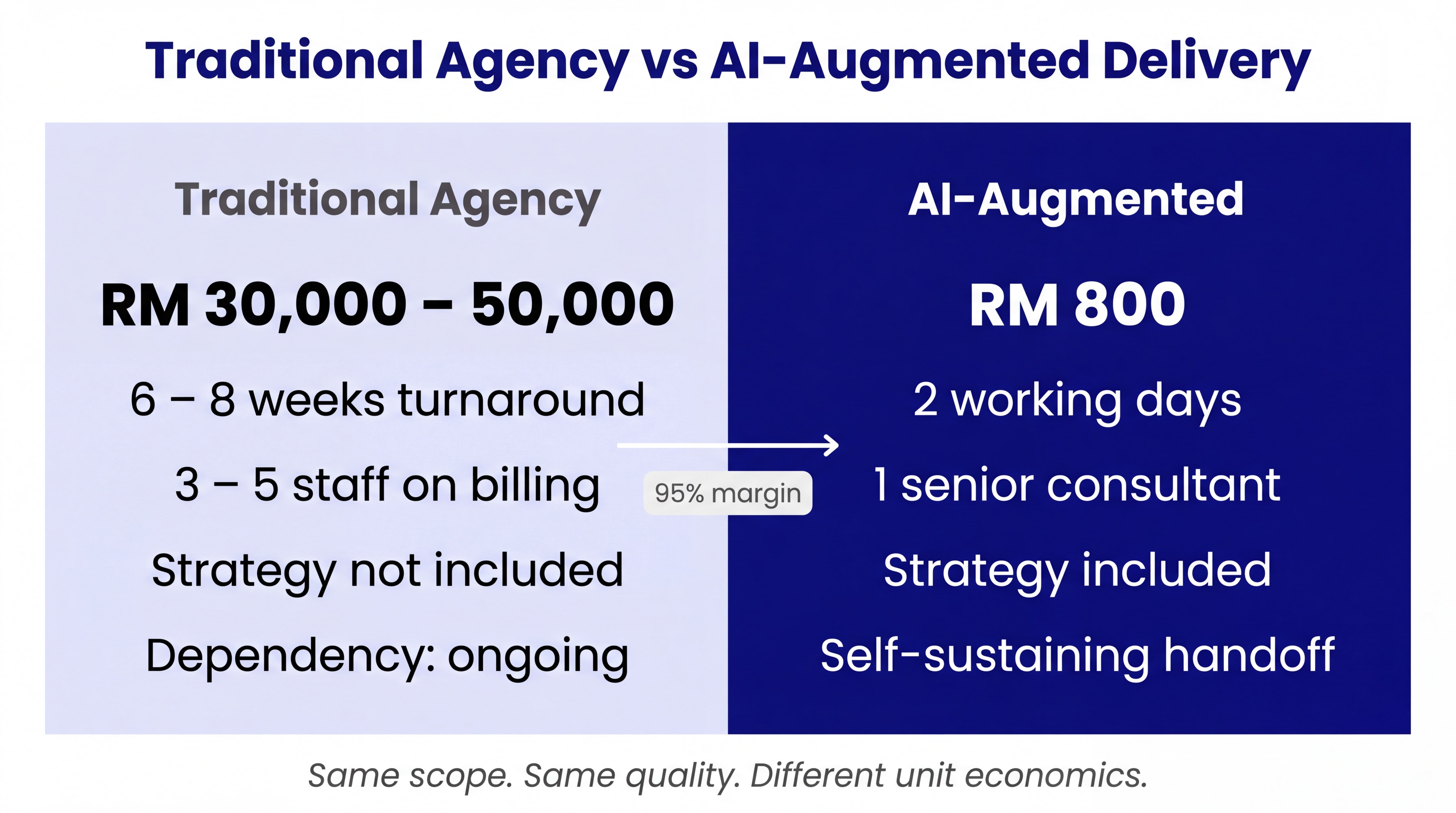
A traditional Malaysian SEO agency will quote you RM 30,000 to RM 50,000 for a topical content cluster. Twenty-five articles, fifty images, a content strategy doc, and a publishing handover. Six to eight weeks of turnaround. Three to five staff billing time against the engagement.
I just delivered the same scope to a client in two working days at a token cost of about RM 800. The deliverable looked like a mid-tier consulting output. The client team can operate the system without me. The gross margin is 95%.
This is not a tools post. This is a structural account of what changed, what the numbers actually are, and the specific moment a workflow tipped from "interesting experiment" to "productised offering."
What Was Built
The client is a business valuation firm. The deliverable was a topical SEO cluster: one pillar architecture, twenty-six articles spanning business valuation, plant and machinery valuation, and vessel valuation, two hundred image briefs with forty production-ready PNGs, and a self-sustaining handoff pack.
The handoff pack is the part that matters most. It is a single 47-kilobyte DOCX file. Seven sections plus a cover page. Roughly ten thousand words. It contains the value framing (their cost vs traditional cost), what was done, why topical content beats keyword stuffing, the WordPress workflow for their non-technical team, instructions for adding new content without me, maintenance and editing protocols, the system prompts I used, and best practices.
The client team can keep producing in this voice and structure indefinitely. They do not need me for the next batch. They might choose to keep me for quarterly refreshes, but the dependency is gone.
The Cost Breakdown
| Phase | Approximate cost (USD) | What it produced |
|---|---|---|
| Strategy and pillar articles (Opus 4.7) | $130 | Topical cluster blueprint, 15 cornerstone articles |
| Use-case article writing (5 parallel Sonnet 4.6 subagents) | $8 | 20 publication-ready articles |
| Image prompt preparation (10 parallel Sonnet 4.6 subagents) | $11 | 200 image briefs across 100 articles |
| Image generation (nanobanana) | $0.90 so far, $30 ceiling | 40 PNGs delivered, 200 ceiling |
| Delivery pack DOCX (mixed Opus and Sonnet) | $15 | The self-sustaining handoff artefact |
| Verification, scrubbing, manifest building | $8 | Quality gates, em-dash discipline, file integrity |
| Total | ~$178 = ~RM 800 | 26 articles, 40 images, DOCX, reusable system |
The pricing comparison only works because the alternative is real. A Malaysian SEO agency at RM 1,000 per article and RM 200 per image hits RM 26,000 to RM 30,000 for the same scope. Add strategy time and project management and you are at RM 35,000 to RM 50,000. I have lived inside both numbers.
What Made It Work
Three architectural decisions matter. None of them are the model choice itself.
First, the two-stage Brief-then-Fire pattern. The bulk work splits into a cheap parallel preparation stage and a more expensive parent-orchestrated firing stage. Ten parallel Sonnet subagents each wrote nineteen image briefs in roughly two minutes of wall time. The parent agent then read the prepared briefs in chunks and triggered the actual image generation calls. This is the pattern that turned a multi-day workflow into a multi-hour one. I write about this pattern in detail here.
Second, pilot-then-bulk discipline. Before firing two hundred image generation calls, we did a ten-image pilot. The pilot caught manifest design issues that would have multiplied across the bulk run. Cost of pilot: 5% of the bulk. Cost of skipping the pilot and finding the manifest defect at one hundred percent: a full re-run, doubled spend, lost confidence with the client.
Third, the manifest is the product. The CSV with image paths, dimensions, alt text, WordPress categories, and sequencing is what the client team actually uses. The images are the by-product. This re-frames the work: the manifest's quality determines whether the client team can succeed without me. Get the manifest right and the engagement self-sustains. Get it wrong and you are back in the loop within a month.
What Made It Replicable
The framing of "industry-agnostic" is easy to assert and hard to prove. Here is the proof.
The pattern is independent of domain knowledge. Business valuation expertise lives in the pillar prompts and the voice spec. Swap business valuation for ISMS consulting, IT services, real estate marketing, food and beverage, or manufacturing, and the topology is identical. The pillar count, the cluster count, the use-case dispersion, the image-to-article ratio, the manifest schema, the handoff DOCX structure: none of those change.
The plumbing is one-time investment. The DOCX generator is 280 lines of node.js. The em-dash scrubbing utility is 30 lines of Python. The manifest verification script is 50 lines. These were written this engagement and will not be re-written. Second engagement plumbing drops from 45% of the work to roughly 30%. Tenth engagement drops below 15%.
The model selection has a clean rule. Strategy and pillar articles run on Opus 4.7. Use-case articles and image briefs run on Sonnet 4.6 in parallel. Plumbing runs on scripts with no model. There is no judgment call once the rule is in place.
Pricing as a Service
The economics shift the offering from billable hours to productised consulting. The client is not paying for my time. They are paying for the system.
| Tier | Scope | Suggested fee (RM) | KG cost (RM) | Margin |
|---|---|---|---|---|
| Pilot | 1 pillar, 5 cluster, 5 use-case (~10 articles, ~20 images) | 8,000 | 400 | 95% |
| Standard | 1 pillar, 10 cluster, 15 use-case (~25 articles, ~50 images, DOCX) | 18,000 | 900 | 95% |
| Enterprise | Multi-pillar, 50+ articles, 100+ images, DOCX, 3-month maintenance | 45,000 | 2,500 | 94% |
| Maintenance retainer | Quarterly refresh, 5 new articles, GSC monitoring | 2,500/quarter | 200 | 92% |
These prices sit 40% to 60% below traditional agency rates while delivering comparable structural quality. The competitive moat is the one to two day turnaround and the self-sustaining handoff. Both are direct consequences of the architecture, not promotional claims.
What the Numbers Do Not Show
This is the first engagement. The plumbing ratio was 45%, higher than ideal. A mature version of this engine should drive plumbing below 25%. The first three to five engagements will absorb the system build cost. The honest move is to price the first three at "founding client" tiers, then ramp.
The biggest cost leak in this engagement was using the Opus 4.7 parent as the orchestrator during bulk image firing. Opus context is expensive per token, each generation call echoes the prompt back into context, and Opus tends to verbalise progress. Switching the orchestrator to Sonnet 4.6 for the firing phase will cut about 60% off that stage. Estimated total spend on the next engagement, with this correction: about RM 740 instead of RM 800.
Marginal? Yes for one client. It compounds across ten engagements. More importantly, the lighter parent context means the engagement runs in fewer sessions, which is the real time saving.
What This Means for the Consultancy
I have run a consultancy in management accounting and embedded executive work for years. The unit economics of advisory work are well known: senior time is the bottleneck, gross margins sit at 30% to 50% after delivery costs, and growth requires hiring more senior people who are difficult to find.
This workflow inverts that. The bottleneck is no longer my time on each engagement. It is my time spent productising the next pattern. The margin profile is software-like, not services-like. Growth requires building more patterns, not hiring more consultants.
The discomfort is real. I have spent years pricing on the time-and-materials model. Charging RM 18,000 for two days of attention feels wrong because the framing is still "what did I do for the money." The framing should be "what did the client get for the money." On that framing, RM 18,000 for a self-sustaining content production system that would otherwise cost RM 30,000 to RM 50,000 from an agency, with no team to manage, is fair to the point of generous.
What Comes Next
Three things have to happen in the next thirty days.
One: identify the next three prospects. Existing clients with weak content marketing are the natural pool. The conversations are short because the framing is concrete: here is what we built, here is the handoff pack they got, here is what it would cost you. Fewer slide decks, more proof artefacts.
Two: ship the supporting skills. The image bulk pipeline and the handoff pack builder are the two most reusable extractions from this engagement. Each is roughly three to five days of build work. Together they cut engagement plumbing in half.
Three: write a one-page sell sheet. The client delivery pack is the proof. The sell sheet is the wrapper. Without it, this stays a story I tell, not a product clients buy.
The Pattern Is Bigger Than Content
The two-stage Brief-then-Fire pattern, the pilot-then-bulk discipline, the manifest-is-the-product reframing, and the model selection rule all generalise beyond content engineering. The next post digs into where else this applies: valuation reports, ISMS gap assessments, PRD generation, investment memos. Same structural moves. Different domain knowledge.
The 95% margin is not in content. The 95% margin is in any consultancy workflow where the deliverable can be split into parallel preparation and orchestrated firing, where a non-technical client team can operate the output, and where the model selection follows a clean rule.
That is most of consulting.
Strategy and technology are the same decision. Over 15 years in fintech (CTOS, D&B), prop-tech (PropertyGuru DataSense), and digital startups, I have built frameworks that help founders and executives make both moves at once. Based in Kuala Lumpur.
Working on a 0→1 product?
I help founders and operators go from idea to validated product. Let's talk about yours.
Get in touch →