The Delegate Reset: When a Team Member's Scope Dies and How to Restart Cleanly

The Situation
One delegate. Twelve open tasks across two products. A project pivot that orphaned all twelve. The cleanest fix was not to triage. It was to declare the old list dead and write a new one.
A small project carried thirteen people, each with their own task lane. One of them had been working on two adjacent products for the last three months. The first product was the active engagement, the second was the upcoming priority. The delegate's task list reflected that mix: twelve active items, divided roughly evenly between the two.
Then the project lead made a call. The first product was being handed to another team. The second was being elevated to the new active engagement. The delegate's twelve tasks were now structurally misaligned with where the project was going.
The instinct of every operator I have watched in this position is to triage. Read each of the twelve tasks. Decide which ones still apply. Update due dates. Reassign owners. Make the list match the new reality task by task.
This is the wrong move. It is slower, it is messier, and it leaves the delegate confused about whether the parts you kept are the same as the parts you would have asked them to do if you had started fresh.
Named Tension: triage preserves history. Reset preserves clarity. When a project pivots, history is the cheaper thing to throw away.
The Move That Worked
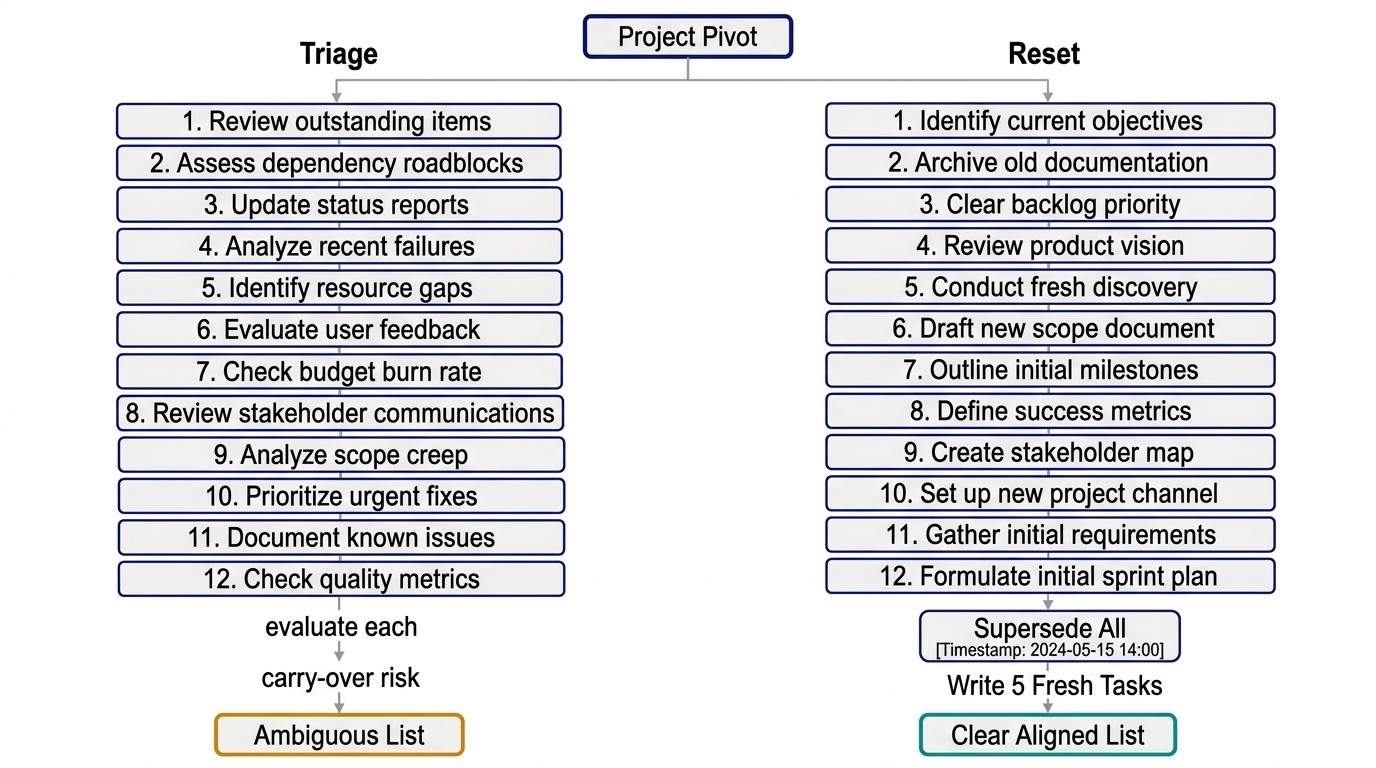
Mark all twelve old tasks as superseded. In one batch. With a one-line note: "scope reset following [project decision], [date]."
Then write the new task list from scratch, oriented to the new active engagement only. No reference to the old list. No carry-overs. No "task 7 was relevant, I am keeping it." If a task happens to look identical to one on the old list, that is fine. It still goes on the new list as a new task with a new framing and a new due date.
The full operation took thirty minutes. The delegate's resulting task list had five items, all clearly oriented to the new product, all with named outcomes and rough timelines. The old list was archived as one block, time-stamped, with the supersession reason captured.
The delegate's response was immediate: "this is much clearer."
Why This Beat Triage
Three reasons, named so they generalise.
Reason 1: A Pivoted Task List Lies About Itself
When you triage a list across a pivot, the list keeps looking like the list. The format is unchanged. The task IDs persist. The history of dependencies and discussions follows each task through the transition.
That continuity is the problem. The delegate, on receiving the triaged list, reads it the way they read it last week. They look for what changed and assume what stayed the same is still the same. The implicit context that used to surround each task is no longer accurate, but the task text does not flag the change.
A reset list does not have that ambiguity. It is new. There is no last week to compare it to. The delegate reads each item as a fresh ask, not as a possibly-still-valid old ask.
Reason 2: The Cost of Wrong Carry-Overs Is Higher Than the Cost of Rewriting
In triage, every wrong carry-over costs you a wasted execution. The delegate works on something for three days, the output is delivered, and the conversation goes "that is no longer the priority." The three days are gone.
In reset, every right rewriting costs you about ninety seconds. You read the old task, you decide whether it is still relevant, you write it new with the new framing.
If the list has twelve items and even three carry-overs are wrong, you have lost approximately nine days of delegate time on misaligned work. The reset costs thirty minutes. The math is not subtle.
Reason 3: The Reset Forces You to Articulate the New Scope
Triage lets you avoid the strategic question. You can patch the old list until it looks current, without ever having to clearly state what the new scope actually is.
Reset does not let you skip that step. To write five new tasks for a delegate, you must know what the new engagement needs from them, what the new milestones are, and what done looks like by when. If you cannot write that, the reset surfaces it. You discover the gap on a Wednesday morning instead of three weeks into delegate execution that turns out to have been pointed at the wrong target.
This is the underrated benefit. The reset is a forcing function on the operator. It makes you articulate the scope cleanly enough that the delegate can act on it.
When Triage Is Still Right
Three cases. Triage when:
-
The pivot is partial. If only one or two tasks are misaligned and the rest of the list still maps to current scope, do the surgery, not the reset. The threshold is roughly forty percent. Below that, triage. Above, reset.
-
The delegate is mid-execution on multiple tasks. Stopping someone mid-flight on five tasks to receive a fresh list creates whiplash. Let them complete the in-flight work, then reset on the next planning cycle.
-
The history of each task is itself the deliverable. Some tasks are research threads where the discussion log around the task is the value. Resetting those orphans the value. Treat them as exceptions and carry them across with explicit framing.
If none of these apply, default to reset.
The Operator's Discipline
Three habits make this work cleanly.
Habit 1: Time-stamp the supersession.
When you mark old tasks superseded, name the date and the reason. This costs ten seconds per batch and makes the archive readable later. "Superseded 2026-05-06, project pivot from product A to product B" is a sentence the next operator, or you in three weeks having forgotten the context, can act on.
Habit 2: Write the new list before showing it.
Do not co-author the new list with the delegate in real time. Write it cold, by yourself, oriented to the new scope. Then share it as a clean document. The delegate's first interaction with the new list should be reading a finished version, not co-creating a half-formed one. They will give better feedback on a complete artefact than on a draft.
Habit 3: Name the previous list once, then never again.
In the message accompanying the new list, say something like: "I have superseded the previous twelve tasks. Here is the new list aligned to the new scope." That sentence acknowledges the transition. After that, do not refer back to the old list in subsequent conversations. Treat it as archived. If the delegate asks about a specific old item, decide in the moment whether to revive it as a new task or confirm it is gone.
Every reference back to the old list reactivates the old context for the delegate. The point of the reset is to clear that context. Talking about it keeps it alive.
The Generalised Pattern
This is not specific to product pivots. The same move applies to any sharp change in delegate scope:
- A team member returns from a long leave and the project has moved on.
- A junior staffer is being repositioned to a different client engagement.
- An external vendor's deliverables are being re-scoped after a contract amendment.
- A new partner takes over a function and inherits the previous holder's task list.
In each case, the choice is the same. Triage preserves continuity at the cost of clarity. Reset trades continuity for clarity. The cleaner default, when scope has changed materially, is reset.
The thing that holds operators back from reset is the implicit sense that the old work was wasted. It was not. The work that mattered created the new scope. The remnants of the old task list are not the work. They are the bookkeeping. Throw away the bookkeeping. Keep the work and keep moving.
This pattern connects directly to The Self-Sustaining Handoff: a clean reset is itself a form of handoff design. You are deciding what survives the transition and what does not. And it connects to Brief-then-Fire, where scoping clearly before execution begins prevents the drift that makes resets necessary in the first place.
What I Would Codify If I Did This Often
If I were running a larger team with multiple delegates, I would build this into the planning workflow as an explicit option. At the end of each fortnight or each milestone, the operator decides for each delegate: continue, triage, or reset. Continue is the default for stable scope. Triage is the surgical fix for partial drift. Reset is the cleanup for pivot-class changes.
Naming it as a discrete option prevents the common failure mode where every delegate is in implicit "continue" mode regardless of how much the surrounding context has shifted. The decision becomes a habit. The habit produces cleaner team coherence with less ambient confusion.
I run a one-person consultancy with project-specific delegates. Even at that scale, the move from "always triage" to "reset when the scope has shifted by forty percent or more" produces measurably cleaner delegate interactions.
The cost is thirty minutes of operator time per reset. The benefit is days of delegate execution pointed at the right target. The operator who skips the reset is hoping the old list is still valid. The operator who runs the reset is making sure.
Hope is not a delegation strategy. The reset is.
Strategy and technology are the same decision. Over 15 years in fintech (CTOS, D&B), prop-tech (PropertyGuru DataSense), and digital startups, I have built frameworks that help founders and executives make both moves at once. Based in Kuala Lumpur.
Working on a 0→1 product?
I help founders and operators go from idea to validated product. Let's talk about yours.
Get in touch →