The Self-Sustaining Handoff: Why Every Consulting Engagement Should End with a System, Not a Report

The Exit Problem
Most consulting engagements end the same way. The consultant delivers a deck or a report, presents it, answers questions, and leaves. The client team reads it once, implements 20% of it, and six months later cannot remember what the recommendations were.
This is not a client failure. It is a delivery architecture failure.
The deliverable was designed to be read, not operated. A report answers "what should we do?" A system answers "how do we do it, indefinitely, without you?" Those are different things. Consultants who confuse them produce excellent reports that sit in SharePoint and decay.
What a Self-Sustaining Handoff Contains
The handoff that matters is not the final presentation. It is the artefact the client team still uses in month six.
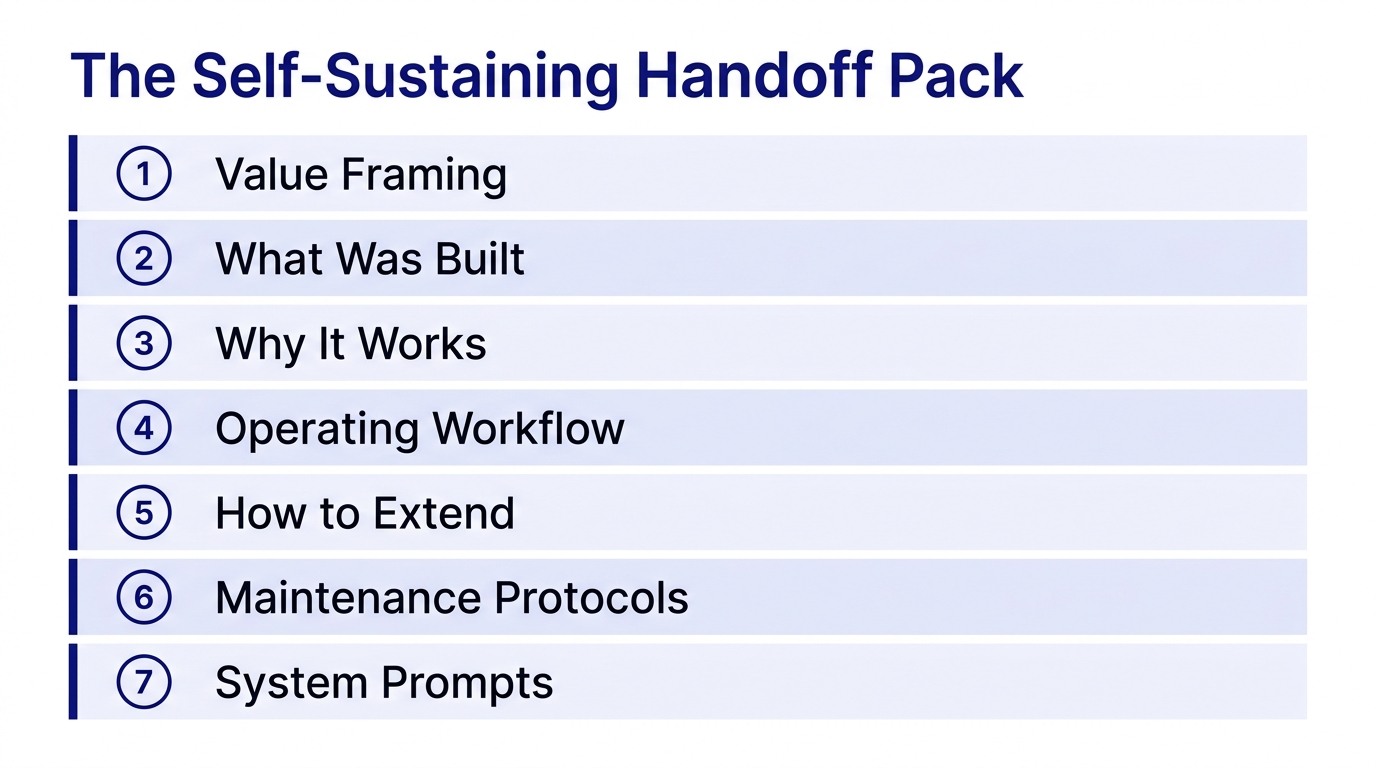
For a content engagement, that artefact is a DOCX file. Not a presentation. Seven sections:
- Value framing: what this cost vs what it would have cost elsewhere
- What was built: structure and rationale
- Why it works: the mechanism, explained for a non-technical reader
- Operating workflow: step-by-step for the client team
- How to extend: adding new content without the consultant
- Maintenance protocols: what to check, when, and how to fix common issues
- System prompts: the actual prompts used, ready to copy
A non-technical client team can pick this up in year two, with no tribal knowledge, and keep producing.
That is the test. Not "did the client like the engagement?" The test is: "can they operate this without calling me?"
Why Consultants Resist This
Two reasons. Both are wrong.
First: "I will lose the retainer." The logic is that dependency creates ongoing revenue. If the client can operate without you, they will not pay for the next batch.
This is backwards. Dependency creates resentment. When a client cannot proceed without you, they feel trapped. That feeling corrodes the relationship. Clients who feel trapped fire their consultants at the first budget cut.
Clients who can operate independently but choose to come back because the value is clear. Those clients retain. The self-sustaining handoff is a stronger commercial position, not a weaker one.
Second: "It takes too long to document." True if you do it at the end. Not true if the system is designed to be documented from the start.
The Brief-then-Fire pattern produces the manifest as a by-product of the work, not as an extra documentation step. The DOCX handoff is written during the engagement, not after it. When you build with documentation in mind, the documentation cost approaches zero.
The Manifest Is the Product
This is the key reframe. In most consulting engagements, the deliverable is the final output. The process is private, messy, and undocumented.
Flip that. Make the manifest (the structured record of inputs, decisions, and outputs) the primary artefact. The final deliverable falls out of the manifest.
In a content engagement, the manifest is the CSV with image paths, alt text, WordPress categories, and publishing sequence. The images are a by-product of the manifest, not the other way around.
In a valuation engagement, the manifest is the evidence table with comparable properties, adjustment factors, and data sources. The narrative report is a by-product of the evidence table.
In an ISMS gap assessment, the manifest is the gap table with control references, evidence, and classifications. The remediation plan is a by-product of the gap table.
When the manifest is the product, documentation is automatic. The client gets a structured artefact they can audit, verify, and extend. The consultant gets a reusable template for the next engagement.
The Compounding Payoff
The first engagement in a new domain is the hardest. The handoff pack template does not exist yet. Every section is a first draft. Every schema is an experiment.
By the third engagement, the template is mature. The gaps from the first two have been filled. The client team gets a better handoff for less effort.
By the tenth engagement, the handoff pack for that domain is a reusable product. The marginal cost of producing it is close to zero. The marginal quality is the highest it has ever been.
This is the productisation pattern applied to knowledge work. The first engagement buys the template. Engagements two through ten sell the template at nearly full margin. That is why the 95% margin is not a ceiling. It is a starting point that compounds upward.
The clients who see this clearly become long-term engagements. Not because they are dependent on you, but because they understand what they are buying. They are buying the next version of the template, not the same work repeated.
What Each Domain Needs
The contents of the handoff pack shift by domain. The structure stays the same.
Content engineering: manifest CSV with image paths and metadata, WordPress upload workflow, voice and style guide with examples, prompt library, quarterly refresh protocol.
Valuation: evidence manifest with comparable properties and adjustment rationale, methodology decision log, comparable selection criteria, IVSC-compliant report template pre-filled with variable fields.
ISMS gap assessment: gap table by control domain, evidence collection protocol, control owner mapping, remediation backlog with owner and target date, quarterly re-assessment checklist.
Product (0→1): mechanism statement, ten-user test plan, parking lot document, sprint structure template, decision log for everything that was cut and why.
In each case, the handoff pack is the system. The executive summary, if there is one, is the first three pages of that system, not a separate document.
The Test
One question to run at the end of every engagement.
"If I were unavailable for six months starting tomorrow, could this client team operate the system we built?"
If the answer is yes, the engagement succeeded.
If the answer is no, you delivered a report. Reports decay. Systems compound.
The goal is not dependency. The goal is a system the client can operate, a template you can reuse, and a relationship where they come back because the value is obvious, not because they have no choice.
Strategy and technology are the same decision. Over 15 years in fintech (CTOS, D&B), prop-tech (PropertyGuru DataSense), and digital startups, I have built frameworks that help founders and executives make both moves at once. Based in Kuala Lumpur.
Working on a 0→1 product?
I help founders and operators go from idea to validated product. Let's talk about yours.
Get in touch →