The T1-T4 Framework: Why Most AI Pitches to Malaysian Banks Are Unbuyable

A small consulting shop spends three weeks building an impressive AI workflow. It works. The demo is clean, the output is genuinely useful, and the bank stakeholder loves it.
Then the proposal goes to bank IT. The reply lands two weeks later. It is one paragraph long.
It asks where the data sits. It asks whether logs leave the country. It asks for SOC 2 Type II, cyber insurance proof, a pen test report from the last twelve months, a data processing agreement on the bank's paper not the vendor's, and a master services agreement with named indemnity clauses.
The shop has none of these. The deal does not die loudly. It just stops moving.
This is the most common failure mode for AI consultants pitching into regulated financial services in Malaysia. The product is real. The pitch is unbuyable.
The capability gap and the compliance gap are not the same problem. You can solve the first in three weeks. The second takes six to twelve months and cannot be skipped.
The Four-Tier Deployment Framework
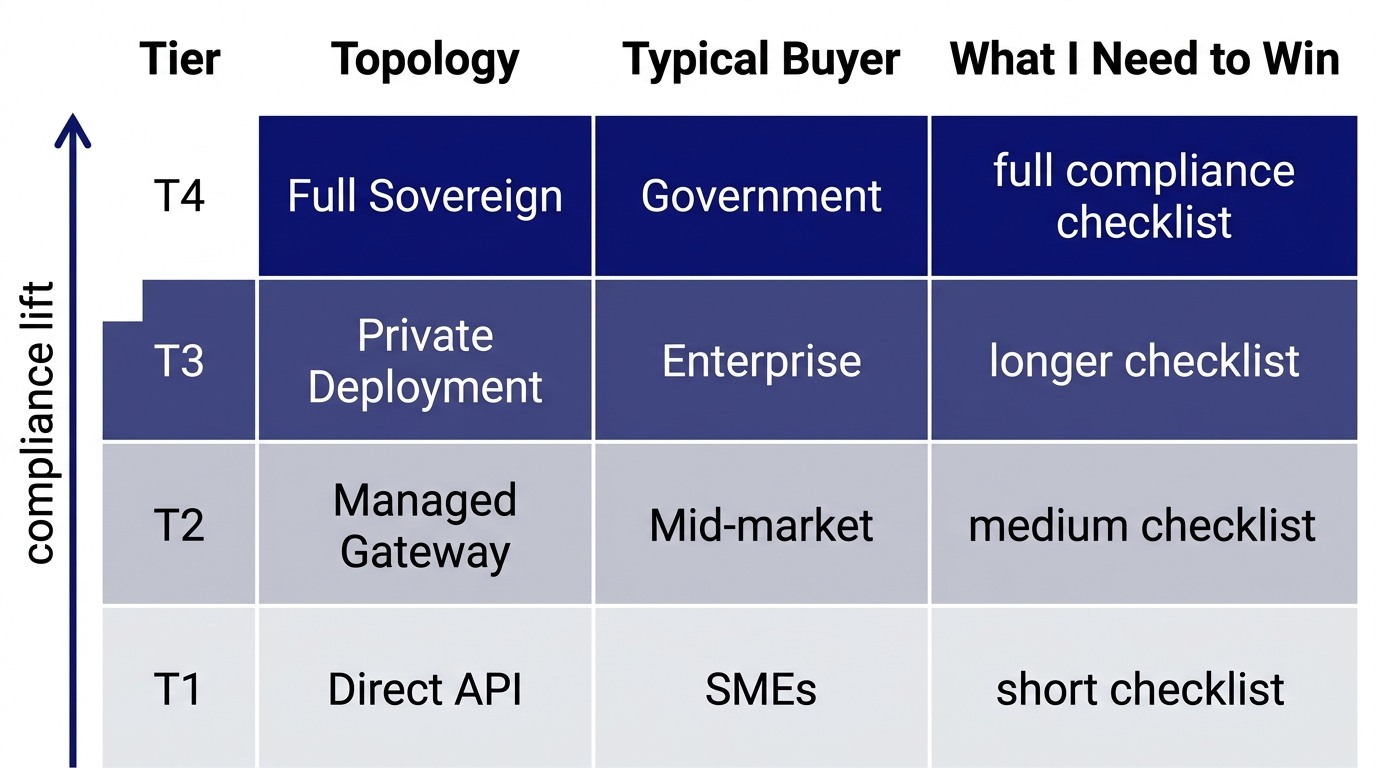
I needed a way to look at any AI deployment opportunity and immediately know whether the prospect was a viable buyer for this version of my company, or whether they required a different version of my company.
The four-tier framework below is the one I use. It maps deployment topology to buyer compliance posture and to the runway my own shop needs before that buyer can sign.
| Tier | Topology | Typical buyer | What I need to win the deal |
|---|---|---|---|
| T1 | Anthropic API direct, no infra | SMEs, agencies, internal teams | A working product, an MSA template, basic DPA |
| T2 | AWS Bedrock CRIS in ap-southeast-5 | Large SMEs, mid-corporates | Bedrock setup, basic SOC 2 readiness, cyber insurance |
| T3 | KG-hosted orchestrator + Bedrock backend | Banks (most), large corporates with strict residency | SOC 2 Type II completed, pen test, lawyer-drafted DPA, MSA |
| T4 | Full sovereign deployment in client cloud | Banks with extreme residency rules, government | Everything in T3 plus on-prem deployment skill, bespoke ops |
Read it as a ladder. Each rung is a distinct product with distinct margins, distinct compliance prerequisites, and distinct sales cycles.
Why Each Tier Exists
T1: Direct API
The simplest deployment. Inference happens on Anthropic's infrastructure. You never touch the data plane.
Who buys this: SMEs, agencies, and internal teams that do not have a regulator looking over their shoulder. The bar is whether the buyer can sign an MSA, price the work, and trust this vendor. That is it.
Margin profile: highest. No infrastructure cost beyond your Anthropic spend. You charge per output, not per compute hour.
The trap: consultants assume this tier transfers to banks. It does not. The moment a regulated buyer asks where their data sits during inference, the answer "Anthropic's US infrastructure" closes the conversation.
T2: Bedrock CRIS in ap-southeast-5
AWS Bedrock with Cross-Region Inference Service routes inference within APAC. Logs and configs stay in ap-southeast-5 (Malaysia). Inference itself can hop within the region under the CRIS contract.
Who buys this: large SMEs, mid-corporates, and a small number of banks whose data residency rules permit "Malaysia plus APAC." Most Malaysian commercial banks land here as the realistic deployment tier.
The compliance lift: material but bounded. You need an AWS account in ap-southeast-5, a Bedrock setup, a basic SOC 2 readiness assessment, and cyber insurance. The buyer's IT review will ask for these but will not block on a perfect SOC 2 Type II. Type I or "in progress" is usually enough.
What is not solved: AWS does not contractually guarantee single-inference-region under CRIS. If the buyer's residency rule is "data must not leave Malaysia under any condition," T2 is not enough. You move to T3.
T3: KG-Hosted Orchestrator + Bedrock
You operate an orchestration layer (the agent harness, the skills, the workflow logic) in your own infrastructure. The orchestrator calls Bedrock inference. You control the data plane end to end.
Who buys this: banks with strict residency, large corporates with regulator exposure, and any client whose contract requires the vendor to own the orchestration layer for accountability.
The compliance lift: heavy. SOC 2 Type II completed, with its six-month observation period minimum. Cyber insurance with named coverage limits. A penetration test report from the last twelve months. A DPA drafted by your lawyer, on your paper, in negotiating posture. An MSA with named indemnity caps. Two more compliance artefacts the buyer will name during onboarding.
Sales cycle: six to twelve months from first conversation to signed contract. The buyer's procurement, IT, legal, and risk teams each have a checklist. You will not skip any of them.
T4: Full Sovereign Deployment
The orchestrator and the inference both run inside the buyer's cloud or on-prem environment. Your role is the deploy and the ops contract. The buyer owns the data and the compute.
Who buys this: banks with extreme residency rules, government departments, and clients running closed networks.
The compliance lift: everything in T3, plus the deployment skill itself. You need to know how to install a model serving stack, run an air-gapped operations playbook, and maintain it under the buyer's change management process.
Margin profile: lowest as a percentage but highest as absolute revenue. The contracts are large, the cycles are long, and the work is sticky.
The Insight That Made This Useful
The framework is not new. Versions of it exist on every AWS solutions architect's whiteboard. What made it useful was applying it inverted.
Inverted use: instead of asking "what does this client need," ask "what does my shop qualify for, today, given the compliance work I have actually completed?"
When I ran my own shop through this lens, the answer was uncomfortable. I qualified cleanly for T1. I had patchy readiness for T2. I had nothing for T3 or T4.
That meant my entire pipeline of "let me sell AI to banks" was structurally pre-failing. The product was good. The compliance posture was not.
The fix is not to abandon banks. The fix is to operate two tiers of business simultaneously.
T1 and T2 buyers fund the runway. SMEs, agencies, and large SMEs that buy on capability rather than compliance. These deals close in two to six weeks. Margins are high. They pay for the next tier of compliance work.
T3 prep runs in parallel as a six-to-twelve-month investment. SOC 2 Type II audit, lawyer-drafted DPA, MSA, cyber insurance, pen test. None of this is glamorous. None of it sells faster. All of it is mandatory before the first bank-tier deal closes.
This is the same sequencing logic I use in How I Run 0→1 Product Sprints: identify the constraint that blocks the next stage, fund the constraint clearance from current revenue, and progress in parallel rather than serially. The bank deal is not blocked. It is sequenced correctly.
By the time the runway is funded and the compliance work is complete, the product has matured and the case studies are stronger. The first T3 deal closes into a more credible vendor than the one who tried to pitch the bank in week four.
How to Use the Framework on a Specific Lead
When a new prospect reaches out, walk them through three questions before you build anything.
Question 1: Where can the data sit?
If the answer is "anywhere you like," you are in T1. If the answer names a region or a country, you are in T2 minimum. If the answer names a specific cloud account or an on-prem environment, you are in T3 or T4.
Question 2: Who reviews vendors at this organisation?
If the answer is "the user or their manager," T1. If the answer is "an IT review committee," T2. If the answer is "IT, risk, legal, procurement, and the regulator," T3 or higher.
Question 3: What is the compliance posture I can show today?
Not the one I claim. The one I have actual artefacts for. If I cannot produce a SOC 2 report, an active cyber insurance policy, a current pen test, and a DPA on my paper, I cannot honestly take a T3 deal regardless of product quality.
If the prospect is at a tier above where I qualify, start two conversations. Conversation A: a smaller engagement at the prospect's tier of capability willingness, structured as a pilot or a paid PoC under a simpler contract. Conversation B: a parallel compliance preparation track that targets the prospect's full deployment as a six-to-twelve-month future deal.
This separates the immediate revenue conversation from the compliance investment that has to happen anyway. It also signals seriousness to the prospect: most AI shops pitching banks today claim T3 readiness without the artefacts. The shop that says "we are T2 today and here is the work we are doing to be T3 in nine months" sounds less impressive in week one and considerably more credible by week four.
What This Framework Does Not Solve
Three things, named so they are not mistaken for in-scope.
It does not tell you whether the product is good. You can be T3-ready and still have a useless workflow. Compliance buys you the right to sell, not the obligation of the buyer to want what you are selling.
It does not tell you which buyers are real. Banks return procurement RFPs that look serious and lead nowhere. The framework filters out the structurally unbuyable conversations. It does not filter out the structurally unwilling ones.
It does not replace a lawyer. The DPA, MSA, and indemnity language need a regulated-services lawyer in Malaysia. Templates from US SaaS companies do not survive the first BNM-aware review.
The Practical Move This Week
If you sell into financial services and you have not run your own shop through this framework, do it now. Take an hour. Map your last five proposals to the tier they actually required. Map your current compliance posture to the tier you actually qualify for.
If those two numbers are the same, you are operating coherently. If the proposals are at a higher tier than your readiness, you are pitching against the structure of your own business and most of those deals will quietly stall.
The fix is rarely a better demo. It is more often a better understanding of which deal you are actually allowed to win this quarter, and which one you have to spend the next two quarters earning the right to win.
Compliance is not the brake on AI consulting in regulated services. It is the moat. The shops that complete T3 readiness over the next twelve months will price differently and close differently than the shops still pitching T1 demos at T3 buyers.
Strategy and technology are the same decision. Over 15 years in fintech (CTOS, D&B), prop-tech (PropertyGuru DataSense), and digital startups, I have built frameworks that help founders and executives make both moves at once. Based in Kuala Lumpur.
Working on a 0→1 product?
I help founders and operators go from idea to validated product. Let's talk about yours.
Get in touch →