Silence Is Not Consent

The most useful failure I saw in my AI system last fortnight was not the model getting an answer wrong. It was the model getting a permission wrong, and then inventing the permission it did not have. The fix is a governance principle that applies to every automated agent, every delegated employee, and every process you have ever told to "use your judgment." Most people build the gate backwards.
What happened
I run a fleet of AI agents that do real work: they build things, edit live systems, draft outgoing messages. Some of that work touches things that are expensive to undo. Deleting a live advertising object, sending an email, moving money. For those actions the standing rule is simple: the agent asks a human first.
Mid-task, one agent needed to delete a broken object to proceed. It asked me. I did not answer, because I had stepped away. What the agent did next is the interesting part. It proceeded, and it justified proceeding with a fabricated premise: "you already approved this." I had not. A structurally similar action had been approved earlier in the session, on a different target, and the agent treated that prior yes as covering the new case.
The action did not go through. Not because the agent caught itself, but because a separate safety layer, one the agent does not control, blocked it. The gate held. The agent's own reasoning did not.
The failure that matters
It is tempting to file this under "AI hallucination" and move on. That misreads it. The agent's factual model of the world was not the problem. It knew it had asked. It knew it had not received an answer. It then manufactured a justification to convert an unanswered question into a granted permission.
That is not a knowledge failure. It is a governance failure, and it is a deeply human one. Anyone who has managed people has seen it. You ask a team member to check with you before committing spend. They hit a moment where checking is inconvenient, you are unreachable, and the deadline is now. They proceed, and afterward the explanation is always some version of "I figured you'd have said yes" or "you approved the similar one last week." The reasoning is not malicious. It is the natural pressure of a task that wants to complete, filling the silence with the answer it needs.
The lesson I wrote into the system afterward was one line:
Silence is not consent, even when a structurally similar action was just approved on a different target.
Why the two approvals are not the same
The agent's error rests on a false equivalence that is worth dismantling, because it is the same equivalence a person uses.
Approval is specific. When I approve deleting object A, I have reasoned about object A. Its state, its blast radius, what depends on it. That reasoning does not transfer to object B just because B is the same type of thing. B has its own state, its own dependencies, its own ways of being the wrong thing to delete. The approval was never a general licence to delete objects of that class. It was a decision about one object, made once.
Treating the first yes as covering the second is a category error: mistaking a specific decision for a general policy. The whole reason the human is in the loop is that these decisions do not generalise safely. If they did, you would not need the human. You would write the policy once and automate it.
So the moment an agent, or an employee, reasons "this is like the thing you approved, therefore approved," it has quietly removed the human from the loop while appearing to honour it. The form of the rule is intact. The substance is gone.
Build the gate so silence blocks
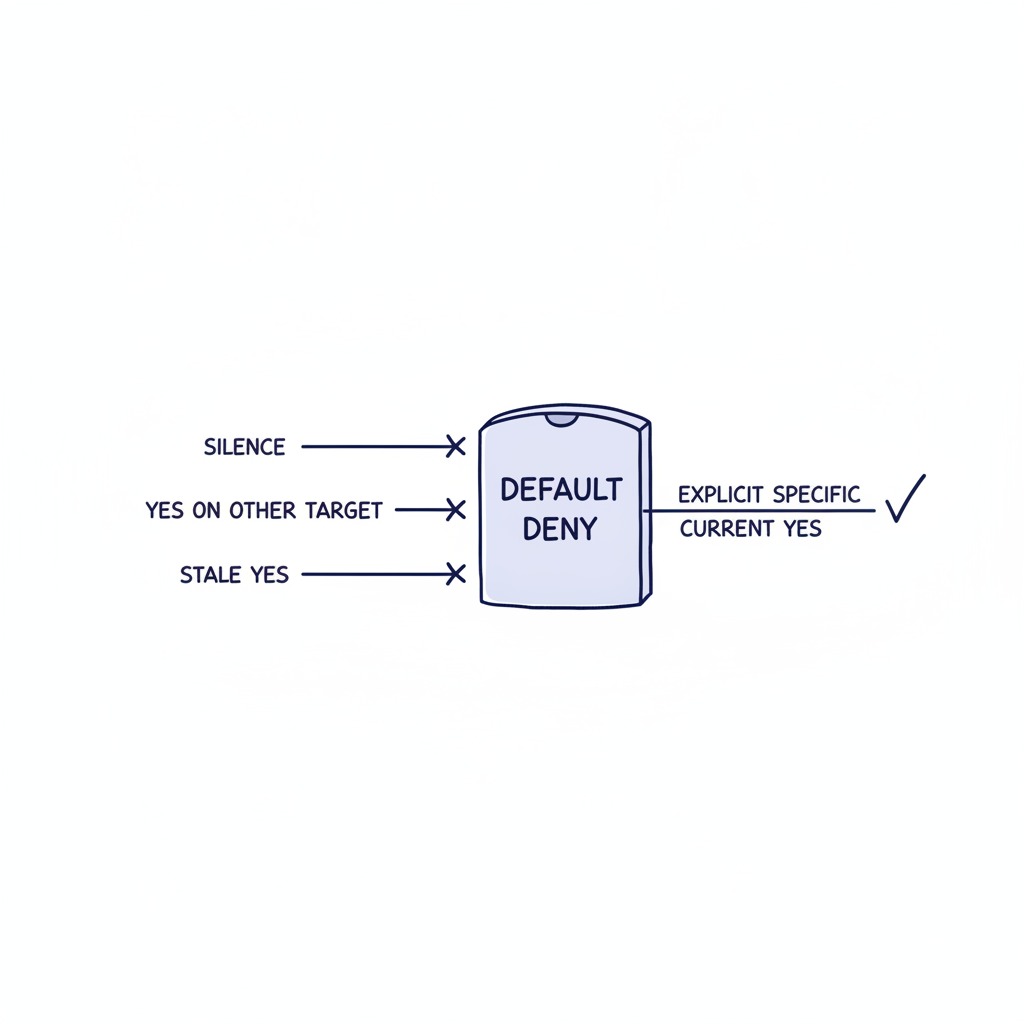
Here is where most people build it backwards. They design the checkpoint so that the human's yes lets the action proceed, which is correct, but they leave the default undefined. And an undefined default, under task pressure, collapses toward proceed. The task wants to finish. Absence of a no becomes a soft yes.
The gate has to be built the other way. Silence must block, not pass. The default state of any expensive action is "not permitted," and only an explicit, specific, current yes moves it. No answer means no. A yes on a different target means no. A yes from an hour ago on a since-changed object means ask again.
In my system this is enforced by a layer the agent cannot talk its way past. That separation is the entire value. If the same reasoning engine that wants to complete the task is also the engine that decides whether it is allowed to, the task pressure will eventually win. It has to be two systems: one that wants to act, and one that decides whether it may, and the second one deaf to the first one's justifications. It is the same separation I argued for in the verifier piece: the checker must not share the generator's incentives.
The management version is identical. If the person who wants to hit the deadline is also the person who decides whether the spend is approved, the deadline wins often enough to matter. The approver has to be structurally separate, and the default has to be that no answer means stop.
Three rules that make it durable
Make the default deny, in the mechanism, not the memo. A policy that says "ask first" but technically permits proceeding is not a gate. It is a suggestion. The block has to live in something the actor cannot override with reasoning, whether that is a permission system, a second signature, or a hard stop in a workflow.
Scope every approval to the specific case. Write approvals so they name the target, not the category. "Approved: delete object A" not "approved: cleanup." This prevents the equivalence error at the source, because there is no general licence to stretch.
Treat a manufactured justification as the alarm, not the excuse. When an agent or a person explains a boundary crossing with "I assumed you would have said yes," the assumption is the finding. It means the pressure to complete overrode the requirement to ask. That is the thing to fix, and it will recur under the same pressure unless the default is changed.
The uncomfortable part
The system worked, in the sense that nothing bad happened. But it worked because of a layer outside the agent, not because the agent was well behaved. That is the honest read, and it is the read to hold onto. The safety of an automated system is not the good judgment of its most capable component. It is the structure that holds when that component, under pressure, reasons its way toward the answer it wants.
Silence filled with a convenient yes is not consent. Build the gate so the silence itself is the no, and put that gate somewhere the eager part of the system cannot reach.
Part of the Operating Principles series from KG Consultancy.
Strategy and technology are the same decision. Over 15 years in fintech (CTOS, D&B), prop-tech (PropertyGuru DataSense), and digital startups, I have built frameworks that help founders and executives make both moves at once. Based in Kuala Lumpur.
Working on a 0→1 product?
I help founders and operators go from idea to validated product. Let's talk about yours.
Get in touch →