The 67/27 Problem: When Your AI System Becomes Its Own Overhead

A named tension in solo AI operations, and the redesign that resolved it.
The Finding
A pattern analysis of 488 tasks across a solo operator's AI-assisted workspace produced an uncomfortable number: 67% of Claude's daily capacity was going to infrastructure work. 27% to revenue-generating work.
Not 60/40. Not even 50/50. Two-thirds of the most capable AI model available was being used to maintain the system that was supposed to free up time for revenue.
This is the 67/27 problem. It emerges in any sufficiently sophisticated personal operating system, and most solo operators never see it because the infrastructure work feels productive. Knowledge graphs get updated. Session telemetry gets logged. Skills get refined. The system improves daily, and revenue stays flat.
How It Happens
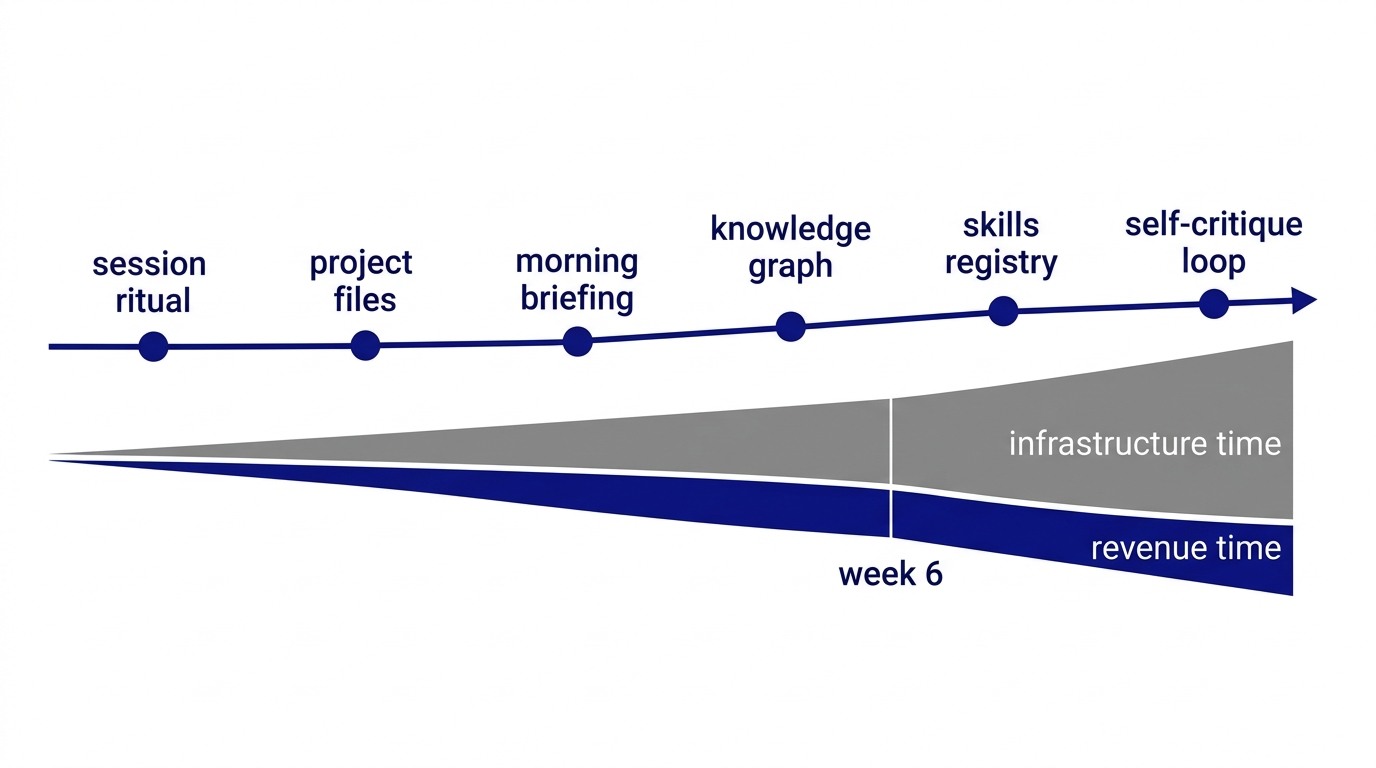
The pattern is predictable. A solo operator discovers AI-assisted work. She builds a session ritual to capture learning. Then a project file structure. Then a morning briefing. Then a knowledge graph. Then a skills registry. Then a self-critique loop. Then an experiment framework. Then a hypothesis-to-rule promotion pipeline.
Each layer adds genuine value. Each layer also adds maintenance overhead. The morning briefing needs a skill. The skill needs a SKILL.md. The SKILL.md needs version control. The version control needs a git commit convention. The convention needs documentation.
At some point, usually around week six of the system, the operator looks at a Monday and notices she spent three hours improving the system and 45 minutes on client work. She calls this a "light day." She is wrong. It is a structural problem.
The better your AI system gets, the more it demands of you. Infrastructure and revenue compete for the same daily budget.
Why This Is Specific to Solo Operators
In a company, infrastructure work is distributed. The DevOps team maintains the pipeline. IT administers the tools. Operations keeps the workspace tidy. The executive focuses on revenue.
The solo operator is all of these simultaneously. Every improvement to the operating system is a choice against client work. Every hour spent refining a skill is an hour not spent on a proposal, a call, a follow-up.
This is not a productivity problem. It is a structural constraint: a fixed daily budget (four hours in this case) being allocated across competing demands, with no one enforcing the split.
AI makes this worse before it makes it better. The initial efficiency gains from AI assistance create capacity. That capacity gets immediately reinvested into building more infrastructure. The operator never accumulates the slack she was promised.
The Revenue-First Redesign
The fix is not to stop building infrastructure. It is to make revenue the weighted priority in every daily planning decision.
The redesign had four components:
1. Revenue-weighted task sequencing. The daily facilitator now scores tasks by type. Revenue-generating tasks (proposals, calls, follow-ups, deliverables for paying clients) score 2x. Infrastructure tasks score 1x. When time is limited, revenue tasks surface first. Always.
2. Infrastructure deferred to Fridays. Any infrastructure item that does not have a hard deadline goes into the Friday queue. Skill refinements, system improvements, experiment designs. All of it waits. The Monday-through-Thursday budget is protected for client work.
3. The boundary check. A Python script runs at session start every day. It reads cumulative session time from the week's telemetry and displays a status: within_budget, warning (above 180 min of 240 min), or exceeded. When the boundary is at warning, the morning briefing surfaces only HOT revenue tasks.
4. Delegation visibility. The facilitator now tracks delegated tasks with escalation timers. If a delegated item has been outstanding for more than 48 hours (HOT) or 14 days (WARM), it surfaces in the briefing. This prevents the common failure mode: tasks leave the desk and disappear.
The Results
The first morning briefing under the new system ran in April 2026. The briefing format changed from a task dump to a revenue-first cascade: critical client follow-ups first, then HOT deliverables, then delegated task escalations, then infrastructure at the bottom.
The structural change is not in the task list. It is in the sequencing signal. The system now tells the operator what matters before she has to decide.
Estimated capacity returned to revenue work: approximately 60 minutes per day. That is 25% more time on the work that pays.
The Generalizable Principle
Any personal operating system that is not revenue-weighted will drift toward infrastructure work. This is not a willpower failure. It is a default state: infrastructure is always urgent (something broke, something is stale, something needs improving), while revenue work is often important but not immediately pressing.
The fix is not discipline. It is architecture. The sequencing of daily tasks must be governed by a rule that has teeth, not a value statement that gets overridden when the knowledge graph needs repair.
Three questions to diagnose your own 67/27 problem:
- Of the last five AI sessions you ran, how many produced something a client could see?
- How many produced something only you can see?
- If you could only work four hours today, which tasks would you eliminate?
If the answers make you uncomfortable, the ratio is off.
The Deeper Tension
There is a version of this problem that has no solution: some infrastructure work is genuinely load-bearing. Without a working morning briefing, the operator loses daily orientation. Without knowledge graph updates, institutional memory degrades. Without skill refinements, quality drops.
The resolution is not to eliminate infrastructure. It is to be deliberate about which infrastructure is revenue-adjacent (it directly enables client delivery) and which is system-perfection (it makes the system more elegant but does not improve output).
Revenue-adjacent infrastructure: always. System-perfection: Fridays only.
The 67% was not all waste, but enough of it was.
For a connected view of how token spending fits this same capital-vs-operating distinction, see Token Economics for Solopreneurs: Build Once With Tokens, Run Forever.
Based on a pattern analysis of 488 tasks across a solo operator's Claude Code workspace, week of 7–10 April 2026. The workspace is a live production system, not a research prototype.
Strategy and technology are the same decision. Over 15 years in fintech (CTOS, D&B), prop-tech (PropertyGuru DataSense), and digital startups, I have built frameworks that help founders and executives make both moves at once. Based in Kuala Lumpur.
Working on a 0→1 product?
I help founders and operators go from idea to validated product. Let's talk about yours.
Get in touch →