Delegation Without a Team: The 3-Tier Classification System

433 tasks, one solo operator, nine subagents, one classification system that exposed the real bottleneck.
The Problem With Solo Delegation
Delegation assumes you have someone to delegate to. Most productivity advice on delegation is written for managers with direct reports. The solopreneur reads it, nods, and then has no one to hand anything to.
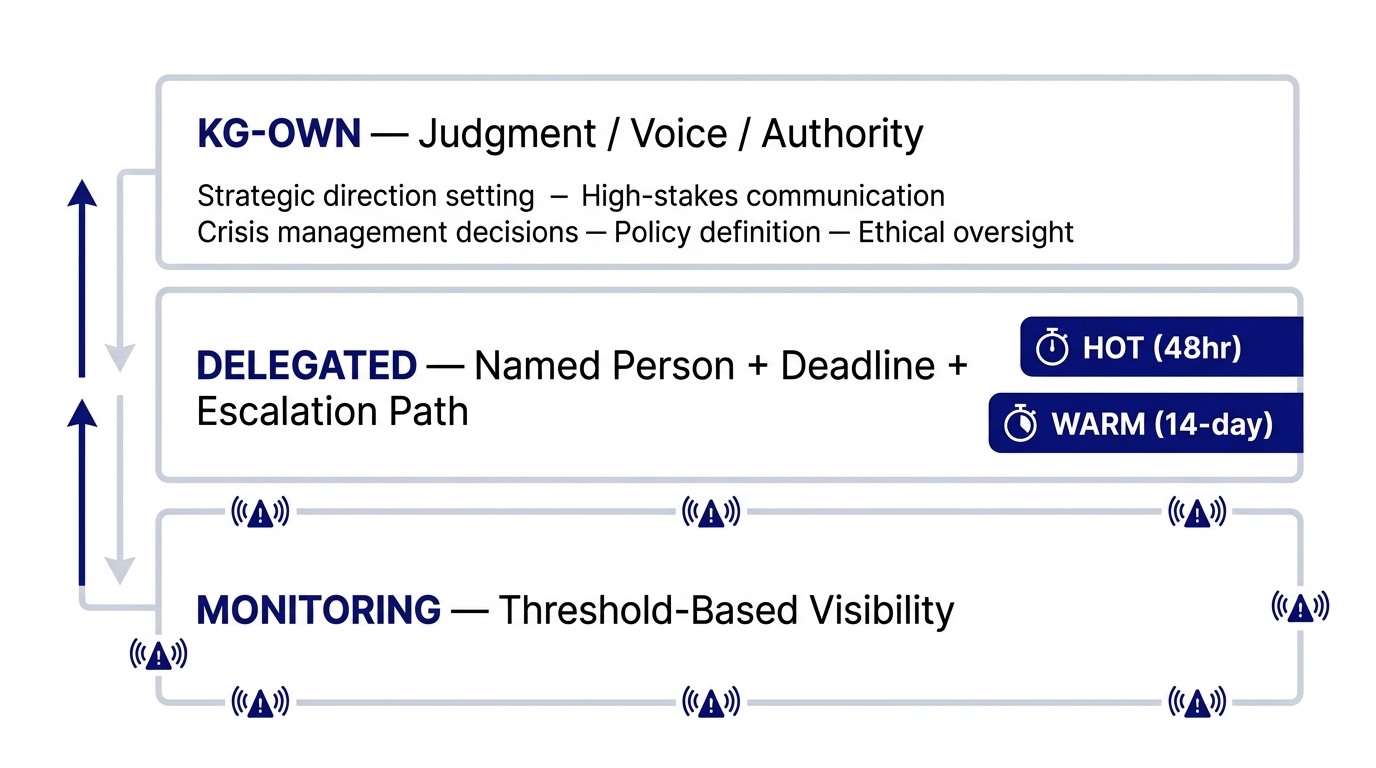
But this framing is wrong. A solo operator with an AI assistant and a network of contractors, partners, and clients does have people to delegate to. The problem is not the absence of delegation targets. It is the absence of a system to classify what can be delegated and track what has been.
When everything lives in your head as "things I need to do," nothing gets delegated effectively. You either hand off too little (doing everything yourself) or too much (handing off things that require your judgment, then spending time managing the handoff).
The 3-tier classification system is a structural solution to this problem.
The Three Tiers
Tier 1: KG-OWN
Tasks that require your judgment, voice, or authority. No one else can or should do these. Examples: strategic decisions, client relationship management, final approval on deliverables, fee negotiations. If the work requires your name and reputation, it is KG-OWN.
Tier 2: DELEGATED
Tasks that have been handed to a specific person or agent, with a clear deliverable, deadline, and escalation path. The task leaves your desk. You track its status. You escalate if it stalls. Examples: a PRD review delegated to a product manager, a data query delegated to the AI assistant, a document preparation delegated to a junior team member.
Tier 3: MONITORING
Tasks that are someone else's primary responsibility, where you need periodic visibility. You are not doing the work and you are not actively tracking a handoff. You are watching for signals that require your intervention. Examples: a bank onboarding process managed by your team, a regulatory submission being handled by your tax agent, a client project where your role is advisory.
The key distinction between DELEGATED and MONITORING is ownership: DELEGATED means you are responsible for the outcome; MONITORING means someone else is.
The Classification Exercise
The exercise that produced this system: scan 433 tasks across a full workspace and classify each one.
Nine subagents worked in parallel. The classification criteria were explicit:
- Does this task require your judgment or voice? KG-OWN
- Has this task been handed to a named person with a deadline? DELEGATED
- Is this a task where you watch for escalation signals? MONITORING
- Does this task belong to an agent (Claude, a scheduled task)? Separate queue
The result: 186 priority tasks reduced to 36 active items. An 80% reduction in the daily briefing surface area.
This is not the same as completing 150 tasks. It is recognising that 150 tasks were either already delegated and being tracked elsewhere, or were monitoring items that only need attention if something goes wrong.
The insight: Most tasks in a solo operator's backlog are not actionable today. They are either delegated (and being monitored) or monitoring (and fine). The briefing should only surface the subset that requires active attention.
What the Classification Revealed
Two structural problems became visible after classification.
Problem 1: Delegation without tracking. Several tasks had been handed off but were not formally in DELEGATED tier. They existed as "I told someone to do this" in the operator's memory. No deadline. No escalation criteria. No check-in cadence. These tasks were neither completed nor escalated. They were simply invisible.
The fix: every DELEGATED task gets a specific person, a specific deadline, and an explicit escalation trigger ("if I haven't heard by Thursday, I message Aiman directly").
Problem 2: KG-OWN overload. An outsized proportion of tasks were classified KG-OWN not because they genuinely required the operator's judgment, but because no one else had been briefed to handle them. The operator had not built enough context around team members to trust delegation.
The fix: invest in briefing documents that transfer context. A 30-minute briefing document enables confident delegation of work that otherwise stays stuck on the operator's desk.
The Escalation Architecture
A DELEGATED task without an escalation mechanism is a task that disappears.
The system introduced three escalation timers.
HOT escalation (48 hours): If a delegated HOT task has not been confirmed received or returned with a question within 48 hours, it surfaces in the next morning briefing with an escalation flag.
WARM escalation (14 days): WARM delegated tasks get a 14-day check-in trigger. The morning briefing flags them: "Task X was delegated to Y on [date]. No update in 14 days. Consider following up."
MONITORING escalation (threshold-based): Monitoring tasks only surface when a threshold is breached: a deadline approaching, a status change, or an external event that changes the risk profile.
This is not a complex system. It is three timers, but without them, delegated work silently falls through the cracks. The operator assumes it is being handled. The delegate assumes it is no longer urgent. The client waits.
The Briefing Document as Delegation Infrastructure
The most expensive part of delegation is context transfer. The operator has months of project history, relationship context, and implicit assumptions in her head. The delegate has none of it.
Without a briefing document, every delegation requires a live conversation. At minimum 30 minutes, often more. This is not scalable.
A strong delegation brief covers:
- Role scope and decision authority
- Projects the delegate owns vs. advises on
- Escalation criteria (what to bring back vs. handle independently)
- Key stakeholder relationships
- Open items requiring immediate attention
This document takes 30 minutes to produce. It enables the delegate to operate for weeks without needing to interrupt the operator for orientation questions.
The investment-to-return ratio on briefing documents is extremely high. The constraint is the discipline to write them before delegation, not after.
The Person-Centric View
The conventional task management view is project-centric: here are the PEPS Ventures tasks, here are the KG Consultancy tasks, here are the research tasks.
The operator's actual mental model is person-centric: what does YT need from me today? What is Aiman waiting on? What has Munir confirmed he will handle?
Restructuring the daily briefing to group tasks by person rather than project surfaces a different kind of question: "Is YT blocked because I haven't reviewed the PRD?" versus "The PRD review is in the PEPS backlog." The first question produces action. The second produces a list.
Person-centric grouping also makes delegation gaps visible. If a team member's section of the briefing is empty, no pending items, no open approvals, one of two things is true: they are operating fully independently (good), or they have no active scope (a resourcing problem that needs attention).
What This Changes
The 3-tier system does not reduce the number of things that need to happen. It changes the operator's relationship to them.
KG-OWN items are finite and explicit. The operator owns them completely and knows it.
DELEGATED items are tracked with timers. The operator monitors them but does not do the work.
MONITORING items are visible only when they need attention. The operator trusts the team or process unless a signal arrives.
The result: a daily briefing surface area that reflects genuine work, not the accumulated weight of everything that has ever been put on the list.
At 7+ active client engagements managed solo, this is not a nice-to-have. It is the structural difference between a manageable day and a day spent reacting to whichever task shouts loudest.
The 3-tier system pairs naturally with The Self-Sustaining Handoff, which covers how to build the briefing infrastructure so delegation holds past the first week. For the 0→1 context where you are often the only person who understands the full scope, How I Run 0→1 Product Sprints shows how to structure sprint cadence so that the KG-OWN list stays narrow even when the build is fast.
Based on a 9-subagent facilitator sprint, 9 April 2026. 433 tasks classified across KG Consultancy and PEPS Ventures workspaces.
Strategy and technology are the same decision. Over 15 years in fintech (CTOS, D&B), prop-tech (PropertyGuru DataSense), and digital startups, I have built frameworks that help founders and executives make both moves at once. Based in Kuala Lumpur.
Working on a 0→1 product?
I help founders and operators go from idea to validated product. Let's talk about yours.
Get in touch →