Brief Before Build: The Hidden Cost of Produce-Then-Constrain

The constraint was in Section 6 of the document. It had been there the whole time.
I discovered it 35,000 tokens into writing a full proposal document: the procurement portal required each product in a bundle to be listed as a separate line item. This is not an unusual requirement for government procurement. It was explicitly documented in the RFx brief. I had read the brief. I had not extracted that particular constraint before building.
The result: a comprehensive, well-formatted proposal document that needed to be partially rebuilt before it could be submitted. About 25,000 tokens of work discarded. Roughly 30 minutes of rework for the client. A second iteration that should have been the first.
This is the produce-then-constrain failure mode. It is common, recoverable, and entirely preventable with one operational change.
Two Flows, One Decision
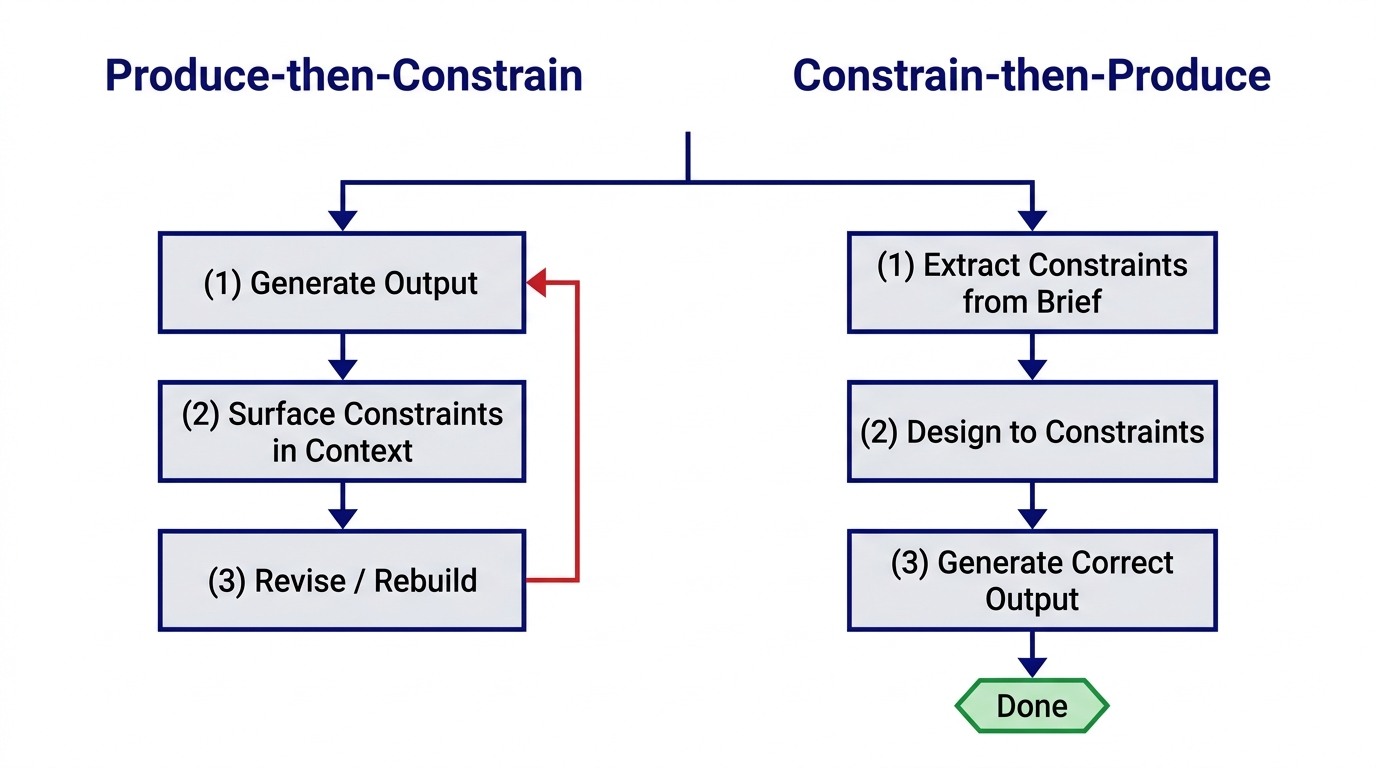
Every document generation task has an implicit decision point at the start, and most people make it unconsciously.
Produce-then-constrain: Generate output first, surface constraints as they become visible in context, revise accordingly.
Constrain-then-produce: Extract constraints before generation, design to those constraints, produce output that meets them from the first draft.
The first flow feels faster. You see output quickly, which creates momentum and often surfaces latent constraints faster than asking questions would. The second flow feels slower. There is a structured pause before anything visible is produced.
Most AI-assisted workers default to the first flow because the feedback loop is immediate and the apparent productivity is high.
Named Tension: Speed vs. Completeness. Fast drafts feel productive because they produce visible output quickly. Gathering constraints first feels unproductive because the output is delayed, but visible output and correct output are different things. The cost of the difference accumulates silently until the revision arrives.
The question is not which flow is always correct. It is knowing which constraints, if missed at the outset, will require structural rework versus cosmetic revision.
The Anatomy of the Rework
In the procurement proposal case, the constraint structure was:
The missed constraint: The submission portal required separate line items for sales and rental data, each with an individual price, even though the product was sold as a bundle.
The consequence: The fee schedule section was written around a single bundled price. This required a complete structural rewrite, not a cosmetic edit. The resolution, attributing the full price to the primary product line and zero to the secondary, with an explanatory note about bundle pricing, was creative, but it required rebuilding the logic of the entire pricing section.
The recoverable waste: Approximately 25,000 tokens of fee schedule, product description, and associated framing were revised or discarded. The generation script was not wrong. It built exactly what it was asked to build. The ask was underpowered.
A brief-before-build approach would have changed the opening sequence: read the RFx, extract the top three structural constraints (portal format requirements, bundle pricing logic, reference to existing agreement terms), then build the document around those constraints from the first draft.
The brief-before-build document would have had the correct fee schedule from the start. The script would have been written once, correctly.
When Fast Draft Wins
The produce-then-constrain flow is not always wrong. There are contexts where it is genuinely superior.
Exploratory or conceptual work: When the deliverable is a first draft intended to surface the client's latent thinking, producing quickly and iterating is correct. The draft is a stimulus for a conversation, not a final document. Getting something in front of the client fast is more valuable than spending time gathering constraints the client has not yet articulated.
Short deadline, high iteration tolerance: When a proposal has a three-day deadline and the client is available for rapid iteration, moving fast and correcting is often net-positive. The structural rework from one missed constraint costs less than the opportunity cost of a longer pre-brief process.
Low-stakes outputs: When the deliverable is a short internal note, a task description, or a reference document that no external stakeholder will see, the fast draft is almost always correct. The cost of structural rework is low.
For a RM10,000 government procurement proposal with a submission deadline and a review by a client success manager before submission, none of those conditions applied.
When Brief-Before-Build Wins
The brief-before-build approach earns its overhead when three conditions are present.
The deliverable is client-facing and high-stakes. A proposal, a valuation report, an advisory document, a board presentation. The cost of a missed structural constraint scales with the stakes and the audience.
The brief contains explicit structural constraints. RFx documents, tender guidelines, regulatory reporting templates, board paper formats. These documents tell you exactly how the output must be structured. Reading them carefully before building is not overhead. It is the work.
Structural revision is expensive. If getting the structure wrong requires rebuilding sections rather than rewriting sentences, the brief-before-build investment pays for itself in avoided rework. A section restructure costs more than rephrasing a paragraph.
The practical heuristic: before generating any client-facing document longer than five pages, extract three to five structural constraints from the brief and state them explicitly before the first tool call.
For the procurement proposal, those constraints would have been: (1) the portal requires separate line items per product, (2) the bundle cannot be separated, so pricing logic must reflect a primary line and a secondary line at RM0.00, (3) reference to the existing subscription agreement must anchor the bundle justification. Three sentences. Thirty seconds of extraction. 25,000 tokens of structural rework avoided.
The Reusable Pattern
The RM0.00 line item framing that resolved the constraint is worth keeping.
When a product is sold as a bundle but a procurement system forces line-item separation, the cleanest resolution: attribute the full price to one line and zero to the other, with an explanatory note referencing the bundled agreement. This is defensible, auditable, and consistent with how government procurement portals typically handle exception cases.
This pattern will recur. Any bundled SaaS product submitted through a government or GLC procurement portal will face the same structure. The portal requirement is not unique; variants of it exist across GLCs, government-linked entities, and regulated procurement environments throughout Malaysia.
Documenting this pattern in a proposal skill or template prevents the next operator from re-deriving it from scratch.
Observation: The cost of not documenting reusable patterns is not just the time spent re-deriving them. It is the risk that the next person derives a different, less defensible resolution under deadline pressure. Documented patterns are quality floors. Undocumented ones become rediscovery costs.
The Diagnostic Questions
Before generating any structured deliverable, run through these four questions.
What format does this deliverable need to conform to? If the answer is a submission portal, a regulatory template, or a client-specified structure, read the format specification before writing a single line.
What are the structural constraints that, if missed, require section-level rework? Not sentence-level constraints (those are easy to fix during revision). Section-level constraints: pricing logic, required section ordering, mandatory appendices, specific field names, approval workflows.
Does an existing template or skill exist for this deliverable type? Before building from scratch, check whether a prior engagement produced a reusable structure. A procurement proposal that was done once should never be fully rebuilt the second time.
What is the cost of getting the structure wrong? For a five-minute internal note: near zero. For a RM200,000 tender: high. Scale your pre-brief investment proportionally.
A Note on AI-Assisted Work
This failure mode is not unique to AI-assisted document generation. Consultants, analysts, and writers have been producing-then-constraining since long before these tools existed.
What AI changes is the speed of the first draft. A document that previously took three hours to produce now takes 20 minutes. This accelerates the produce-then-constrain cycle without changing its structural failure mode. The rework still costs what the rework costs. The section rebuilds, the structural rewrites, the alignment reviews all run at the same human-time rates as before.
The brief-before-build discipline matters more in an AI-assisted workflow, not less. The faster the first draft, the more tempting it is to skip the constraint-extraction step. The faster the first draft, the more structural rework accumulates before the deadline.
Speed is not the goal. Correct output at the end of the first iteration is the goal. Brief-before-build is what makes that possible.
This is the same principle behind Brief-then-Fire: the quality of the brief determines the quality of the output, regardless of how capable the tool is, and for solo operators managing multiple client deliverables simultaneously, The Self-Sustaining Handoff shows how to build the briefing infrastructure that makes every handoff the last conversation you need to have.
This piece draws on analysis of a procurement proposal session, April 2026. Numbers reflect actual session telemetry and retrospective diagnostics. Client and procurement body details anonymised.
Strategy and technology are the same decision. Over 15 years in fintech (CTOS, D&B), prop-tech (PropertyGuru DataSense), and digital startups, I have built frameworks that help founders and executives make both moves at once. Based in Kuala Lumpur.
Working on a 0→1 product?
I help founders and operators go from idea to validated product. Let's talk about yours.
Get in touch →