The Intent Gap: What Nielsen's AI UX Framework Gets Right and Misses for Regulated Software

Jakob Nielsen's March 2026 analysis of intent-based UX is the most important thing written about AI product design this year. It is also incomplete in a way that matters to anyone building AI tools for licensed professionals.
Nielsen's argument: AI systems have ended the command-based interaction era. In the old model, users and computers alternated turns. Click, respond, decide what to click next. In the new model, users specify a goal and the AI figures out the steps. The user moves from operator to supervisor. The entire vocabulary of UX, discoverability, error prevention, task completion rate, must be rebuilt from scratch.
This is correct. The implication Nielsen draws is also correct: most AI interfaces today are still command-based systems with a text box grafted on. They ask users to specify how, not what. This creates an interaction contract that is already obsolete.
Where the framework needs extension is in the regulatory dimension. Nielsen's model assumes a user who is free to delegate any goal to the AI system. In regulated markets, the user is not free. The licensed professional is accountable for every output the AI produces, regardless of whether they issued the command or simply reviewed the result.
This changes the design problem in ways that require a different vocabulary.
What Nielsen Gets Right
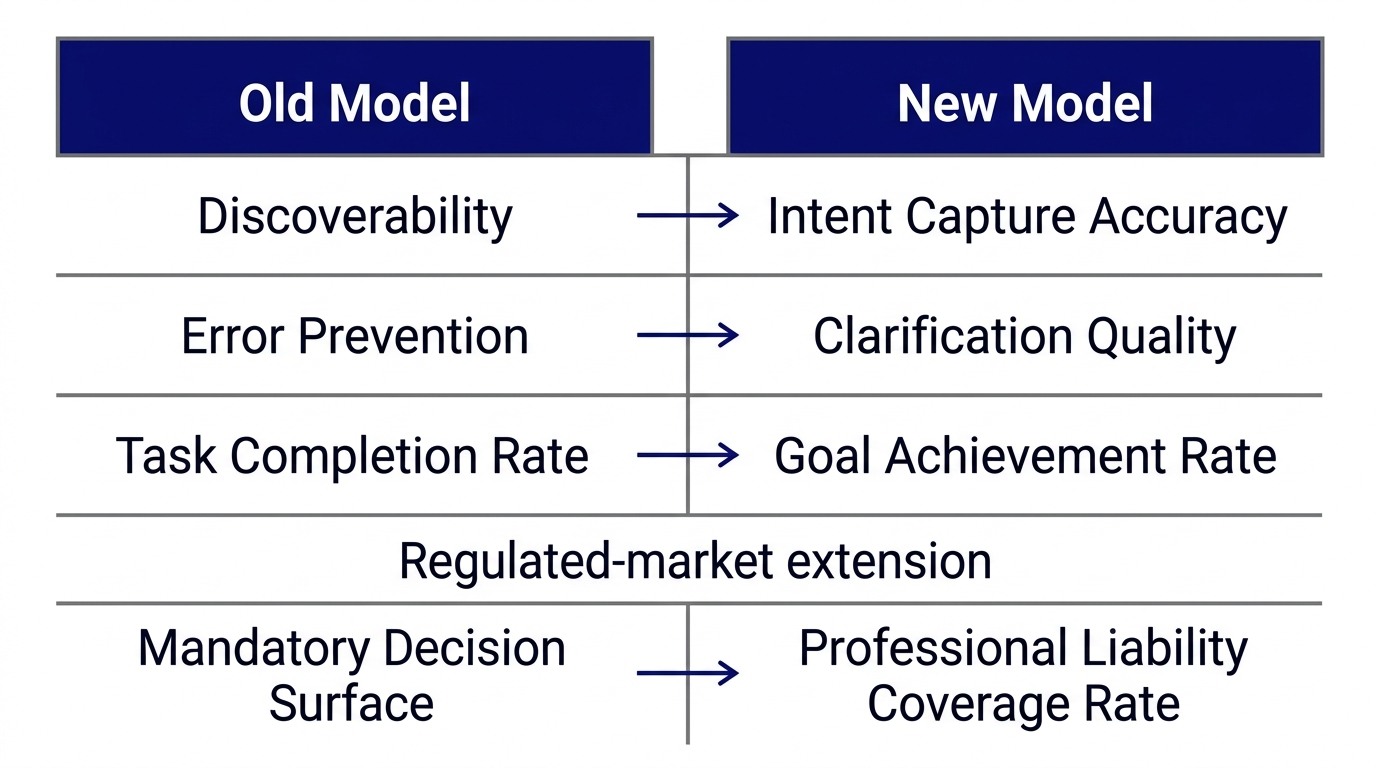
The three metrics Nielsen replaces are the right three to replace.
Discoverability becomes intent capture accuracy. Traditional UX measures whether users can find features. In intent-based systems, the feature list is irrelevant. What matters is whether the AI correctly interprets the user's goal. A system that understands "prepare the valuation for Jalan Ampang Unit 14B" better than it understands "draft report for Client Ref 2024-089" has higher intent capture accuracy for the same users, even if the underlying task is identical.
Error prevention becomes clarification quality. Traditional UX prevents errors by constraining user input: required fields, dropdown menus, validation rules. In intent-based systems, errors surface when the AI misunderstands intent and completes the wrong task. Clarification quality is the metric that matters. Does the system surface ambiguity before it executes, or does it execute and force costly correction? For a 15-page valuation report, the difference is enormous.
Task completion rate becomes goal achievement rate. Completing tasks was measurable in command-based systems because tasks were discrete. Intent-based systems execute compound goals: "prepare the report AND check comparable transactions AND flag any unusual market movements." These don't have natural task boundaries. Goal achievement rate is the right metric because it measures the end state, not the intermediate steps.
Nielsen's substitution is correct at the metric level. The design implications are also largely correct: AI systems should surface uncertainty before acting, request permission before irreversible steps, and maintain a legible audit trail of what they did and why.
This last point is where the regulated-market case gets interesting.
What Changes When the User Has a Professional Licence
A Registered Valuer in Malaysia operates under Act 118 of 1981. Under that Act, the professional valuation report carries the valuer's professional signature and their LPPEH registration number. If the valuation is disputed, in court, in a bank's credit committee, in an insurance claim, the valuer's signature is the accountability anchor.
This creates what I call the intent gap in AI-assisted professional work.
The intent gap is the distance between the goal the user delegates to the AI and the specific professional judgment the user is still required to exercise. In consumer software, this gap can close entirely. The AI navigates, books, purchases, and reports back. The user's preference is the only constraint.
In regulated professional software, the gap cannot close below a floor set by the licensing framework. The licensed professional must exercise specific judgment at specific decision points. An AI that automates across that floor does not save the professional time. It exposes them to liability they cannot discharge.
The design implication: An AI tool for licensed professionals is not optimised by minimising user input. It is optimised by minimising irrelevant user input while preserving, and surfacing, the decision points where professional judgment is mandatory.
This is a different product. Not a harder product, but a different one.
Three Design Patterns for Regulated Intent-Based UX
Pattern 1: The Derivation Chain
Every calculated output must display how it was derived, not just what the value is. This is not about transparency for its own sake. It gives the licensed professional the information they need to exercise professional judgment on the output before they sign it.
In a valuation tool, every market adjustment to a direct comparison carries a citation to the comparable transaction and the adjustment formula. The valuer can agree, override, or query each component. The AI produces the framework. The professional exercises judgment on its application.
This is significantly more complex UX than a system that shows an output and asks for approval. It requires surfacing reasoning at the right level of granularity: detailed enough to be reviewable, not so granular that the professional drowns in derivation.
Pattern 2: The Consent Architecture
Regulated transactions require explicit consent at defined points. In a property transaction, the Housing Development Act mandates specific disclosures before a developer can receive purchase consideration. A payment platform built for this market cannot treat consent as a generic "I agree" checkbox. The consent architecture is load-bearing.
The UX challenge: consent flows interrupt the goal-completion pattern that Nielsen's framework optimises for. From a pure UX standpoint, these interruptions reduce goal achievement rate. From a regulatory standpoint, they are mandatory. The design job is to make mandatory consent flows feel like part of the transaction rather than friction grafted onto it.
This requires designing consent as contextually embedded: appearing at the logical moment in the transaction flow, with the specific disclosure text the law requires, presented clearly enough that the party actually reads it.
Pattern 3: The Professional Handover
Intent-based systems fail in regulated contexts when they try to close the intent gap by completing the professional's task instead of supporting it. The right design pattern is a structured handover: the AI completes everything it is authorised to complete, then surfaces a structured dossier that enables the professional to complete their portion efficiently.
The dossier contains: the AI's work product, the specific decision points requiring professional judgment, the information needed to make each decision, and the signature mechanism that attaches the professional's accountability to the final output.
This is not how consumer AI assistants work. It is exactly how professional AI tools must work.
The Metric That Actually Matters
Nielsen's framework replaces task completion rate with goal achievement rate. For regulated software, there is a more appropriate metric: professional liability coverage rate.
The question is not whether the AI completed the user's goal. The question is whether the professional who signed the output can, in the event of a dispute, demonstrate that they exercised the judgment the regulatory framework requires.
A goal achievement rate of 95% is excellent consumer product performance. A professional liability coverage rate of 95% is a disaster. It means 5% of outputs were signed without the required professional judgment, which is not a UX failure. It is a LPPEH disciplinary matter.
This reframes the design problem. The goal is not to minimise user input. The goal is to minimise the cost of the professional input that cannot be eliminated, while eliminating everything else.
Building on Nielsen
Nielsen's framework is the right foundation. Intent capture, clarification quality, and goal achievement rate are the right abstractions for AI-era product design.
The extension required for regulated markets is a fourth concept: the mandatory decision surface. The AI must not only execute goals. It must correctly identify the points in execution where professional judgment is mandatory, surface those points at the right moment, present them with the right information, and record that the professional exercised their judgment before the output was finalised.
This is not a compromise of the intent-based model. It is the intent-based model applied correctly to a context where the regulatory framework is itself part of the system specification.
The regulated professional's intent is not just "produce the valuation." It is "produce the valuation in a way that I can defend under professional scrutiny." An AI that ignores the second clause of that intent is not executing the user's goal. It is executing a simplified version of it that will eventually produce a regulatory consequence the user did not intend.
Good AI product design for regulated industries reads the full intent, not the simplified one. That's the same design discipline I apply in 0→1 product sprints: the system specification includes the constraints, not just the happy path.
For teams navigating scope under regulatory pressure, the Scope Compression and 0→1 framework covers how to sequence what gets built first when every feature carries compliance risk.
KG is ACMA, CGMA and General Manager of PEPS Ventures Berhad. He builds AI-assisted tools for the Malaysian property valuation and transaction market.
Strategy and technology are the same decision. Over 15 years in fintech (CTOS, D&B), prop-tech (PropertyGuru DataSense), and digital startups, I have built frameworks that help founders and executives make both moves at once. Based in Kuala Lumpur.
Working on a 0→1 product?
I help founders and operators go from idea to validated product. Let's talk about yours.
Get in touch →