Phase-Gated Pipelines: Why the Best AI Tools Separate Inspection from Construction

The Temptation
There is a particular seduction in asking a large language model to do everything at once.
Show it a webpage. Ask it to clone the design and write the code. Wait 60 seconds. Collect the output. Ship it. This is the dream of single-pass generation: speed without ceremony, result without process.
The dream fails reliably.
What emerges from single-pass generation is often a reasonable approximation. A design that looks right at first glance. Code that runs but carries hidden brittleness. The agent had to hold the entire problem in working memory: observe the layout, infer the design tokens, reason about component boundaries, write the CSS, write the JavaScript, test the logic. All in one forward pass.
When something breaks, a layout shift on mobile, a color that drifts slightly from the original, a component that fails to cascade correctly, the agent has no audit trail. No explicit handoff point where a human could have caught the error. No intermediate spec against which to verify. The agent looked at the screenshot and guessed. The guess was close. Close is not enough.
The best AI tools do not work this way. They work in phases. Each phase has explicit inputs and outputs. Each phase is inspected before the next phase begins. The inspection is not a luxury. It is the architecture.
The Coordination Problem
Why does staged verification matter more as systems grow in complexity?
Consider a multi-agent AI system tasked with a nontrivial job. Three agents, each building a component. Agent A writes the header. Agent B writes the sidebar. Agent C writes the form. They work in parallel to save time. Each agent receives the same screenshot of the original design.
Agent A, without a spec, infers that the header uses a 12px sans-serif font. Agent B, looking at the same screenshot, infers 11px. Agent C infers 12px but assumes a different line-height. When the three components assemble, they jar against each other. The header font does not match the subheader in the sidebar. The form inputs feel misaligned.
This is the coordination problem. Without explicit intermediate representations, specs that all agents reference, multi-agent systems create friction where there should be consistency.
The naive fix is to serialize: run agent A, wait for approval, run agent B. This forces correctness but eliminates parallelism. Work takes longer.
The staged-verification approach is different. It says: extract the truth once. Represent it explicitly. Give that representation to all agents. Let them work in parallel.
A single inspection agent looks at the original design and extracts the facts. Font sizes. Color values. Spacing rules. Responsive breakpoints. Interaction patterns. It writes these facts into a specification document. This spec becomes the single source of truth.
Now three builder agents work in parallel, each armed with the same authoritative spec. Agent A cannot infer. It reads. Agent B reads the same values. Agent C implements what is written. When the components assemble, they do so against shared ground truth, not competing approximations.
The spec is also human-readable. A human can skim it before the builders start. If the extracted values are wrong, the human catches the error at the spec level, before expensive building work begins. If the spec is correct, the builders' work is mostly mechanical transcription. Coordination becomes trivial.
The Five-Phase Pipeline
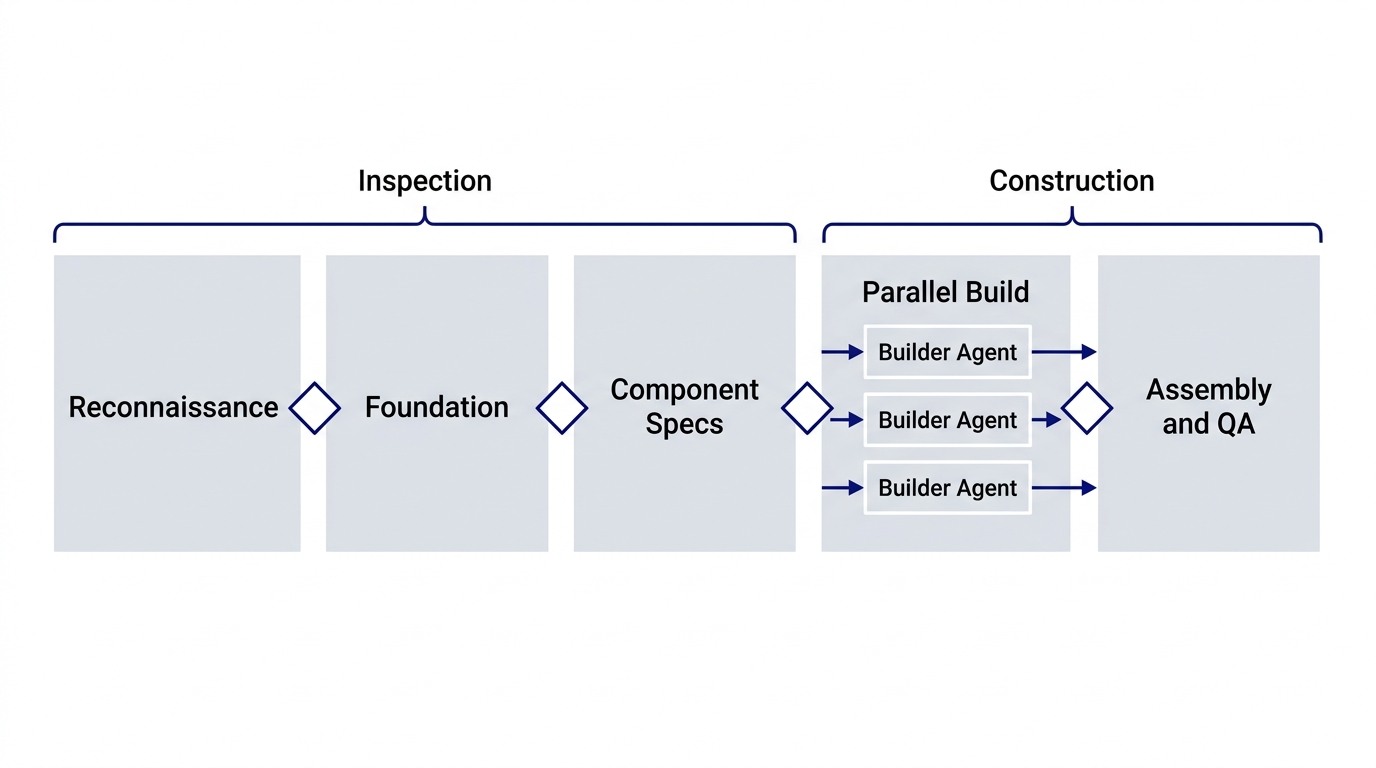
The best implementations of this principle operate in five distinct phases. The architecture is instructive.
Phase 1: Reconnaissance. The tool opens the target and takes observations at multiple viewports. It does not try to approximate visual properties from images. It extracts computed values directly: font family, size, weight, color, line-height, margin, padding, border-radius. The exact values, not visual guesses.
This phase is about seeing without building. It is pure observation.
Phase 2: Foundation. The reconnaissance data becomes infrastructure. Global variables are defined for every extracted token: colors, typography scales, spacing units, breakpoints. This phase codifies what was observed into reusable rules.
Phase 3: Component Specs. For each distinct component, a detailed specification file is written. This spec is not a design document for humans. It is a construction manual for an AI agent. It includes exact computed values, responsive behavior, interaction models, and edge cases observed.
The spec is written by an agent who has seen the originals but will not build the component. It is read by an agent who will build the component but has not seen the original. This separation is crucial. The spec writer must think in terms of what another agent needs to know, not what they happen to remember from observation.
Phase 4: Parallel Build. One builder agent is deployed per component. Each works in isolation. No agent can accidentally touch another's work. They cannot conflict. They cannot coordinate through side effects. Each agent reads its spec, implements the component, and commits independently.
Parallelism is no longer a speed hack. It is a correctness strategy. Isolation means each agent has complete context and cannot corrupt shared state.
Phase 5: Assembly and QA. The outputs are merged. A visual diff compares the merged result against the original. Any layout shifts, color drift, or responsiveness failures surface immediately.
Notice what the pipeline does. It separates inspection from construction. Phases 1 and 3 are inspectors. Phase 2 is infrastructure. Phases 4 and 5 are constructors. An inspector never builds. A builder never looks at the original. The handoff is explicit. Each phase is verified before the next begins.
Why This Is Not Just Code Architecture
This pattern is not unique to software problems.
Consider a research pipeline: one stage consumes raw inputs. A second stage enriches each item with full content. A third stage synthesizes the enriched items into structured insights. A fourth stage wraps those insights into publishable knowledge products. Four stages. Each stage has explicit inputs and outputs. Each stage can be audited. If stage two fails to enrich a URL, the failure is visible, not silently degraded downstream.
These are management patterns applied by knowledge workers to knowledge work.
Consider a traditional organizational process: a person specifies a task. A different person executes it. The executor asks clarifying questions. The spec writer adjusts. Work proceeds. This is a two-phase pipeline with explicit handoff. The spec writer inspects the problem domain. The executor constructs the output. They are in dialogue.
Now consider dysfunction: a single person both specifies and executes. They carry all the context internally. They move fast because they skip the specification phase. But when the work scales, when others need to review the output, maintain it, or build on it, the lack of intermediate representation becomes a tax. The solo executor skipped the handoff conversation. Now others must reverse-engineer the implicit reasoning.
Or consider multiple executors with no specification. They infer their own understanding of the requirement. They build in parallel and discover conflicts only when assembling. Coordination becomes expensive. Time-to-completion stretches.
The phase-gated pipeline is a management principle. Separate inspection from construction. Make the inspection explicit. Give the construction agents authoritative specs. This works whether the agent is a human, an AI model, or a team.
This principle sits at the core of how I structure client work. See How I Run 0→1 Product Sprints for the sprint-level version, and The Self-Sustaining Handoff for how the spec artifact outlives the engagement itself.
The Named Tension
Speed demands single-pass generation. Accuracy demands staged verification with explicit handoffs.
For decades, these felt like competing forces. You chose speed and accepted brittleness. Or you chose correctness and accepted delay.
Phase-gated pipelines dissolve the choice. Each phase is fast. An inspector agent extracts values in seconds. A builder agent reads a spec and produces output in seconds. The overhead is minimal. But the verification structure, the explicit boundaries between phases, ensures that errors do not propagate silently. A mistake in phase 3 gets caught before phase 4 begins.
The parallelism is a downstream benefit. Because phases are decoupled, multiple builders can work independently. But the real insight is earlier: isolation and explicit handoffs are themselves a correctness strategy, not merely a speed strategy.
Designing for the Handoff
What do you design for when you build a system?
In the era of single-agent, single-pass LLMs, the answer was often: design for inference speed. Shorter prompts. Fewer examples. Minimal context. Get the answer and move on.
But as systems grow in scope and consequence, the constraint shifts. You design for the handoff. What information must flow from one phase to the next? What could go wrong in that transition? How can you make the implicit explicit?
A specification document is an artifact designed for a handoff. It contains only what the next phase needs. It contains no ambiguity that the next phase must resolve. It is audit trail and construction manual at once.
This principle applies beyond software. A project brief is a specification. A compliance checklist is a specification. A medical protocol is a specification. The quality of the system depends not on how fast each phase moves, but on how well the phases communicate.
The seduction of single-pass generation was the promise of eliminating the communication layer. In practice, eliminating the communication layer eliminates the structure. What emerges is faster to produce and harder to trust.
The best systems trust in the layers. They invest in making the handoffs explicit. They slow down at the right moments: not in construction, but in specification. This is the opposite of what the optimization impulse suggests. But it is what works.
Strategy and technology are the same decision. Over 15 years in fintech (CTOS, D&B), prop-tech (PropertyGuru DataSense), and digital startups, I have built frameworks that help founders and executives make both moves at once. Based in Kuala Lumpur.
Working on a 0→1 product?
I help founders and operators go from idea to validated product. Let's talk about yours.
Get in touch →