From SEO to GEO: What Being the Answer Requires

For 25 years, professional services firms have built content strategies around a single principle: visibility. Get ranked. Get clicked. The machinery of search engine optimization was designed to move your web page from page five to page one, on the assumption that position equals probability. More eyeballs. More leads. More revenue.
That assumption is now structurally broken.
The shift from SEO to GEO is not incremental. It is not "SEO plus artificial intelligence." It is a fundamental rewiring of how clients discover expertise. The question has changed from "Will my page appear?" to "Will my page be cited as credible?"
When an AI system synthesizes an answer to a professional question, it does not return links. It returns citation. It evaluates hundreds of sources, weighs their authority, and names the ones it trusts enough to credit in its response. Visibility becomes irrelevant. Citability becomes everything.
For Malaysian professional services firms, for PropTech companies managing capital flows and valuations, for chartered accountants and advisors operating in regulated domains, the question is not whether this change will happen. It is whether your content is structured to be the answer when an AI is asked.
The Macro Context
What Agentic AI Changes
The large language model is not a search engine. It does not browse the web and return 10 blue links. It reads sources, synthesizes knowledge, and generates an answer grounded in the sources it has internalized. If your content was in those sources, your perspective becomes part of the answer. If your content was invisible to the training process, it ceases to exist in that context.
This is already happening. Medical professionals are finding that insurance guidelines and treatment protocols appear in AI-generated health summaries. Financial advisors are discovering that their published research is being cited by AI agents making investment recommendations. The signal is structural: sources with clear identity, verifiable credentials, and organized evidence are being elevated into AI outputs.
The shift from attention economy to trust economy is not rhetorical. In the attention economy, you win by being visible. In the trust economy, you win by being referenced as trustworthy.
The Evidence Requirement
SEO operated on the assumption that relevance could be signaled. Stuff the keyword in the title, the meta description, and the first paragraph. The algorithm matches it. Relevance was linguistic.
GEO operates on a different assumption: relevance is structural. An AI system evaluating whether to cite your content asks not "Does this page mention capital valuation?" but "Does this page present entities, relationships between entities, and verifiable evidence in a way that a knowledge graph can ingest?"
This is the ERE Model in action: Entity, Relationship, Evidence.
When a Malaysian property valuation firm publishes content about the impact of interest rate changes on residential property prices, GEO optimization means structuring that content so that:
-
Entities are explicit. You name the specific interest rate regime, the property segment (residential properties in Klang Valley, Malaysia), the valuation methodology (discounted cash flow), the time period covered.
-
Relationships are documented. You show how changes in interest rates relate to changes in valuation assumptions, which relate to changes in final valuations. You do not describe these as abstract principles. You map them.
-
Evidence is verifiable. You cite the data sources (Bank Negara Malaysia monetary policy statements, specific transaction prices from the real estate database, published valuation models). You provide dates, percentages, specific examples.
A blog post that says "Interest rates affect valuations" ranks nowhere in GEO. A structured briefing that says "A 100 basis point increase in Bank Negara's Overnight Policy Rate correlates with an average 8 to 12% compression in residential valuation multiples in urban Malaysia, documented across 347 transactions in Q4 2025" is a citation magnet.
Why This Matters for Regulated Industries
In regulated industries, credibility is not optional. When a client is making a decision about a corporate valuation, a property acquisition, or a financing structure, they need to know that the advisor understands the specific regulatory environment, the specific market context, and the specific risks.
AI systems are learning to distinguish between generic advice and contextually grounded analysis. Content that ignores geography, regulatory jurisdiction, and time horizon is less useful than content that explicitly acknowledges them.
Malaysian professional services firms have an advantage here that many do not recognize: you already work in a specific context. You already understand BNM regulations, Bursa Malaysia listing rules, the Land and Strata Titles Acts, the Malaysian Tax Act. The question is whether your content makes that specificity visible to AI systems, or whether you are burying it in narrative that treats Malaysia as an afterthought.
The Close Shot: How a Property Valuation Platform Structures for Citation
Let's walk through how ValuationXchange, a property valuation platform in Malaysia, would restructure its content library for GEO rather than SEO.
SEO approach to "how to value commercial property in Malaysia":
- Keyword: commercial property valuation Malaysia
- Article length: 2,000 words
- Structure: introduction, method 1, method 2, method 3, conclusion
- Goals: rank for the keyword, get clicks, build authority through breadth
GEO approach to the same question:
- Entities: specific properties, valuation approaches, regulatory models, market data sources
- Relationships: how approach selection relates to property type, how property location affects applicable regulations, how market cycles affect capitalization rate assumptions
- Evidence: actual valuations (anonymized), regulatory citations, market data (structured and dated)
- Packaging: not a 2,000-word article, but a series of evidence blocks that an AI can ingest
The GEO-optimized brief would be titled "Cost Approach to Valuation: Commercial Property in Selangor, Malaysia, 2024 to 2025." Its content is organized as named sections:
Applicable Regulatory Model lists BGSM guidelines effective January 2024, RISM standards Issue 4 (2021), Bursa Malaysia property listing requirements, and relevant Land and Strata Titles Act provisions.
Entities in Scope specifies property type (commercial office buildings), geographic scope (Petaling Jaya, Shah Alam, Kuala Lumpur, defined at postcode level), size range (10,000 to 100,000 square feet), and construction period (1998 to 2023).
Cost Components includes land acquisition cost per square foot sourced from 23 recent transactions, construction cost per square foot sourced from the Ministry of Works cost index Q4 2025, professional fees from RISM scale 2025 edition, and industry benchmarks for contingency and developer profit.
Methodology Application walks through a 50,000 sq ft building in Petaling Jaya as a worked example, with exact calculations, exact data sources, exact assumptions, and a sensitivity analysis.
This structure is not an article. It is a citation block. An AI system evaluating whether to cite ValuationXchange when answering a user question about commercial property construction costs in Selangor has clarity on scope, verifiable entities, traceable evidence, and relationship mapping. The article does not exist to rank. It exists to be cited.
What Practitioners Should Do
The mental shift required here is not about adding keywords or optimizing for "AI readability." Those are tactical responses to a strategic change.
The strategic change is this: your content library is no longer a collection of marketing assets. It is a structured knowledge base that AI systems will evaluate for inclusion in their answers.
This requires three concrete changes.
1. Audit your content for entity clarity. Read through your 10 most important pieces. For each one, extract the entities it discusses: people, products, concepts, regulatory models, market conditions, specific dates and numbers.
If your writing sounds like "Professional valuations are important in Malaysia, and our platform helps firms execute them efficiently," you have zero entities. You have generic claims.
If your writing sounds like "Under BGSM Valuation Standard 1, effective January 2024, valuers assessing property for financing purposes must document three approaches. Our platform integrates cost, income, and market approaches, with mandatory data sourcing from Bank Negara Malaysia interest rate curves and the National Property Information Centre," you have named entities that an AI can cite.
Go through your content. Find every place where you have written generically. Replace it with specific entities, specific regulations, specific markets, specific time periods.
2. Restructure for evidence density, not narrative flow. Traditional marketing content is structured around narrative: problem, answer, benefit. This is great for clicks. It is terrible for AI citation.
GEO content is structured around evidence blocks: a specific question, the data that answers it, the sources of that data, the assumptions, the limitations.
Instead of writing "Our platform helps valuers save time," publish structured briefs:
- "Valuation Turnaround Times: Malaysia vs Singapore, 2024 to 2025" (actual data from your platform)
- "Interest Rate Sensitivity in Property Valuations: A Case Study of 12 Bank Financing Assessments" (anonymized case studies with real numbers)
- "Regulatory Compliance Rates: Firms Using Manual Workflows vs Platform-Integrated Workflows" (comparative metrics)
These are not marketing claims. They are evidence blocks that an AI system can cite directly.
3. Add attribution and compliance intentionally. For every fact you publish, you must be able to answer: where did this number come from? Is this claim exposed to regulatory risk? Am I being precise about limitations?
When content includes cost data, every figure needs the source (government index, real estate database, survey of firms), the date, the geographic scope, and the limitation. An AI system reading this content knows it is grounded. It can cite it with confidence.
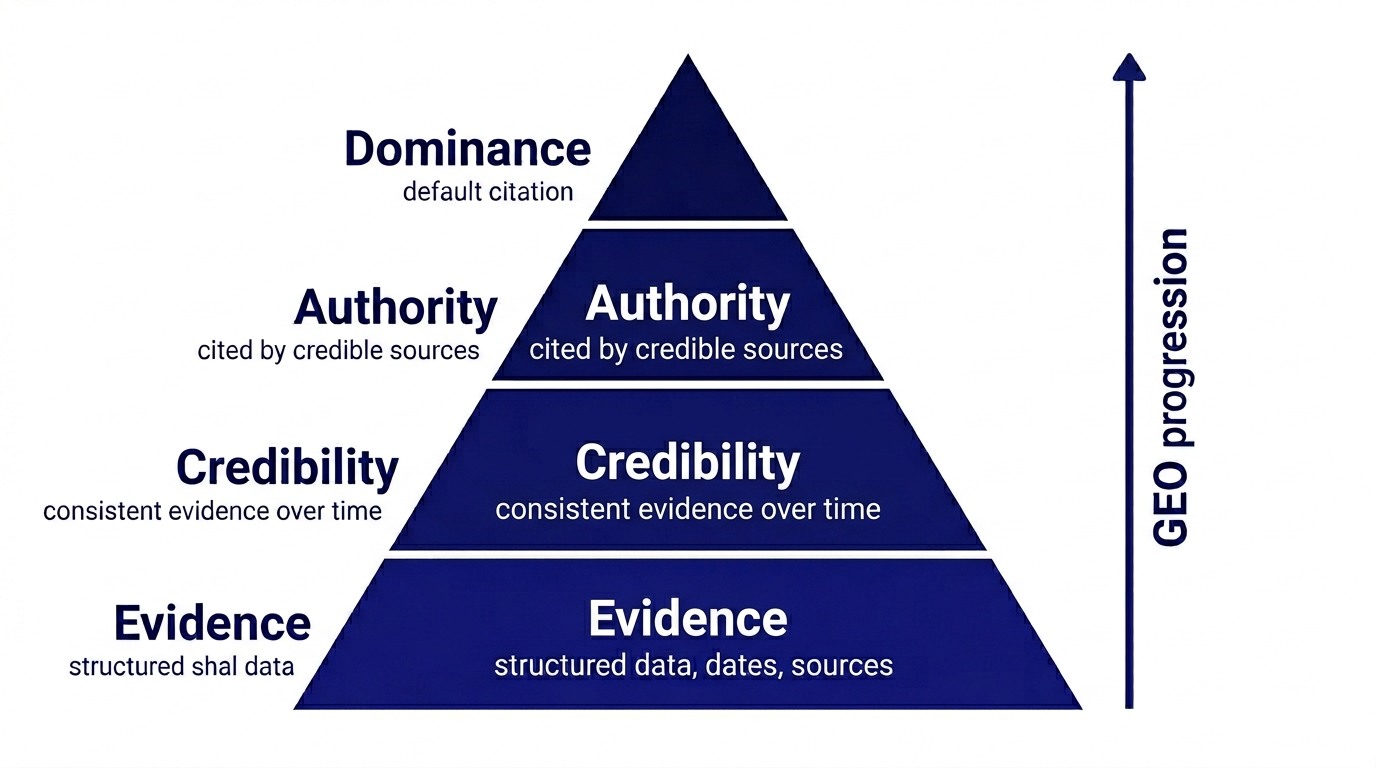
The Authority Pyramid
The ACE Model (Authority, Credibility, Evidence) structures how AI systems evaluate sources. You move up the pyramid by:
- Evidence: You publish structured data, with sources, dates, and limitations. (Tier 1)
- Credibility: Multiple pieces of evidence, consistent with each other, over time. (Tier 2)
- Authority: You are cited by other credible sources. AI systems find references to your work in other professional content. (Tier 3)
- Dominance: You become the default citation for a specific question in your domain. (Tier 4)
Most professional services firms structure for visibility and click-through. They do not structure for being cited. They remain in Tier 1 if they make it there at all.
The competitive advantage for firms that move to GEO is structural. When AI systems answer questions about property valuation in Malaysia, they will cite the firms that have done the work to make themselves citable. Everyone else becomes background noise, ranked by SEO metrics that no one is using anymore.
This is the same logic that makes Topical Authority effective for search: depth beats breadth, specificity beats volume, and the content that wins is the content that earns trust rather than clicks. GEO extends that logic into a new era where the intermediary is an AI, not a search ranking.
Closing
The question "How do I rank for this keyword?" was a good one for 25 years. It is no longer the right question.
The right question now is: if an AI system were synthesizing an answer to a professional question in my domain, would my content be cited? Would it be trusted enough to appear in that synthesis?
This requires a different discipline. Not broader content. Not more keywords. Not faster updates. It requires structured, evidence-dense content that makes credibility visible.
For Malaysian professional services firms operating in property finance, valuations, capital markets, and regulated advisory services, this is not an abstract future consideration. It is happening now. AI systems are being trained on professional content, evaluated on whether they can synthesize credible answers to expert questions, and deployed to clients who are asking those exact questions.
The firms that restructure their content libraries around GEO principles in the next 12 to 18 months will find themselves cited automatically, building authority without additional effort. The firms that remain optimized for SEO will find themselves increasingly invisible, not because their content is bad, but because it is no longer in a format that AI systems can trust.
The shift from being seen to being trusted is not optional. It is the next phase of how knowledge work is distributed in the professional services market.
Strategy and technology are the same decision. Over 15 years in fintech (CTOS, D&B), prop-tech (PropertyGuru DataSense), and digital startups, I have built frameworks that help founders and executives make both moves at once. Based in Kuala Lumpur.
Working on a 0→1 product?
I help founders and operators go from idea to validated product. Let's talk about yours.
Get in touch →