Topical Authority and AI: Rank Page 1 in 45 Days

Content marketers live in a contradiction. They are asked to drive traffic. Sales teams need conversions. These are not the same metric, and they often pull in opposite directions.
Watch a typical content strategy meeting: a marketer presents keyword research. 50,000 searches per month for "property valuation software." Impressive number. The CEO nods. Budget gets allocated. Six months later: no top-10 rankings. Why? Because 800 companies are chasing the same 50,000-search keyword.
Meanwhile, "property valuation software Malaysia" sits at 300 monthly searches. It is lonely. No one is writing about it. A Malaysian valuer types that phrase because they have already decided they need software and want to know what exists locally. They convert. They buy.
The tension is real: high-volume keywords look impressive in reports. Buyer-intent keywords convert into revenue. Most content strategies inadvertently serve the report, not the business.
AI just made this tension easier to resolve. The traditional timeline was brutal: three months of solo writing or six months with a small team. Today, the same cluster takes two weeks. The timeline shifts from a strategic liability into an advantage.
What Is Topical Authority?
Google's algorithm evolved. For years, the rule was simple: backlinks determined rank. Then Google realized that was noisy. A single well-researched article on a topic sometimes outranked ten mediocre articles linked from low-quality sites.
The insight became systemic. Google started rewarding "topical authority": sites that demonstrate deep, comprehensive, interlocking coverage of a subject. Not one great article. Not many random articles. A cluster where each piece covers a distinct angle of the same topic, links to the others, and builds semantic depth.
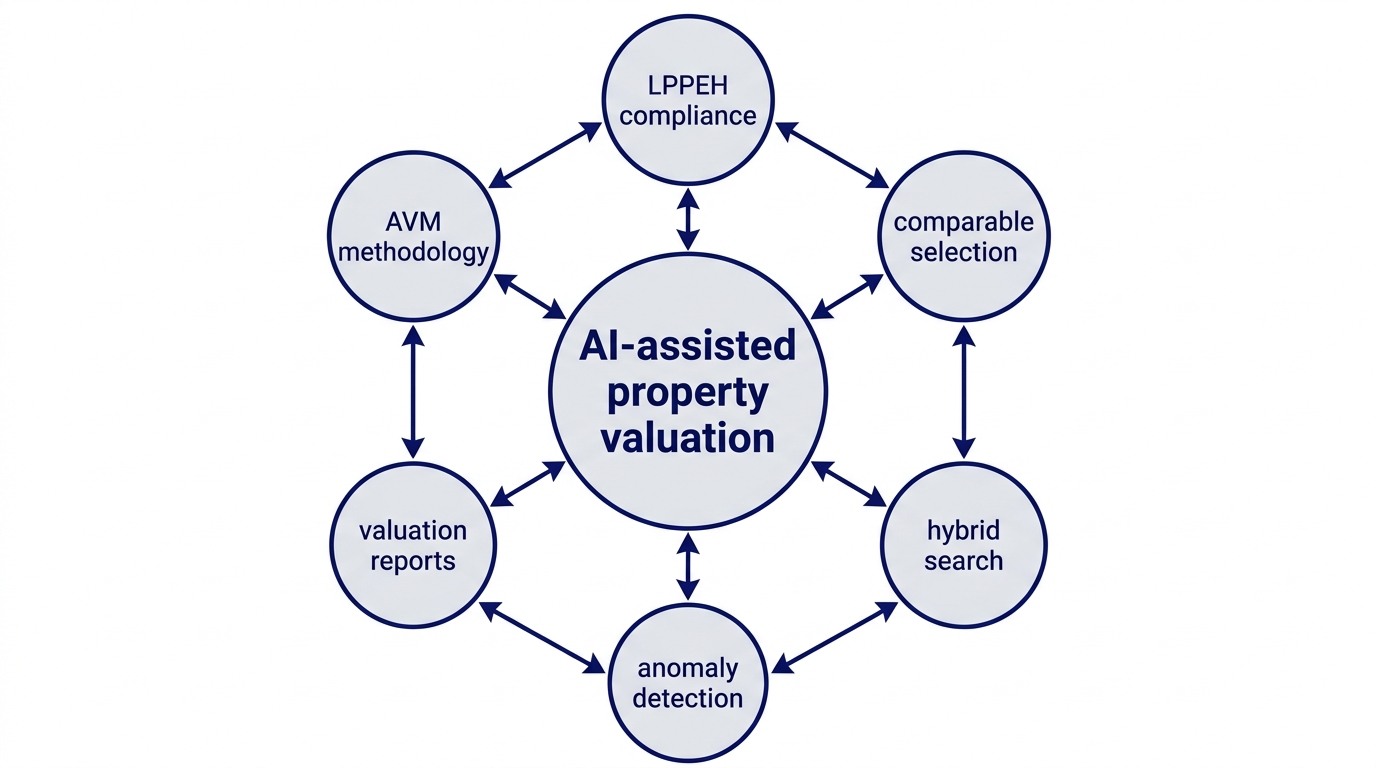
For property valuation, topical authority looks like this: you publish an article on automated valuation models for Malaysian property, then how comparable property selection works, then condition adjustment methodology, then hybrid search versus pure vector matching for comparable retrieval, then how AI detects comparable anomalies, then building a defensible valuation report with AI-assisted research. Each article is self-contained. Together, they form a web of authority.
Google notices. The algorithm reads: this site does not just mention comparable selection. This site lives in the world of property valuation.
That is topical authority. Not magic. Structure.
The Buyer-Intent Filter
Here is where most content strategies collapse: they confuse search volume with business value.
A keyword with 40,000 monthly searches is valuable to investors and reports. It is a disaster for a solo consultant or a three-person product team. You cannot out-rank large incumbents on generic terms. You do not have the domain authority, the link budget, or the team to win that game.
Buyer-intent keywords are different. They imply that the searcher has already made a decision about what type of product or service they want. They want to know what options exist within their specific context.
Examples in the property valuation space:
- "Best property valuation software for small Malaysian practices" (buyer-intent)
- "How to select comparable properties for LPPEH valuations" (buyer-intent)
- "AI comparable property selection for valuers" (buyer-intent)
- "Automated valuation model accuracy in Southeast Asia" (buyer-intent)
Compare these to high-volume generic terms:
- "Property valuation" (40k searches, mostly window-shopping)
- "Real estate appraisal" (30k searches, largely educational)
- "Property software" (25k searches, too broad to convert)
The buyer-intent keywords have lower volume (200 to 1,000 searches per month), but conversion rates run 10 to 15 times higher. Someone typing "best property valuation software for Malaysia" is two steps away from buying. Someone typing "property valuation" may be a student, a developer, a news reader, or a valuer.
For a solo consultant or small team, buyer-intent keywords are the only rational target. You cannot win on breadth. You win on depth, precision, and relevance within a tightly defined slice of the market.
The AI Acceleration Factor
Building a topical cluster used to mean months of research and writing. For a 12-article cluster on property valuation software, the traditional timeline ran 10 to 12 weeks solo.
With AI-assisted production, the timeline collapses:
- Research phase: Two weeks. You still have to know what you are talking about. AI cannot substitute here.
- Outlining and structure: Two days. AI generates detailed outlines based on your brief.
- Drafting: One week. AI generates first drafts for 12 articles; you batch-review them.
- Editing and fact-check: One week. You refine, insert proprietary insights, remove hallucinations, ensure regulatory accuracy.
- Publishing and promotion: Two to three days.
Total: three to four weeks, solo.
The time saving is not because AI writes better. It is because AI handles the grunt work of synthesis. You do the work only you can do: setting strategy, fact-checking, inserting proprietary insight, and ensuring accuracy in regulated domains.
The multiplicative effect: because you can produce the cluster in three weeks instead of twelve, you can run multiple iterations. Publish. Monitor rankings. Refine. Republish. By week 8, you have a cluster you have already tested and improved. The team that takes the traditional approach publishes at week 12 and hopes. You have been iterating for five weeks.
This is the same operating logic I use in How I Run 0→1 Product Sprints: compress the cycle, iterate faster, let data correct your assumptions before the window closes.
Building the Cluster: A Concrete Example
Let's walk through how this works for someone building authority around AI-assisted property valuation for Malaysian practitioners.
The buyer-intent keywords to target:
- "AI comparable selection for LPPEH valuations" (150 searches/month, near-zero competition)
- "Automated valuation models Malaysia" (200 searches/month)
- "Property valuation software for Malaysian valuers" (100 searches/month)
- "Hybrid search for property comparable retrieval" (50 searches/month, niche but high-intent)
- "AI anomaly detection in comparable properties" (30 searches/month, extremely niche, but experts search this)
Around "AI comparable selection for LPPEH valuations," you write:
- What LPPEH compliance means for AI-assisted appraisal
- How comparable selection works (for non-valuers reading)
- The technical architecture of semantic search for properties
- Common comparable selection errors and how AI catches them
Each article runs 1,500 to 2,500 words. Each links to the others. A prospect starts with "automated valuation models Malaysia," finds your article, gets curious, clicks to comparable selection, finds the LPPEH compliance piece, sees you understand both the technical and regulatory landscape, and downloads your case study. Conversion.
The cluster is built in three weeks with AI assistance. You publish two articles per week. By week 5 or 6, rankings begin to move. By week 8, you are on page 1 for three of the buyer-intent keywords. By week 12, five of them.
The AI-Legible Content Requirement
There is one more wrinkle: content must be structured so that AI systems can read and summarize it.
Increasingly, users do not search Google directly. They ask ChatGPT, Perplexity, Claude, or use Google AI Overviews. These systems read your content, summarize it, and cite you. If your article is well-structured and semantically clear, you get cited more often. If it is rambling and unclear, the AI skips it.
This means:
- Clear heading hierarchy (H1 for title, H2 for sections, H3 for subsections)
- Semantic markup where possible (schema.org markup signals to AI what facts you are asserting)
- Blockquotes for key insights (AI systems favor clearly marked authoritative statements)
- Linked related content (internal linking structure signals relationships)
It also means you cannot just publish anything. If your article says "AI comparable selection reduces valuation time by 40%" in one section and "reduces time by 60%" in another, the AI notices the inconsistency and deprioritizes you. Precision is non-negotiable.
This is where AI-assisted drafting meets human fact-checking. Claude generates a first draft with good structure. You read it for accuracy. You insert proprietary data. You ensure consistency. You publish something that is both AI-legible and factually sound.
This connects directly to what I cover in The 95% Margin Workflow: the human judgment layer is not optional, and it is not the bottleneck. It is the quality gate that makes the system defensible.
The Regulatory Defensibility Angle
There is a reason this framework works particularly well for PropTech and property valuation.
Property valuation is regulated. In Malaysia, valuers must follow LPPEH guidelines. Appraisals must be defensible. Clients are risk-averse. They want to know that your software or your advisory approach follows established frameworks.
Topical authority on buyer-intent keywords builds that trust. When a valuer in Kuala Lumpur searches "AI comparable selection for LPPEH valuations," they are asking: can I use this tool and still comply with the regulations my professional body enforces? Your content ecosystem answers that question with precision, depth, and citations.
The cluster becomes a trust-building mechanism. Each article is proof that you understand not just the technology but the regulatory context. That is not something a generic "AI in real estate" article does. It is what a tight, focused, buyer-intent topical cluster does.
A regulated industry buyer converts because you eliminated uncertainty. Topical authority does exactly that.
The Practical Playbook
Zoom back to the macro picture. You started with a tension: marketing wants traffic volume, sales wants conversion. Topical authority with buyer-intent focus resolves it. You rank on low-volume, high-intent keywords (lower competition, faster ranking, higher conversion). The cluster drives qualified traffic. And Google, over time, discovers that your site is authoritative in a vertical.
The practical steps for someone building personal brand authority in a regulated vertical:
- Identify your five to ten buyer-intent keywords in your niche.
- Cluster them into two to three sub-topics.
- Write a brief strategic outline for each sub-topic: what questions each article answers, how they link to each other.
- Use AI to draft the full cluster (12 to 20 articles).
- Spend a week fact-checking, inserting proprietary insight, ensuring regulatory accuracy.
- Publish two articles per week.
- By week 8, monitor rankings. By week 12, expect page 1 appearances on three to five buyer-intent keywords.
This is not generic content strategy. It is an operating model for how a consultant, a solo founder, or a small team captures authority in a space where they already have legitimate operational expertise.
The content marketing game used to reward the well-resourced: companies with large teams, deep budgets, and time. AI has rebalanced it. It rewards the precise: teams that can articulate a clear buyer-intent strategy and execute it with rigor.
The teams winning today have already made that choice.
Strategy and technology are the same decision. Over 15 years in fintech (CTOS, D&B), prop-tech (PropertyGuru DataSense), and digital startups, I have built frameworks that help founders and executives make both moves at once. Based in Kuala Lumpur.
Working on a 0→1 product?
I help founders and operators go from idea to validated product. Let's talk about yours.
Get in touch →