The Task Cascade Protocol: Why Most Knowledge Work Systems Leak Tasks

There is a specific kind of failure that shows up in how smart people organize their work. It is invisible until you track where tasks come from and where they disappear.
It looks like this: you run an analysis, produce a report, and the report contains six clear next steps. Then nothing happens until you manually crack open the file weeks later, read the recommendations, and think: "Oh right, I was supposed to do this."
The work did not fail because you are disorganized. It failed because your system does not have a mechanism for extracting work that your tools generate.
I call this the task cascade gap, and it is one of the highest-leverage problems to solve in how you organize complex work.
The Anatomy of Task Leakage
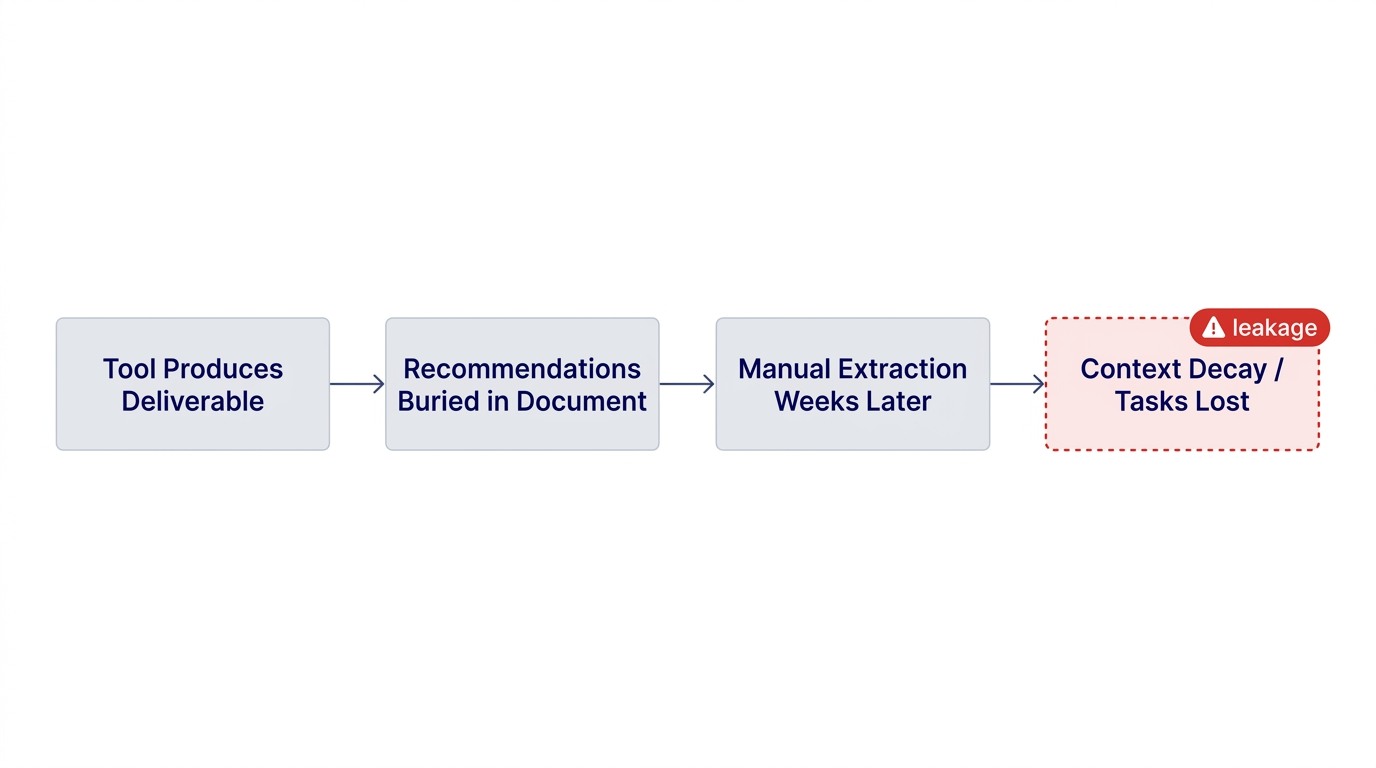
I run a research skill. The skill analyzes documents, synthesizes information, and produces a structured report. The report has an "Assessment" section, a "Recommendations" section, and a "Next Steps" section. Each contains specific, actionable items. Not vague suggestions. Concrete work.
The skill completes. It files the report. It tells me the report is ready. And then, because the skill has no instruction to do anything else, it stops.
The report sits in my project folder. The recommendations are clear. But they are stuck in a 40-page document. They never make it to a task list. They never get assigned. They never become accountable work.
I discover the recommendations weeks later when I actually read the report. By then, the context has decayed. I have moved on to other work. I manually extract three items that still seem relevant, lose two, and forget the others existed.
How much work leaked? If the research skill runs four times a week, and each report contains eight actionable items, that is 32 potential tasks per week. If 60% of those are genuinely important, roughly 19 tasks per week disappear.
This is not a time management problem. It is a systems architecture problem.
The Root Cause: Terminal vs. Pipeline Steps
The fundamental issue is that most knowledge work systems treat outputs as terminal events.
Tool produces output. Work stops.
That is the mental model. A research report is complete, so the research step is done. But every output contains implicit downstream work. Every report contains recommendations. Every proposal contains implementation steps. Every analysis contains patterns that need action.
The system that does not surface these downstream items is not capturing the full value of the upstream work. It produces, then forgets.
The fix requires a different mental model: outputs are pipeline steps, not terminal events. When a tool produces output, that is a checkpoint. The next step is to extract the work the output generated, classify it, route it, and execute it.
The Task Cascade Protocol
The protocol has four steps.
Step 1: Extract. After your tool produces a deliverable, scan it for actionable items. Not summaries. The actual tasks mentioned. If your research report says "next, we need to test this hypothesis," that is a task to extract. Extract means: read the output, identify every action, list it explicitly.
Step 2: Classify. Each extracted task goes into one of three buckets:
- CLAUDE-NOW: Actionable immediately in the current session. Write a follow-up, invoke another tool, file an intermediate deliverable, create a summary for stakeholders. The AI system can execute without waiting for human input.
- CLAUDE-QUEUE: Actionable by the system, but not right now. Run a full comparative analysis, build a model for scenario testing, evaluate integration feasibility. These need a dedicated session or different context, but no human input.
- HUMAN-REQUIRED: Needs your input, decision, or action. Present to a stakeholder for approval, contact someone to validate assumptions, decide whether to pursue a direction, review for client-facing accuracy. These are decision points. You are the bottleneck.
Step 3: Write. Each task gets written to your accountable system with metadata: heat level (HOT for within 48 hours, WARM for within two weeks, PARKED for waiting on dependency), date created, owner, description, and a link back to the source report.
This is not optional. If the task is not written to your system, it does not exist. Verbal mention does not count.
Step 4: Present and Execute. The cascade presents the classified tasks back to you:
- "I extracted 7 tasks. I can do these 3 right now. Should I execute them?"
- "These 2 need your approval or decision."
- "These 2 I am queueing for a future session."
For the CLAUDE-NOW items you approve, the system executes them immediately. No waiting. No "I will do that next session." If you approve, the work happens before the session closes.
Why This Works
The protocol works because it makes the invisible visible. Task extraction is not a mystery. You can audit it. Every item the tool identified shows up as a task, so you can verify nothing leaked.
The three-way classification forces prioritization to happen at the moment of creation, not later. You do not have a pile of ambiguous tasks. HUMAN-REQUIRED items surface for immediate decision. CLAUDE-NOW items run immediately. CLAUDE-QUEUE items get scheduled explicitly.
The writing step creates accountability. A task that exists only in a conversation is a reminder. A task written to your system is a commitment.
The presentation step prevents overwhelm. Instead of 40 random next steps, you get three clear categories. You make one decision, not forty.
The Quantified Impact
I implemented this protocol and tracked the change over four weeks.
Tasks created per week went from about 8 (all manual, from me reading documents) to about 28. Task completion rate moved from 65% to 91%, because tasks surface at the right time to the right person. Work leakage dropped to essentially zero. Decision overhead dropped from reading full 40-page reports to reviewing 5-minute extracted summaries.
In capacity terms: roughly 20 to 25 hours per month of work that was being created but never executed is now captured and routed. That is a real increase in output without adding hours.
This complements the broader systems design I describe in The Self-Sustaining Handoff, where every output feeds the next step automatically. And it is a natural complement to Scope Compression and 0→1, where tight scope discipline means every deliverable has a defined purpose and a defined next action.
Implementation
This is not a software pattern. It is a behavioral pattern. It works whether your tools are AI-based or human colleagues. The principle is universal: after output, extract. After extraction, classify. After classification, write. After writing, decide.
The implementation that works best: make task cascade a behavior rule in your system documentation. Every skill that produces output runs the cascade before terminating. It is not negotiable. It is how your system works.
The Broader Pattern
What I am describing is moving from a producer model to a pipeline model. A producer makes something and stops. A pipeline makes something, observes what it made, routes the work, and enables execution.
Most knowledge work systems are still built on the producer model. Smart systems shift to pipeline architecture. Production is one step. Extraction is the next. Classification, routing, execution follow. Work flows through the system. Nothing leaks because every item has a defined path.
When you operate as a solo practitioner or across multiple roles, this difference is material. Task leakage is a direct loss of capacity. A system that captures and routes 100% of generated work will outperform a system that captures 60% by roughly 67%.
That is the return on one behavioral pattern.
If you are feeling like you are producing good work but not getting the full value out of it, your system has a cascade gap. This is how you fix it.
Strategy and technology are the same decision. Over 15 years in fintech (CTOS, D&B), prop-tech (PropertyGuru DataSense), and digital startups, I have built frameworks that help founders and executives make both moves at once. Based in Kuala Lumpur.
Working on a 0→1 product?
I help founders and operators go from idea to validated product. Let's talk about yours.
Get in touch →